🇪🇺 Fast delivery (3–5 working days) with GLS ✅ Card or bank transfer 📦 Free shipping from €50

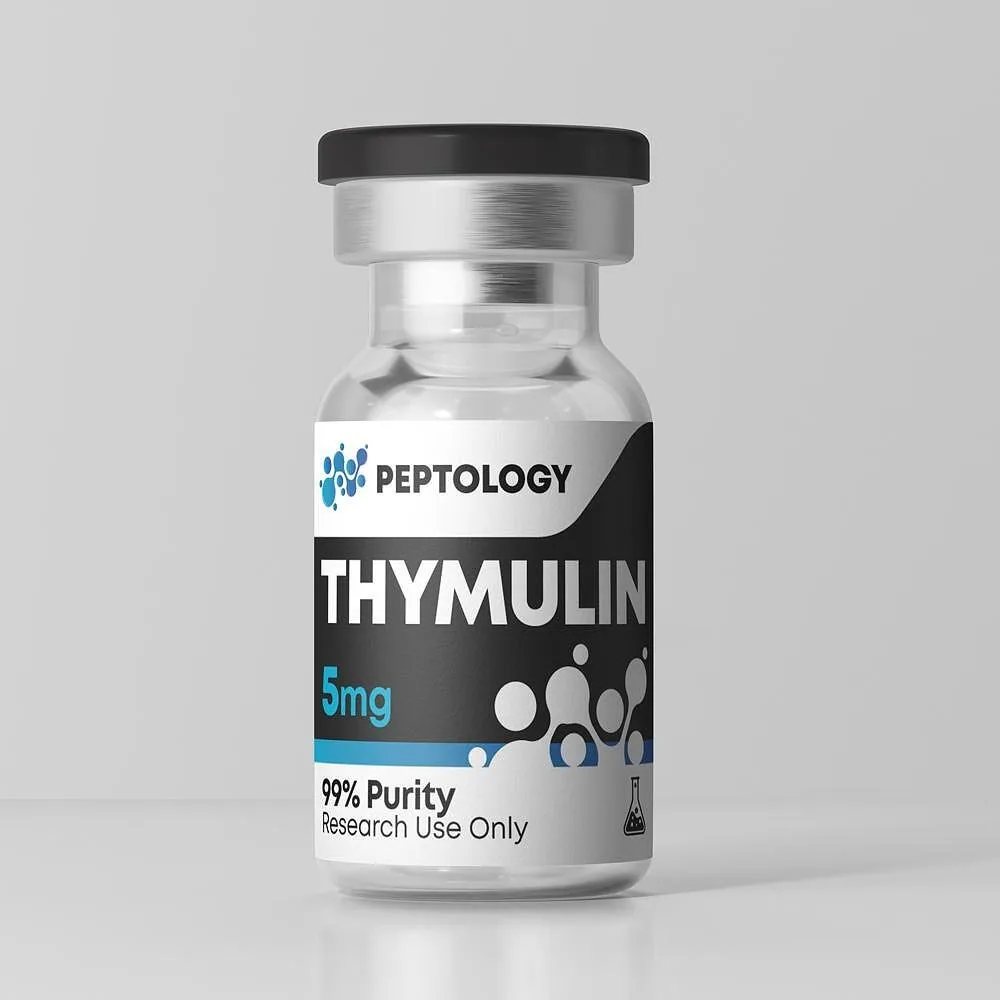
Thymulin
Thymulin 5mg/10mg – Zinc-dependent thymic nonapeptide for research
Peptology Ltd. · Peptides for immunity and hormonal balance
Thymulin (FTS, facteur thymique sérique) – the nonapeptide hormone of the thymus (pGlu-Ala-Lys-Ser-Gln-Gly-Gly-Ser-Asn), active as a zinc complex; a synthetic research peptide for T-lymphocyte and neuroimmune models. Purity 99%+, HPLC/MS report for every batch.
📦 The product is in our EU warehouse – delivery within 3–5 working days.
30,00 € · In stock
- 5mg — 30,00 €
- 10mg — 50,00 €
For research use only / Not a medicine
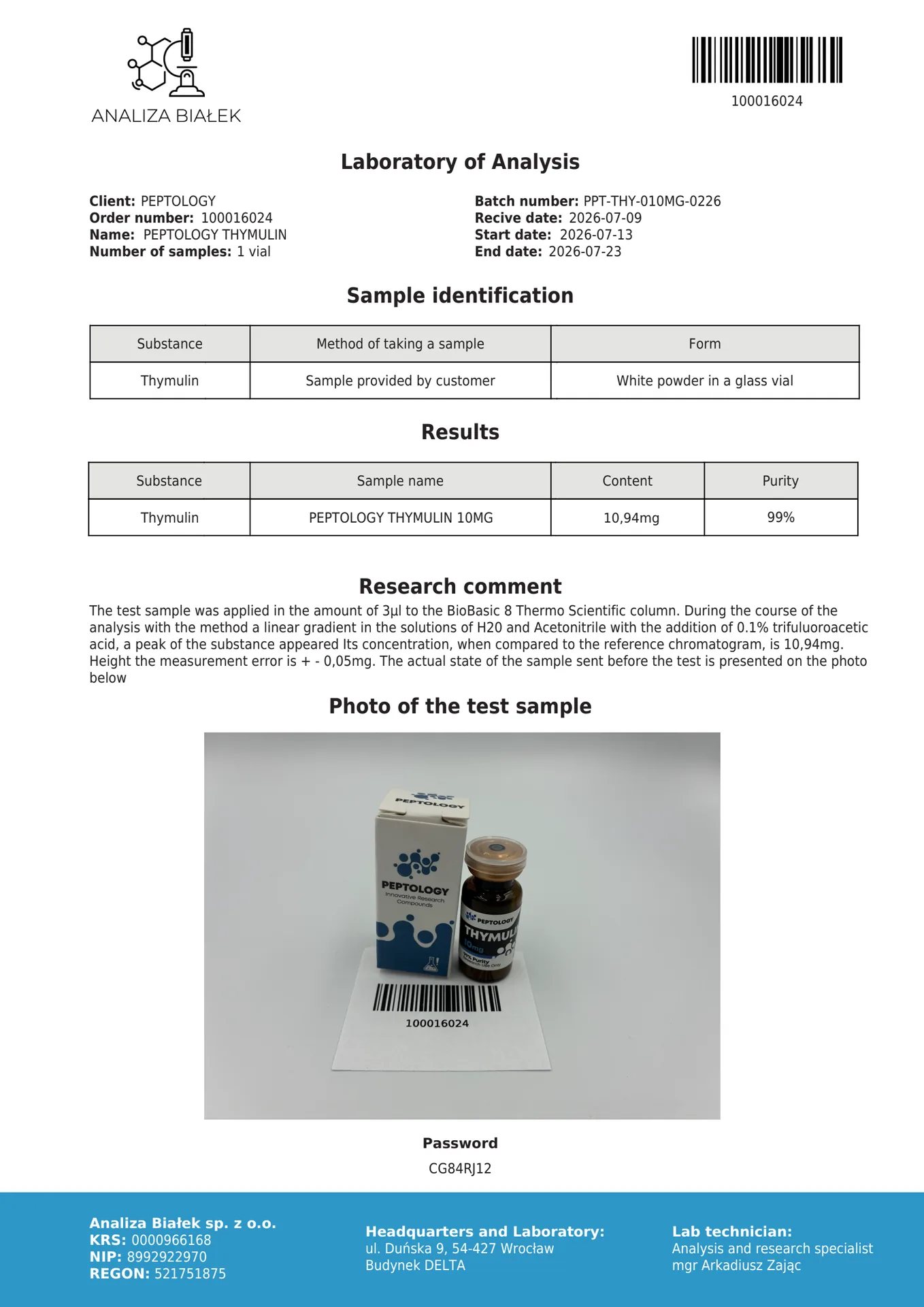
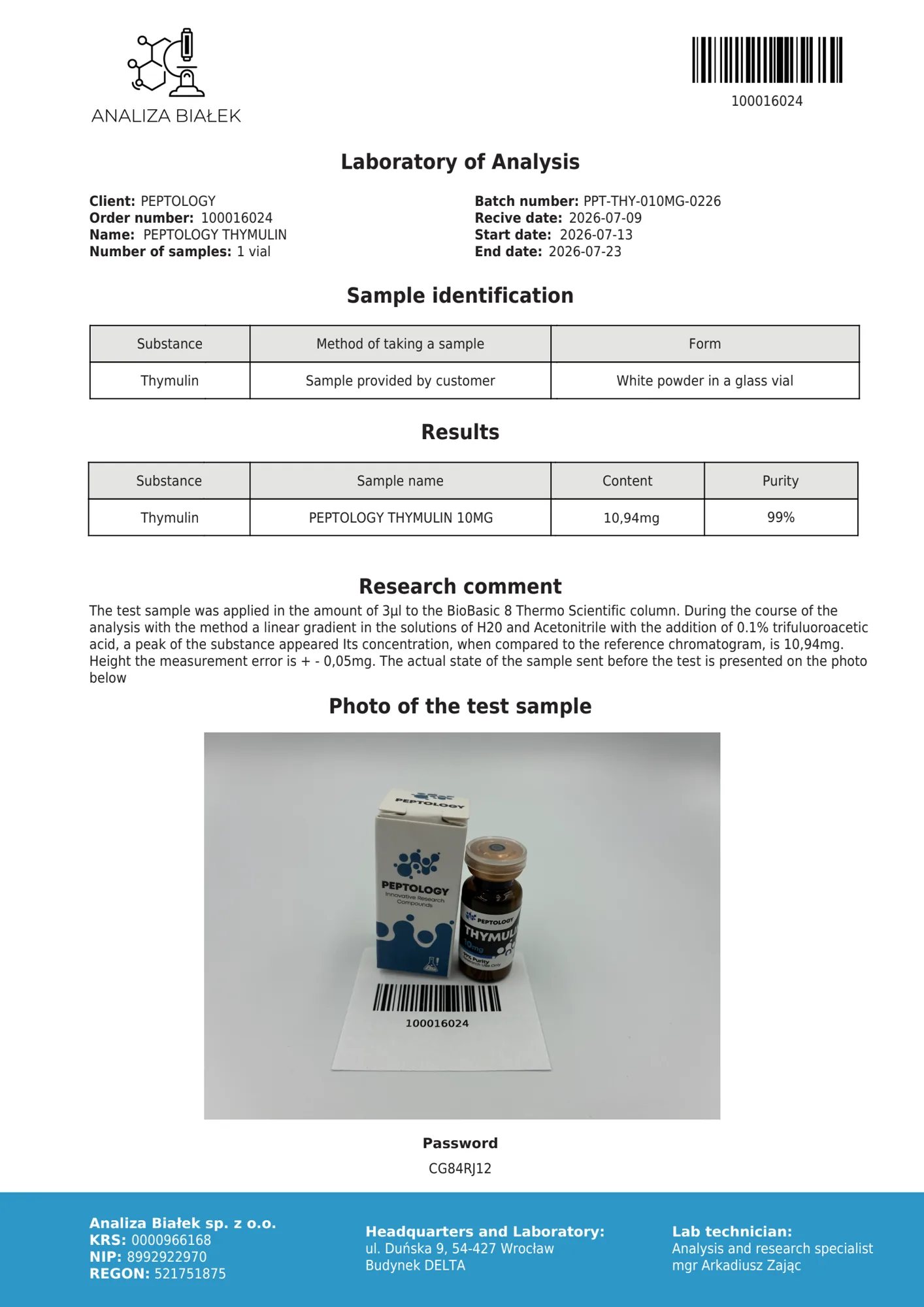
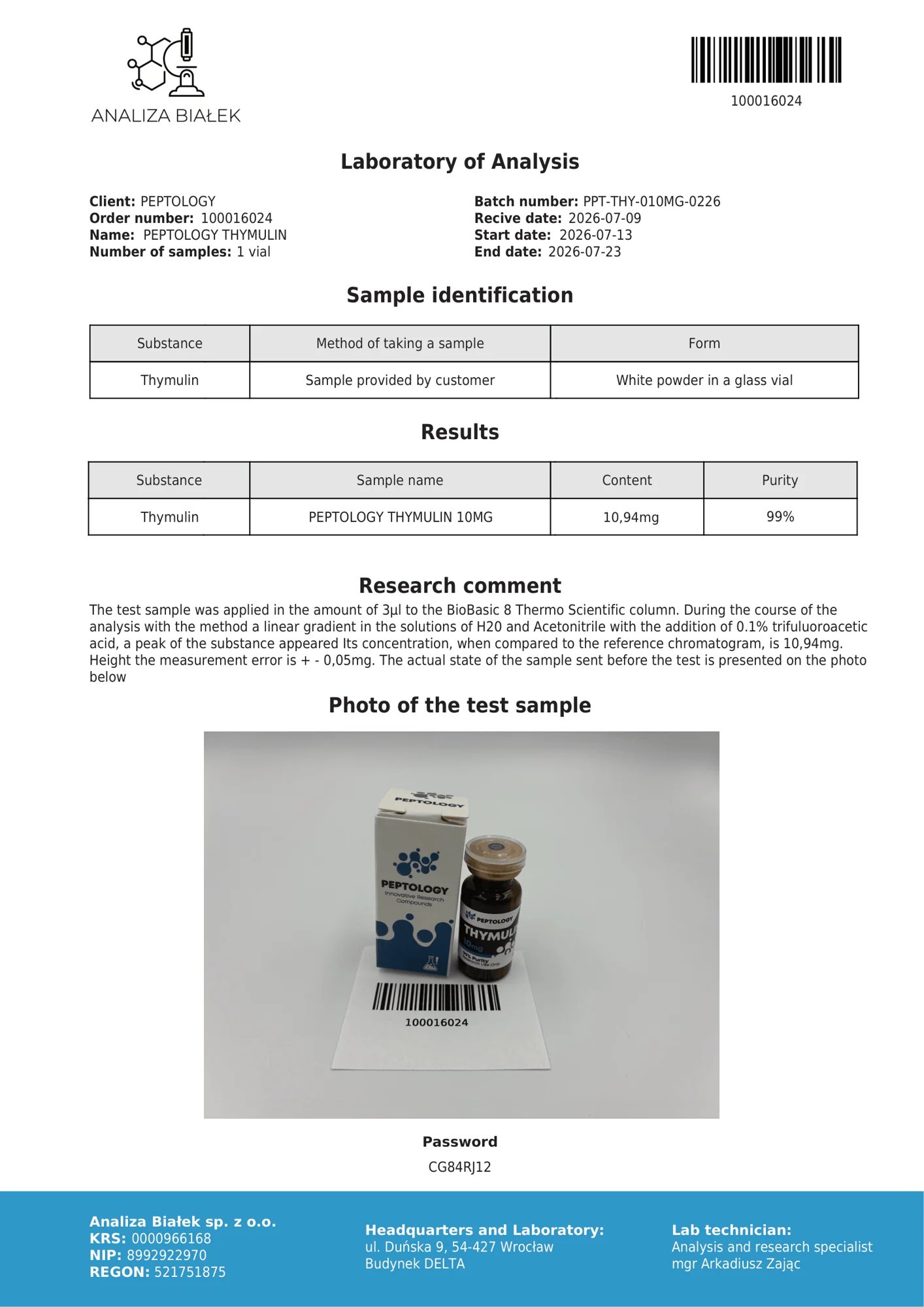
| Purity | >99% |
|---|---|
| Method | HPLC + LC/MS |
| Laboratory | Analiza Białek |
| Batch | 0226 |
What is Thymulin 5 mg / 10 mg?
Thymulin is a natural thymic peptide hormone (a nonapeptide; also known as facteur thymique sérique, FTS), playing a key role in the maturation and functioning of T lymphocytes. Its distinguishing feature is that it is active only in the presence of zinc ions — zinc is essential for its biological action. In the research literature it is described as a neuroimmune modulator linking immunity with hormonal balance.
Thymulin belongs to the category peptides for immunity and hormonal balance. It is one of the three "immune" peptides in the catalog, alongside Thymosin Alpha-1 (activation of T/NK cells) and the anti-inflammatory KPV.
It is a research compound — it is not a medicinal product and holds no authorization for clinical use. The product offered by Peptology is a research-grade reagent, not intended for the diagnosis or treatment of any immune system conditions.
Thymulin is available in two dosage variants — 5 mg and 10 mg — as a lyophilized peptide of high purity, confirmed by independent laboratory analysis (CoA for every batch). The product is intended exclusively for scientific research and in vitro applications.
How Thymulin works — the neuroimmune mechanism
In the research literature, Thymulin is described as a thymic peptide regulating immunity and its links with the hormonal axis. Below are the three most frequently studied elements.
T LYMPHOCYTES (Zn-dependent)
Supports the maturation and activity of T lymphocytes — active only in the presence of zinc ions.
Th1/Th2 BALANCE
Acts anti-inflammatorily and regulates allergic reactivity and the autoimmune response.
NEUROIMMUNO-ENDOCRINE AXIS
Regulates the relationships between the nervous, immune and hormonal systems (especially under stress).
Why the zinc dependence matters
Thymulin is biologically active only after binding a zinc ion — without zinc it remains inactive. This is a unique feature that links the body's zinc status with thymic function and cellular immunity (T lymphocytes). In studies it is an important element in the interpretation of results.
Thymulin differs from Thymosin Alpha-1 (another thymic peptide that strongly stimulates T and NK cells) and from the purely anti-inflammatory KPV. This data comes from the research literature and does not constitute a claim about the effect of the research-grade product offered by Peptology.
Pharmacokinetics and pharmacodynamics (research framework)
Thymulin is a thymic nonapeptide with zinc-dependent action. The most important research characteristics:
- Class: thymic peptide hormone (nonapeptide, FTS) — active in complex with zinc
- Targets: maturation/activity of T lymphocytes, the neuroimmuno-endocrine axis
- Condition for activity: the presence of zinc ions (Zn²⁺) — without it the peptide is inactive
- Effects in studies: ↑ T-cell activity, anti-inflammatory action, allergy regulation
- Schedule: subcutaneous administration 1–2 times a week is described
- Profile: described as very well tolerated, minimal side effects
Variant comparison: Thymulin 5 mg vs 10 mg
Thymulin is available in two doses. Both variants are the same peptide — the difference concerns only the amount of substance in the vial, which translates into the scale and length of the research protocol.
| Thymulin 5 mg | Thymulin 10 mg | |
|---|---|---|
| Amount of peptide | 5 mg | 10 mg |
| Peptide | Thymulin (Zn-dependent) | Thymulin (Zn-dependent) |
| Purity | High (CoA per batch) | High (CoA per batch) |
| Protocol scale | Smaller / shorter | Larger / longer |
| Best for | Initial / shorter research series | Extended protocols / economy of scale |
Both variants are the same high-purity peptide — the difference concerns only the amount in the vial. The choice depends on the scale of the planned protocol. Regardless of the variant, it is worth adding Peptide Matrix Water™ for reconstitution.
Comparison: Thymulin vs Thymosin Alpha-1 vs KPV
Within the same category, it is worth comparing Thymulin with two other immune peptides — Thymosin Alpha-1 (another thymic peptide) and the anti-inflammatory KPV. All concern immunity, but via different pathways.
| Thymulin (this page) | Thymosin Alpha-1 | KPV | |
|---|---|---|---|
| Origin | Thymic hormone (nonapeptide, FTS) | Thymic peptide (28 aa) | Tripeptide (fragment of α-MSH) |
| Main mechanism | T-cell maturation (zinc-dependent) | Activation of T and NK cells | Anti-inflammatory action |
| Main research area | Neuroimmunology, allergies, hormonal axis | Immunity, chronic infections | Inflammation, gut health |
| Dose (variants) | 5 / 10 mg | 5 / 10 mg | 10 mg |
| Best for research on | Neuroimmune-hormonal balance | Immune stimulation | Dampening inflammation |
Thymulin regulates neuroimmunology and T-cell maturation (zinc-dependent), Thymosin Alpha-1 strongly stimulates immunity (T/NK cells), and KPV dampens inflammation. The comparison is indicative in nature and does not constitute a recommendation for use.
Areas of research on Thymulin
Thymulin is a well-described thymic hormone, studied in the context of immunity and neuroendocrine links. Below are the most frequently explored directions.
Immunity and T cells
The main direction of research on Thymulin concerns the maturation and activity of T lymphocytes and the strengthening of the immune response — particularly in states of its weakening. In pilot studies, increased T-cell activity was described in adults and children.
Allergies and inflammation
Thymulin is studied in the context of allergic reactivity, asthma and autoimmune-based diseases — through the regulation of the Th1/Th2 balance and anti-inflammatory action.
The neuroimmuno-endocrine axis
Thymulin is widely studied for the links between the immune and hormonal systems (including GnRH regulation, balance under stress). These are research directions, not confirmed applications of the research-grade product.
Note: The information is presented for scientific and informational purposes and is based on the literature on thymulin. It does not constitute medical advice, a recommendation for use or a claim about the effect of the research-grade product offered by Peptology.
Thymulin profile at a glance
- Thymic peptide hormone (FTS) — regulates the maturation and activity of T lymphocytes
- Active only with zinc — links zinc status with immune function
- Neuroimmune modulator — immunity + the hormonal axis (especially under stress)
- Anti-inflammatory action — Th1/Th2 regulation, allergies, autoimmunity
- Other immune peptides: Thymosin Alpha-1 and KPV
- Every batch with a CoA and confirmed laboratory purity
All information provided refers to the research literature on Thymulin and should not be interpreted as a promise of effect, an instruction for use or a claim about the effect of the research-grade product offered by Peptology.
Research dosing protocols
Important: The information below describes schedules used in research on Thymulin. It is provided for scientific and informational purposes and does not constitute a recommendation for individual use, medical advice or administration instructions. The research-grade Thymulin offered by Peptology is not a registered drug.
In research protocols, Thymulin is usually administered after reconstitution of the lyophilizate, most often subcutaneously:
- Subcutaneous administration 1–2 times a week is described
- The 5 mg variant for initial, shorter series; 10 mg for extended protocols
- Due to the zinc dependence, the zinc status of the model is taken into account in studies
- Calculate precise volumes and units in the peptide calculator (max. 3 mL of solvent per vial)
In combined protocols, Thymulin is sometimes paired with Thymosin Alpha-1, reparative peptides (BPC-157, TB-500) or hormonal-axis compounds (Kisspeptin-10). These schedules come from the research literature and do not constitute a recommendation for self-administration.
Side effects and safety
In research observations, Thymulin is considered very safe, with minimal side effects. The data concern research on the molecule.
Frequent (mild)
- Mild pain at the injection site
Very rarely
- Headache
- Fatigue
Tolerability profile
- Very well tolerated in observations
- No serious effects with standard use
- Hypersensitivity to components — to consider
With standard use in studies, no serious side effects were observed. This information is scientific in nature and does not constitute an instruction for use.
Storage and reconstitution
Thymulin is supplied as a lyophilized (freeze-dried) powder in a vial. In lyophilized form it is stable at room temperature, protected from light and moisture — refrigeration before reconstitution is not mandatory. After reconstitution, stability depends on the solvent used, with Peptide Matrix Water™ significantly extending the peptide's lifespan.
- Before reconstitution: room temperature, in the original packaging, protected from light and moisture. A refrigerator is not mandatory.
- After reconstitution with Peptide Matrix Water™: stability in the refrigerator +2 °C to +8 °C for up to 60 days under appropriate laboratory conditions — the stabilizing formula extends the peptide's lifespan relative to standard solvents.
- After reconstitution with bacteriostatic or sterile water: stability in the refrigerator +2 °C to +8 °C for up to 28 days under appropriate conditions. Do not refreeze the reconstituted solution.
- Reconstitution: in a laboratory setting, Peptide Matrix Water™, bacteriostatic water or sterile water for injection is usually used, depending on the protocol.
- Volume: maximum 3 mL of solvent (capacity of a standard vial). For a precise calculation of volume and units, use the peptide calculator.
- Homogenization: add the solvent slowly down the vial wall, without vigorous shaking, then wait 10–15 min. Swirl gently, do not shake.
Laboratory tip: With your order, you can add Peptide Matrix Water™ to the cart — a stabilizing solution designed for working with reconstituted research peptides. More in the article Bacteriostatic water vs acetic acid vs matrix water.
Frequently asked questions about Thymulin
What exactly is Thymulin?
It is a natural thymic peptide hormone (a nonapeptide, FTS), active only in the presence of zinc. It regulates the maturation and activity of T lymphocytes and the links between immunity and the hormonal axis. The results come from the research literature.
Why does Thymulin need zinc?
Thymulin is biologically active only after binding a zinc ion — without zinc it remains inactive. This is a unique feature linking the body's zinc status with thymic function and cellular immunity.
How does it differ from Thymosin Alpha-1?
Both are thymic peptides, but different molecules. Thymulin (zinc-dependent) regulates T-cell maturation and the neuroimmune axis, while Thymosin Alpha-1 strongly stimulates T and NK cells. They are sometimes paired in immune protocols.
Can it be combined with other peptides?
In the research literature, Thymulin is sometimes paired with BPC-157, TB-500, HCG or Kisspeptin-10 in regenerative/hormonal protocols. This is a research context, not a recommendation for use.
How is Thymulin stored and reconstituted?
The lyophilized vial is stored at room temperature, protected from light and moisture. After reconstitution, stability depends on the solvent: with Peptide Matrix Water™ — up to 60 days in the refrigerator +2 °C to +8 °C; with bacteriostatic or sterile water — up to 28 days. Avoid refreezing.
Where to buy Thymulin for research?
Peptology offers Thymulin (5 mg / 10 mg) as a research peptide with confirmed purity and independent laboratory analysis for every batch. Fast shipping, discreet packaging and certificates of purity with the product. For scientific background, also see the article Peptides — what they are, how they work, main categories and safety profile.
Related products in the Peptology catalog
Researchers working with Thymulin often also consider related peptides of immunity and the hormonal axis. Each of the products below has a certificate of purity (CoA):
Thymosin Alpha-1
Thymic peptide — activation of T/NK cells
KPV
Anti-inflammatory peptide — immunity and the gut
Kisspeptin-10
Regulator of the hormonal axis (GnRH)
Gonadorelin
GnRH agonist — the hormonal axis
Semax
Neuropeptide — neuroendocrine adaptation
Peptide Matrix Water™
Stabilizing solution for reconstitution
See the full catalog: Peptides for immunity and hormonal balance · Peptides for skin, sleep and libido · Peptides for energy and regeneration · All peptides · Blog on peptide research
Research warning: Thymulin is offered exclusively for scientific research and in vitro purposes. It is not a medicinal product, is not approved for use in humans or animals, and does not replace medical advice. It is not intended for the treatment of immune disorders, allergies or other conditions. All information comes from the research literature and is provided for scientific and informational purposes; it does not constitute a claim about the effect of the research-grade product offered by Peptology.
Laboratory reconstitution
Laboratory protocol — reconstitution, research protocols, storage
Standardized protocol applicable to all research peptides in the Peptology catalogue. To calculate the solution concentration (mg/mL) for each vial, use the peptide reconstitution calculator.
60-second protocol
1. SOLVENT
2. RECONSTITUTION
Add the solvent down the side of the vial, without shaking, wait 10–15 min.
3. CALCULATION
Calculator → concentration mg/mL
4. STORAGE
+2 °C to +8 °C, up to 60 days with Peptide Matrix Water
Quick reference
| Parameter | Value |
|---|---|
| Form | Lyophilized powder |
| Solvent | Peptide Matrix Water |
| Reconstitution volume | 1–3 mL — maximum 3 mL (capacity of the standard vial) |
| Storage before reconstitution | Room temperature, protected from direct light (refrigeration not required) |
| After reconstitution | Up to 60 days at +2 °C to +8 °C with Peptide Matrix Water |
What you need
Precision pipette
Calibrated, 100–1000 µL — for accurately measuring the volume of solvent added to the vial.
70% alcohol swabs
Two swabs — to disinfect the peptide vial and the solvent vial.
Stabilized solvent for lyophilized peptides. Why this one.
Five rules for reconstitution
| ✅ Correct | ❌ Mistake |
|---|---|
| Disinfect the vial caps and the work surface with 70% alcohol; wear gloves | Working without disinfection |
| Add the solvent slowly along the vial wall | Direct jet onto the powder — foaming and denaturation |
| Gentle rolling between the palms | Shaking — foam, which denatures peptides |
| 10–15 minutes waiting at room temperature | Mechanical mixing or heating |
| Visual check: clear, particle-free | Working with a cloudy or discolored solution |
Calculating concentration
⚠️ Maximum 3 mL solvent. The standard vial does not accommodate larger volumes — do not exceed during reconstitution.
- Concentration (mg/mL) = mg in the vial ÷ mL of solvent
- Volume per sample (mL) = amount per sample (mg) ÷ concentration (mg/mL)
- 1 mg/mL = 1 µg/µL · 1 mL = 1000 µL
Reconstitution per vial — solvent: Peptide Matrix Water. Concentration after adding the solvent (1 mg/mL = 1 µg/µL):
| Vial | + 1 mL | + 2 mL | + 3 mL |
|---|---|---|---|
| 5 mg | 5 mg/mL | 2.5 mg/mL | 1.67 mg/mL |
| 10 mg | 10 mg/mL | 5 mg/mL | 3.33 mg/mL |
👉 For any vial and solvent volume — use the calculator. It calculates the concentration (mg/mL, µg/µL) and the volume per sample (mL, µL).
Storage
BEFORE RECONSTITUTION
Room temperature, protected from direct light, in original packaging. Refrigerator not required.
AFTER RECONSTITUTION
+2 °C to +8 °C, up to 60 days with Peptide Matrix Water. Discard any remainder after this period.
FREEZING
Not recommended. Freeze/thaw cycles degrade peptide structure.
Four mistakes to avoid
1. Shaking "to dissolve faster"
Foam = denaturation. Only gentle rolling between the palms.
2. Inappropriate solvent
For peptide stability use only sterile, specially formulated solvent — recommended Peptide Matrix Water.
3. Ignoring slight turbidity
Not fully clear = the sample does not meet the criteria for use.
4. Taking it out of the refrigerator "for an hour–two"
Short exposures add up and compromise stability.
Research status: All Peptology products are intended for laboratory and research use only. They are not medicinal products, not approved for human or veterinary use and do not substitute medical advice. The described protocol is standard laboratory practice for working with lyophilized peptides.
Shipping information
🚚 Shipping information
-
Products in our warehouse – orders placed by 15:00 on working days are dispatched the same day, later orders on the next working day.
-
Delivery with GLS to your address in 3–5 working days.
-
Shipping costs €5 and is free from €50.
Frequently Asked Questions (FAQ)
What is the primary action of Thymulin?
Immunostimulation and restoration of the hormonal axis by regulating GnRH and the Th1/Th2 balance.
In what form is Thymulin supplied and how should it be stored?
It is supplied as a lyophilized (freeze-dried) powder in a sealed vial. Store the unopened vial dry and protected from light, ideally at 2–8 °C. After laboratory reconstitution, keep the solution at 2–8 °C and use it within the period stated in the “Laboratory reconstitution” tab (up to 60 days with Peptide Matrix Water).
Is a prescription required to order?
No – the product is for laboratory and research use only.
Where can I buy Thymulin in Europe and what does it cost?
You can buy Thymulin in Europe online from Peptology, from 30,00 €. Delivery with GLS in 3–5 working days. Shipping is free from 50,00 €. Payment by card. Purity 99%+, with an HPLC report for every batch.
Laboratory Analysis
Thymulin - 10 mg - Batch - 0226 - Purity