
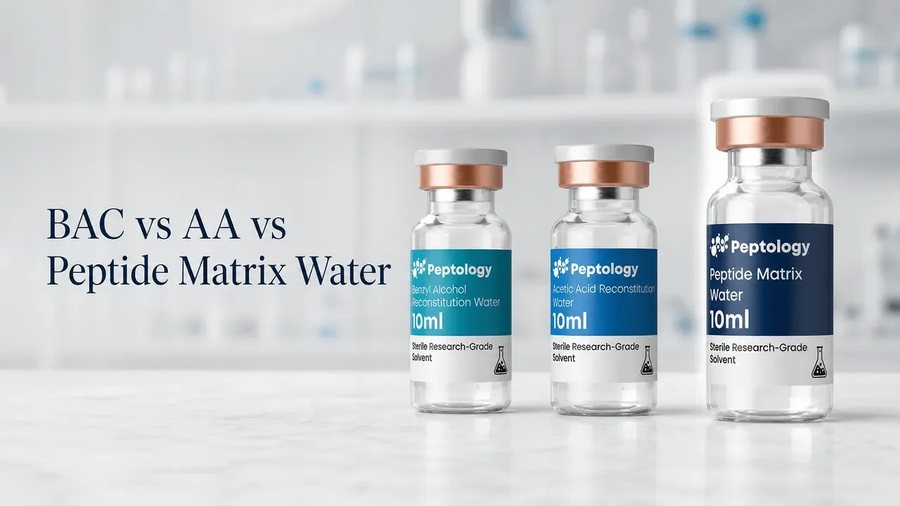
Bacteriostatic Water vs. Acetic Acid vs. Peptide Matrix Water: Which is the Best Reconstitution Medium?
A complete comparative analysis of solvents in peptide science: mechanisms for molecular protection and why Peptide Matrix Water is the unequivocal choice over traditional methods.
Every researcher knows that peptide quality is only the first step. The critical moment comes at its reconstitution. The wrong choice of solvent can lead to degradation, oxidation or aggregation (clumping) of the amino acid chains. Today we compare standard Bacteriostatic Water, classic Acetic Acid and innovative Peptide Matrix Water to determine which medium offers the highest security for your research.
1. Bacteriostatic Water (Bacteriostatic Water): The Standard Choice
Bacteriostatic water is sterile water containing 0.9% benzyl alcohol. Its main function is to prevent bacterial contamination.
- Who it's for: Standard studies with stable peptides.
- The problem: It has no buffering properties. When dissolving delicate molecules such as NAD+ 1000 mg, Bac Water cannot protect the structure from degradation due to changes in pH or temperature.
2. Acetic Acid (Acetic Acid): The Specific Solution
Some peptides known for their poor solubility in neutral media traditionally require the use of Acetic Acid. It creates an acidic environment that helps hydrophobic peptides like IGF-1 LR3 to fully dissolve.
Risks: Acetic Acid is an aggressive solvent. Too high a concentration can denature the peptide, and application in research models is often accompanied by irritation and discomfort. It is an "old-school" solution that requires exceptional precision in dosing.
3. Peptide Matrix Water: The Technological Leader
Peptide Matrix Water (matrix water) has been developed specifically for the needs of advanced peptide science. It is not just a sterile liquid but a complex solvent that mimics the intracellular environment.
"While acetic acid simply dissolves and bacteriostatic water simply preserves, peptide matrix water actively stabilises the molecule by building a protective layer around it."
You can purchase it here: Peptide Matrix Water (10ml).
4. Comparative Analysis: Why Peptide Matrix Water (matrix water) Wins?
The superiority of Peptide Matrix Water is due to three key factors:
Intelligent pH Regulation
Unlike Acetic Acid, which is fixedly acidic, the matrix water maintains an optimal pH balance specific to the peptide's needs.
Extended Viability
Studies show that peptides dissolved in Peptide Matrix Water retain their activity up to 40% longer when stored refrigerated compared with Bac Water.
5. Advantages and Disadvantages
- Acetic Acid may damage delicate protein bonds.
- Bac Water is ineffective for long-term studies.
- Plain water does not provide structural support.
6. Table: Matrix vs. Bac vs. AA
| Function | Peptide Matrix Water | Bac Water | Acetic Acid (AA) |
|---|---|---|---|
| Long-term Stability | Extremely high | Medium | Low |
| Safety for the Peptide | Maximum (protective layer) | Basic | Risk of denaturation |
| Versatility | Yes (for all peptides) | Yes | No (only for specific ones) |
| Price/Quality | Best pricing | Low price / basic grade | Specific cost |
7. The Science Behind the "Matrix" Structure
The secret lies in the hydrated network technology. When you add Peptide Matrix Water to lyophilised powder, its components form a microscopic "scaffold" around the peptide chain. This prevents mechanical damage to the molecule during mild agitation or temperature fluctuations – something that neither bacteriostatic water nor ethanoic acid can do.
8. Guidelines for Research Protocols
To achieve maximum efficacy:
- Slow mixing: Always dispense the solvent down the side of the vial.
- Temperature regimen: Store the prepared solution between 2°C and 8°C.
- Solvent choice: Use Peptide Matrix for expensive or delicate peptides from the Recovery Peptides category.
Invest in the Accuracy of Your Results
Don't let a poor solvent ruin your research. Buy Peptide Matrix Water online at Peptology.
Buy Peptide Matrix Water from Peptology9. Conclusion
The analysis is clear: while ethanoic / acetic acid and bacteriostatic water are historically proven tools, peptide matrix water is the evolutionary step forward. It provides stability, safety and longevity for peptides in research projects. At Peptology we work to the same quality standard for every product.