🇪🇺 Fast delivery (3–5 working days) with GLS ✅ Card or bank transfer 📦 Free shipping from €50

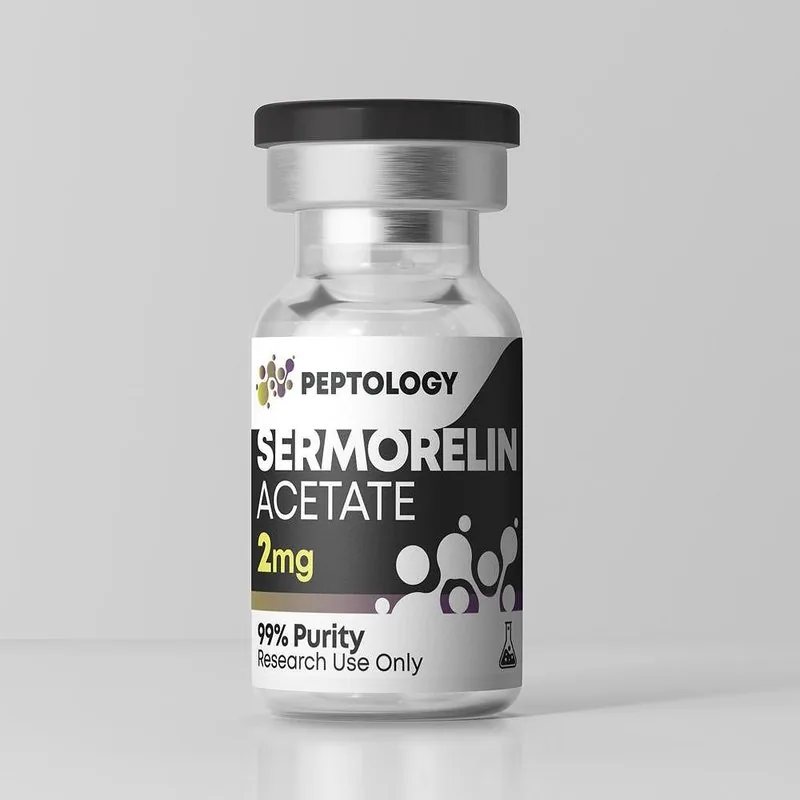
Sermorelin
Sermorelin Acetate 5 mg – Growth hormone stimulator (GHRH)
Peptology Ltd. · Recovery and anabolic peptides
Sermorelin Acetate (GRF 1-29) – a synthetic GHRH analogue: the first 29 amino acids of the natural 44-amino-acid GHRH, the shortest fragment with full activity at the GHRH receptor; research peptide for studies of the GH axis. Purity 99%+, HPLC/MS report for every batch.
📦 The product is in our EU warehouse – delivery within 3–5 working days.
39,00 € · In stock
For research use only / Not a medicine
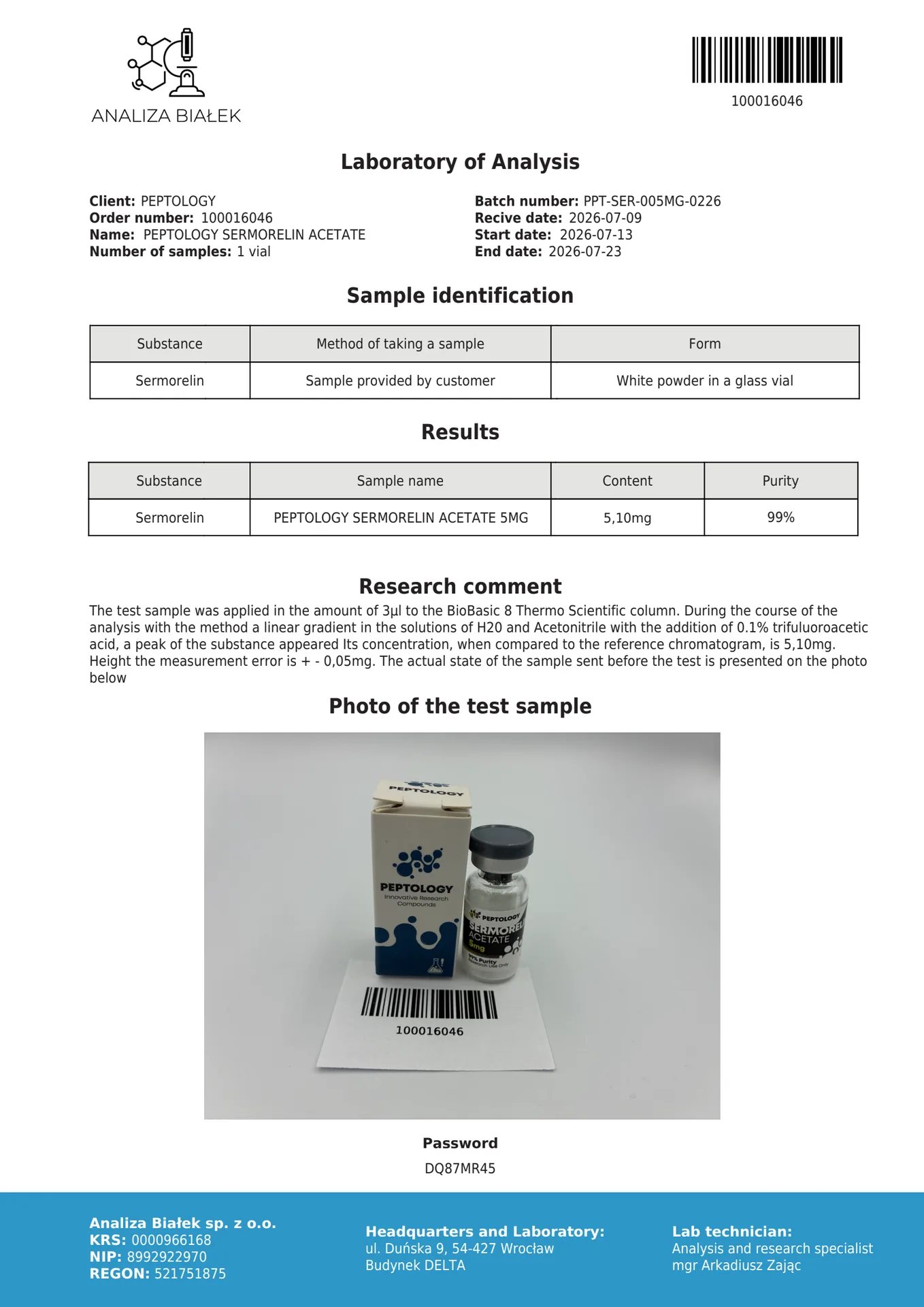
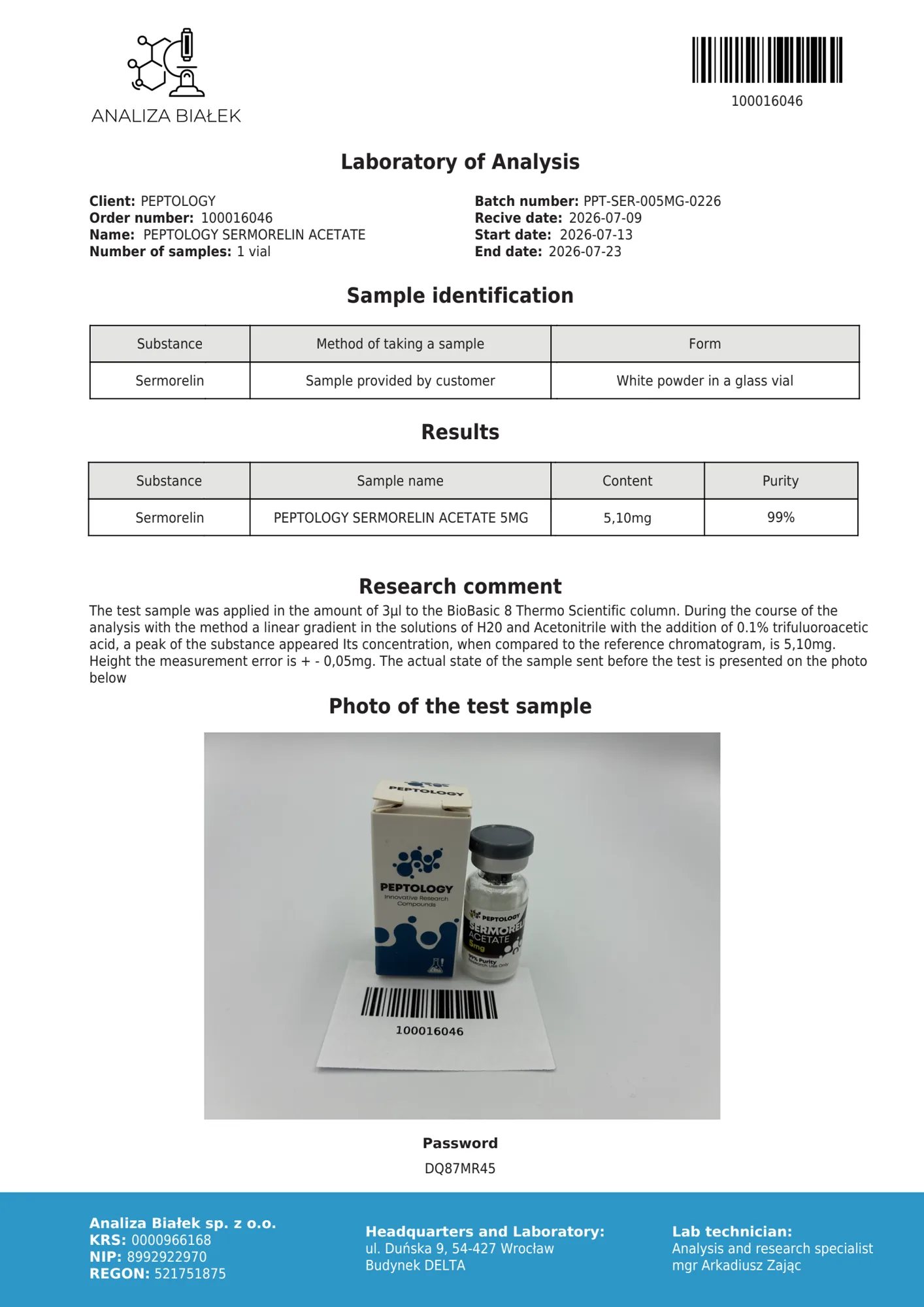
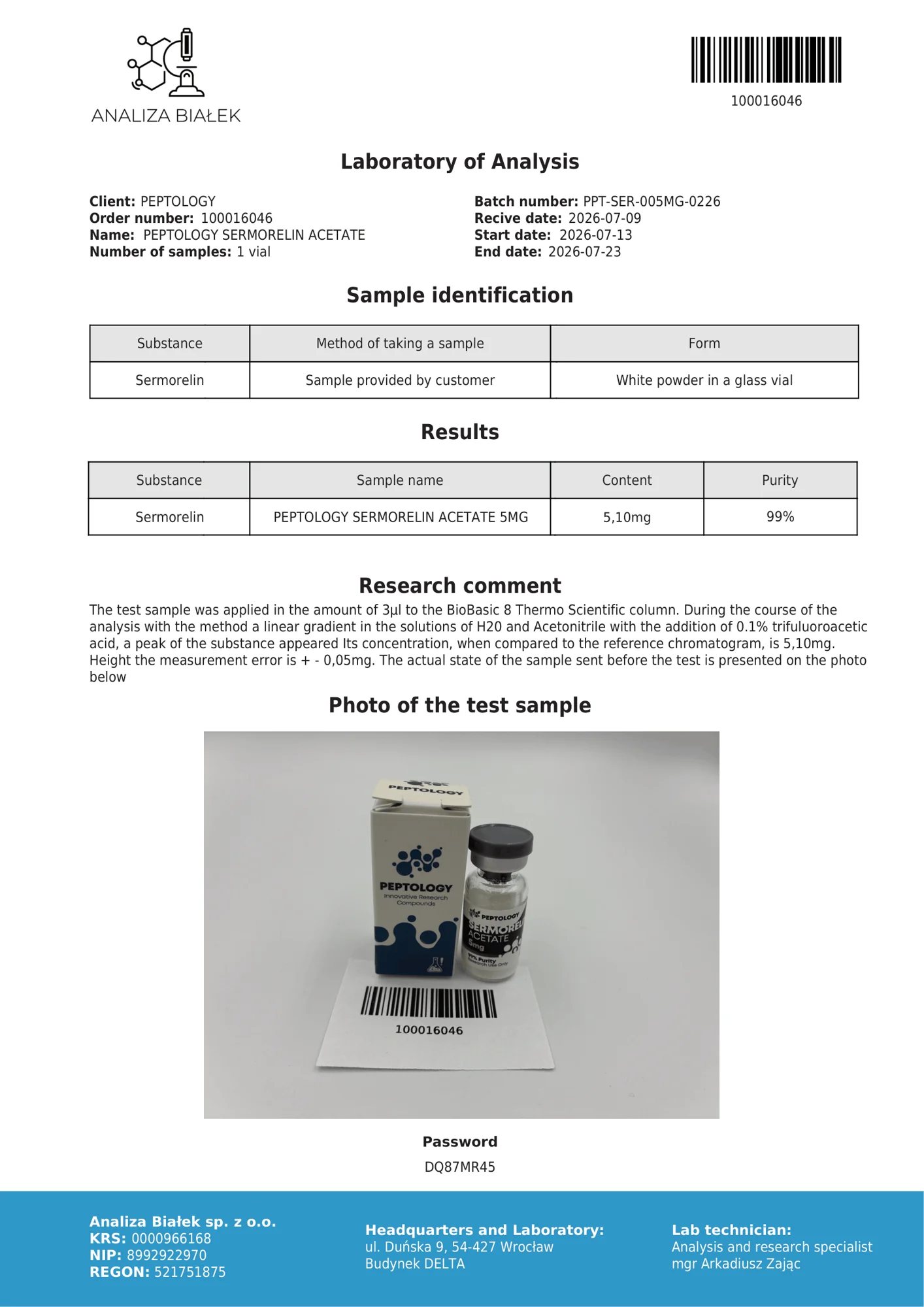
| Purity | >99% |
|---|---|
| Method | HPLC + LC/MS |
| Laboratory | Analiza Białek |
| Batch | 0226 |
What is Sermorelin?
Sermorelin (sermorelin acetate, GRF 1-29) is a synthetic GHRH analog — the growth-hormone-releasing hormone. It consists of the first 29 amino acids of the natural, 44-amino-acid GHRH and is its shortest, fully functional fragment, retaining full biological activity at the GHRH receptor. It stimulates the pituitary to the natural, pulsatile secretion of growth hormone (GH), and indirectly IGF-1.
In contrast to the administration of exogenous growth hormone, Sermorelin supports the body's own GH production, preserving the physiological feedback mechanisms (somatostatin). This means a more natural, pulsatile profile and a low risk of "overdosing" the GH axis. Sermorelin is the historic, first GHRH analog to which newer molecules are compared, like CJC-1295 or Tesamorelin.
The research-grade Sermorelin offered by Peptology is not a medicinal product — it is a lyophilized research peptide intended exclusively for scientific and in vitro applications, not intended for use in humans or animals. See also the other recovery and anabolic peptides in our category.
In the version offered by Peptology, Sermorelin is supplied as a lyophilized peptide with purity above 99% (HPLC/MS), confirmed by independent laboratory analysis (CoA for every batch). It is available in two vial formats — 2 mg and 5 mg — depending on the scale of the research protocol.
Available formats: 2 mg and 5 mg
Sermorelin is available in two lyophilized formats that cover different scales of research work — from single in vitro series to longer GH-axis protocols with higher peptide consumption.
2 MG
Standard format
Suitable for validation experiments, single in vitro series and shorter GH-axis protocols.
5 MG
Enlarged format
For longer research series, schedules combined with a GHRP secretagogue and protocols with higher peptide consumption.
Both formats have identical purity > 99% and the same laboratory certificate for the batch. The choice of size depends on the scale of the protocol, not on the concentration of the active substance.
How Sermorelin works — physiological stimulation of the GHRH axis
In the research literature, Sermorelin is described as a GHRH analog that stimulates the body's own GH production while preserving natural regulatory mechanisms. The three features below together explain its physiological, "safe" profile.
GHRH RECEPTOR
Binds the GHRH receptor on the pituitary somatotropic cells, stimulating the synthesis and release of endogenous GH — instead of delivering GH from the outside.
PRESERVED FEEDBACK
Natural regulation by somatostatin remains active — a pulsatile, physiological GH profile and a low risk of excessive stimulation of the axis.
SYNERGY WITH GHRP
Acts on a different receptor than GHRP secretagogues (GHS-R1a), which is why combining it with Ipamorelin amplifies GH release.
Why the physiological profile matters
Direct administration of growth hormone bypasses natural regulation and can shut down the body's own GH production. Sermorelin acts "higher up" in the cascade — it stimulates the pituitary but leaves the somatostatin feedback intact. Thanks to this, GH release retains a pulsatile, physiological character, and the pituitary axis is not suppressed. This makes Sermorelin a model research tool for studying the regulation of the GH axis.
Due to its very short half-life, Sermorelin gives a single GH pulse; in studies it is combined with a GHRP secretagogue (e.g. Ipamorelin) acting on a separate receptor. This data comes from pharmacological studies and does not constitute a claim about the effect of the research-grade product.
Pharmacokinetics and pharmacodynamics of Sermorelin
Sermorelin is a short peptide, which in the published pharmacokinetic data is described as a molecule with a very short half-life and a fast, pulsatile profile of action on the GH axis.
- Biological half-life: very short — below 10 minutes (on the order of 5–10 min)
- GH profile: a single, physiological GH pulse — without a constant, elevated background
- Target: the GHRH receptor on the pituitary somatotropic cells
- Regulation: preserved somatostatin feedback (low risk of excessive stimulation)
- Structure: GRF (1-29) — the shortest fully active fragment of GHRH
- Research schedule: subcutaneous (SC) administration, usually daily, often in the evening
Sermorelin vs CJC-1295 vs Tesamorelin
The table below compares three GHRH analogs acting on the same receptor, but differing in stability and half-life. Sermorelin is the original, shortest GHRH fragment with the shortest profile; CJC-1295 is resistant to DPP-4; and Tesamorelin is stabilized and stands out for its effect on visceral fat. The data are scientific and comparative in nature.
| Sermorelin | CJC-1295 without DAC | Tesamorelin | |
|---|---|---|---|
| Class | GHRH analog (GRF 1-29) | GHRH analog (Mod GRF 1-29) | Stabilized GHRH analog (1-44) |
| Half-life | < 10 min (the shortest) | ~30 min | ~26 min |
| GH profile | Single, physiological pulse | Pulsatile (DPP-4 resistant) | Sustained |
| Distinguishing feature | The original, physiological GHRH | Enzymatic stability | Visceral fat reduction |
| Status | Research peptide | Research peptide | Research peptide |
The pharmacokinetic values are approximate and come from the literature on GHRH analogs. The table is scientific and comparative in nature and does not constitute a direct head-to-head comparison or a claim about the effect of the research-grade product.
Clinical and research data on Sermorelin
Sermorelin has a long research history — it was studied clinically in GH-axis diagnostics and in GH deficiency. Below are the most important observations from the literature.
GH-axis diagnostics and GH deficiency in studies
Sermorelin was studied clinically for assessing pituitary function (the GHRH stimulation test) and in growth hormone deficiency in children. Clinical studies confirmed that it stimulates endogenous GH secretion and raises IGF-1 with good tolerability.
The GH/IGF-1 axis and aging
Because GH secretion naturally declines with age, Sermorelin was studied in the context of maintaining the GH/IGF-1 axis in adults — with observations concerning sleep, body composition and regeneration. These results are part of the broader literature on the physiological stimulation of GH.
GHRH + GHRP synergy
In studies, the combination of Sermorelin with a GHRP secretagogue (like Ipamorelin or GHRP-2) is associated with stronger GH release than either component alone, because they act on separate receptors.
Note: The information is presented for scientific and informational purposes and is based on the clinical and pharmacological literature. It does not constitute medical advice, a recommendation for use or a claim about the effect of the research-grade product offered by Peptology.
Sermorelin profile at a glance
- The original GHRH analog (GRF 1-29) — the shortest, fully functional fragment of the GH-releasing hormone
- Physiological, pulsatile GH secretion with preserved somatostatin feedback
- Does not suppress the pituitary axis — it stimulates the body's own GH production, rather than delivering it from the outside
- Clinical history — studied in GH-axis diagnostics and GH deficiency
- Very good tolerability and low risk of excessive stimulation of the GH axis
- Synergy with a GHRP secretagogue (Ipamorelin, GHRP-2) — two separate receptors
All information provided refers to the clinical and pharmacological literature on sermorelin and should not be interpreted as a promise of effect, an instruction for use or a claim about the effect of the research-grade product offered by Peptology.
Research dosing protocols
Important: The information below describes schedules used in research on sermorelin. It is provided for scientific and informational purposes and does not constitute a recommendation for individual use, medical advice or administration instructions. The research-grade Sermorelin offered by Peptology is not a registered drug.
Due to its very short half-life, Sermorelin is administered in studies subcutaneously, usually daily, often in the evening (in line with the nocturnal GH rhythm):
- Subcutaneous (SC) administration, usually on an empty stomach, often before sleep (the physiological model)
- Usually a daily schedule, due to the very short profile of action
- Combined schedules: GHRH (Sermorelin) + GHRP (e.g. Ipamorelin) for a synergistic effect
- The literature describes cyclical protocols with break periods
Like other GHRH analogs — CJC-1295 or Tesamorelin — Sermorelin is sometimes combined in studies with a GHRP secretagogue, like Ipamorelin. These schedules come from the research literature and do not constitute a recommendation for self-administration.
Side effects and safety
Sermorelin is described as exceptionally well tolerated, especially with gradual introduction. Thanks to its physiological mechanism and preserved feedback, the risk of excessive stimulation of the GH axis is low. Side effects are usually mild and transient.
Frequently observed (mild)
- Redness/discomfort at the injection site
- Transient facial redness (flushing)
- Mild pain or dizziness at the start
- Transient sensation of warmth
Less frequently described
- Fatigue or irritability
- Increased hunger
- Transient metabolic discomfort
Advantage of the profile
- Does not suppress the body's own GH production
- Preserved feedback
- Low risk of excessive stimulation of the axis
Most observed side effects are mild and transient with appropriate, gradual dosing. Due to the GH-dependent mechanism, glucose handling remains an important element of observation. This information is scientific in nature and does not constitute an instruction for use.
Storage and reconstitution
Sermorelin is supplied as a lyophilized (freeze-dried) powder in a vial. In lyophilized form the peptide is stable at room temperature, protected from light and moisture — refrigeration before reconstitution is not mandatory. After reconstitution, stability depends on the solvent used, with Peptide Matrix Water™ significantly extending the peptide's lifespan.
- Before reconstitution: room temperature, in the original packaging, protected from light and moisture. A refrigerator is not mandatory.
- After reconstitution with Peptide Matrix Water™: stability in the refrigerator +2 °C to +8 °C for up to 60 days under appropriate laboratory conditions — the stabilizing formula extends the peptide's lifespan relative to standard solvents.
- After reconstitution with bacteriostatic or sterile water: stability in the refrigerator +2 °C to +8 °C for up to 28 days under appropriate conditions. Do not refreeze the reconstituted solution.
- Reconstitution: in a laboratory setting, Peptide Matrix Water™, bacteriostatic water or sterile water for injection is usually used, depending on the protocol.
- Volume: maximum 3 mL of solvent (capacity of a standard vial). For a precise calculation of volume and units, use the peptide calculator.
- Homogenization: add the solvent slowly down the vial wall, without vigorous shaking — peptide bonds are sensitive to mechanical stress. Swirl gently, do not shake.
Laboratory tip: With your order, you can add Peptide Matrix Water™ to the cart — a stabilizing solution designed for working with reconstituted research peptides. More in the article Bacteriostatic water vs acetic acid vs matrix water.
Frequently asked questions about Sermorelin
What exactly is Sermorelin?
It is a synthetic GHRH analog consisting of the first 29 amino acids of the growth-hormone-releasing hormone (GRF 1-29) — the shortest fully active fragment of GHRH. It stimulates the pituitary to the natural, pulsatile secretion of GH. The results come from the clinical and pharmacological literature.
Does Sermorelin suppress the body's own growth hormone production?
No — Sermorelin stimulates endogenous GH secretion and does not shut down the pituitary axis. The preserved somatostatin feedback maintains a physiological, pulsatile profile and limits the risk of excessive stimulation.
How does Sermorelin differ from CJC-1295?
Both are GHRH analogs acting on the same receptor. Sermorelin (GRF 1-29) has a very short half-life (< 10 min), whereas CJC-1295 (Mod GRF 1-29) has amino acid substitutions increasing resistance to DPP-4 and a slightly longer profile. Both are studied as a GHRH base, often combined with GHRP.
Can it be combined with other peptides?
Yes — it is classically combined with a GHRP secretagogue, like Ipamorelin or GHRP-2 (two separate receptors, synergy), and also with regenerative peptides like BPC-157.
What is Sermorelin's half-life?
Very short — below 10 minutes. This is a design feature: Sermorelin gives a single, physiological GH pulse, mimicking the natural rhythm, rather than a constant, elevated background. That is why it is used daily in protocols.
Which format to choose — 2 or 5 mg?
Both have identical purity > 99% and the same batch certificate. 2 mg works well for shorter protocols and single series, and 5 mg — for longer GH-axis studies and schedules combined with GHRP.
How is Sermorelin stored and reconstituted?
The lyophilized vial is stored at room temperature, protected from light and moisture. After reconstitution, stability depends on the solvent: with Peptide Matrix Water™ — up to 60 days in the refrigerator +2 °C to +8 °C; with bacteriostatic or sterile water — up to 28 days. Avoid refreezing.
Where to buy Sermorelin for research?
Peptology offers Sermorelin (5 mg) as a research peptide with confirmed purity above 99% (HPLC/MS) and independent laboratory analysis for every batch. Fast shipping, discreet packaging and certificates of purity with the product. For scientific background, also see the article Peptides — what they are, how they work, main categories and safety profile.
Related peptides in the Peptology catalog
Researchers working with Sermorelin often also consider other GH-axis tools — GHRH analogs, GHRP secretagogues and ready-made complexes. Each of the products below has a certificate of purity above 99%:
CJC-1295 without DAC
Modified GHRH analog (DPP-4 resistant)
Tesamorelin
Stabilized GHRH (visceral fat)
Ipamorelin
Selective GH secretagogue (a stack partner)
GHRP-2
Ghrelin mimetic (GHS-R1a)
CJC-1295 + Ipamorelin
Ready-made GH-axis complex
Peptide Matrix Water™
Stabilizing solution for reconstitution
See the full catalog: Recovery and anabolic peptides · Solutions for peptides · All peptides · Blog on peptide research
Research warning: Sermorelin (GRF 1-29) is offered exclusively for scientific research and in vitro purposes. It is not a medicinal product, is not a registered drug, is not intended for use in humans or animals, and does not replace medical advice. All information comes from the clinical and pharmacological literature and is provided for scientific and informational purposes; it does not constitute a claim about the effect of the research-grade product offered by Peptology.
Laboratory reconstitution
Laboratory protocol — reconstitution, research protocols, storage
Standardized protocol applicable to all research peptides in the Peptology catalogue. To calculate the solution concentration (mg/mL) for each vial, use the peptide reconstitution calculator.
60-second protocol
1. SOLVENT
2. RECONSTITUTION
Add the solvent down the side of the vial, without shaking, wait 10–15 min.
3. CALCULATION
Calculator → concentration mg/mL
4. STORAGE
+2 °C to +8 °C, up to 60 days with Peptide Matrix Water
Quick reference
| Parameter | Value |
|---|---|
| Form | Lyophilized powder |
| Solvent | Peptide Matrix Water |
| Reconstitution volume | 1–3 mL — maximum 3 mL (capacity of the standard vial) |
| Storage before reconstitution | Room temperature, protected from direct light (refrigeration not required) |
| After reconstitution | Up to 60 days at +2 °C to +8 °C with Peptide Matrix Water |
What you need
Precision pipette
Calibrated, 100–1000 µL — for accurately measuring the volume of solvent added to the vial.
70% alcohol swabs
Two swabs — to disinfect the peptide vial and the solvent vial.
Stabilized solvent for lyophilized peptides. Why this one.
Five rules for reconstitution
| ✅ Correct | ❌ Mistake |
|---|---|
| Disinfect the vial caps and the work surface with 70% alcohol; wear gloves | Working without disinfection |
| Add the solvent slowly along the vial wall | Direct jet onto the powder — foaming and denaturation |
| Gentle rolling between the palms | Shaking — foam, which denatures peptides |
| 10–15 minutes waiting at room temperature | Mechanical mixing or heating |
| Visual check: clear, particle-free | Working with a cloudy or discolored solution |
Calculating concentration
⚠️ Maximum 3 mL solvent. The standard vial does not accommodate larger volumes — do not exceed during reconstitution.
- Concentration (mg/mL) = mg in the vial ÷ mL of solvent
- Volume per sample (mL) = amount per sample (mg) ÷ concentration (mg/mL)
- 1 mg/mL = 1 µg/µL · 1 mL = 1000 µL
Reconstitution per vial — solvent: Peptide Matrix Water. Concentration after adding the solvent (1 mg/mL = 1 µg/µL):
| Vial | + 1 mL | + 2 mL | + 3 mL |
|---|---|---|---|
| 2 mg | 2 mg/mL | 1 mg/mL | 0.67 mg/mL |
| 5 mg | 5 mg/mL | 2.5 mg/mL | 1.67 mg/mL |
👉 For any vial and solvent volume — use the calculator. It calculates the concentration (mg/mL, µg/µL) and the volume per sample (mL, µL).
Storage
BEFORE RECONSTITUTION
Room temperature, protected from direct light, in original packaging. Refrigerator not required.
AFTER RECONSTITUTION
+2 °C to +8 °C, up to 60 days with Peptide Matrix Water. Discard any remainder after this period.
FREEZING
Not recommended. Freeze/thaw cycles degrade peptide structure.
Four mistakes to avoid
1. Shaking "to dissolve faster"
Foam = denaturation. Only gentle rolling between the palms.
2. Inappropriate solvent
For peptide stability use only sterile, specially formulated solvent — recommended Peptide Matrix Water.
3. Ignoring slight turbidity
Not fully clear = the sample does not meet the criteria for use.
4. Taking it out of the refrigerator "for an hour–two"
Short exposures add up and compromise stability.
Research status: All Peptology products are intended for laboratory and research use only. They are not medicinal products, not approved for human or veterinary use and do not substitute medical advice. The described protocol is standard laboratory practice for working with lyophilized peptides.
Shipping information
🚚 Shipping information
-
Products in our warehouse – orders placed by 15:00 on working days are dispatched the same day, later orders on the next working day.
-
Delivery with GLS to your address in 3–5 working days.
-
Shipping costs €5 and is free from €50.
Frequently Asked Questions (FAQ)
Will it suppress natural GH?
No – Sermorelin stimulates natural secretion and does not shut down the pituitary axis.
In what form is Sermorelin supplied and how should it be stored?
It is supplied as a lyophilized (freeze-dried) powder in a sealed vial. Store the unopened vial dry and protected from light, ideally at 2–8 °C. After laboratory reconstitution, keep the solution at 2–8 °C and use it within the period stated in the “Laboratory reconstitution” tab (up to 60 days with Peptide Matrix Water).
Is a prescription required to order?
No – the product is for laboratory and research use only.
Where can I buy Sermorelin in Europe and what does it cost?
You can buy Sermorelin in Europe online from Peptology, from 39,00 €. Delivery with GLS in 3–5 working days. Shipping is free from 50,00 €. Payment by card. Purity 99%+, with an HPLC report for every batch.
Laboratory Analysis
Sermorelin - 5mg - Batch - 0226 - Purity