🇪🇺 Fast delivery (3–5 working days) with GLS ✅ Card or bank transfer 📦 Free shipping from €50


KLOW80
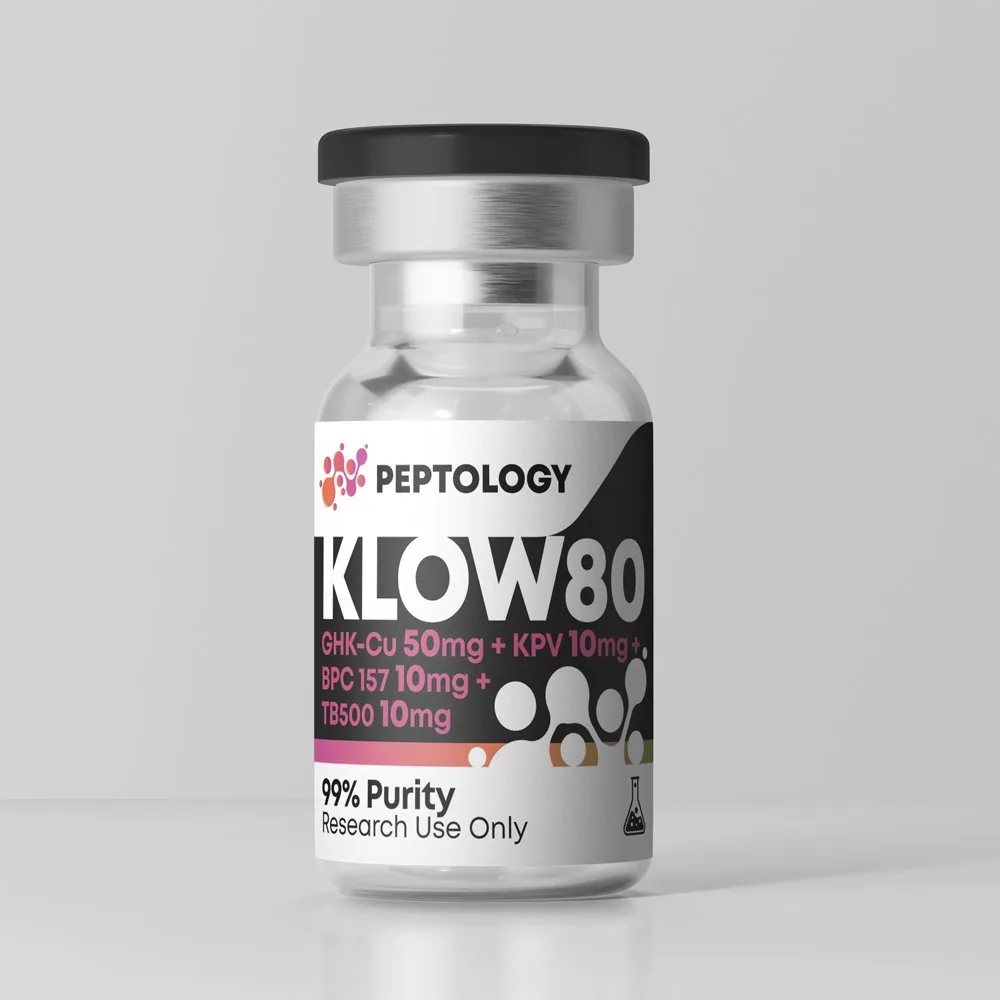
KLOW80 – Blend: GHK-Cu 50 mg, TB-500, BPC-157 and KPV 10 mg each
Peptology Ltd. · Peptides for energy and regeneration
KLOW80 – enhanced regenerative complex 4-in-1: GHK‑Cu 50 mg + KPV 10 mg + BPC‑157 10 mg + TB‑500 10 mg. Total 80 mg active peptides, combining four research axes – collagen and matrix, angiogenesis, cellular migration and anti-inflammatory (NF‑κB). Purity over 99 %, confirmed by independent laboratory analysis. For research use only.
📦 The product is in our EU warehouse – delivery within 3–5 working days.
169,00 € · In stock
For research use only / Not a medicine
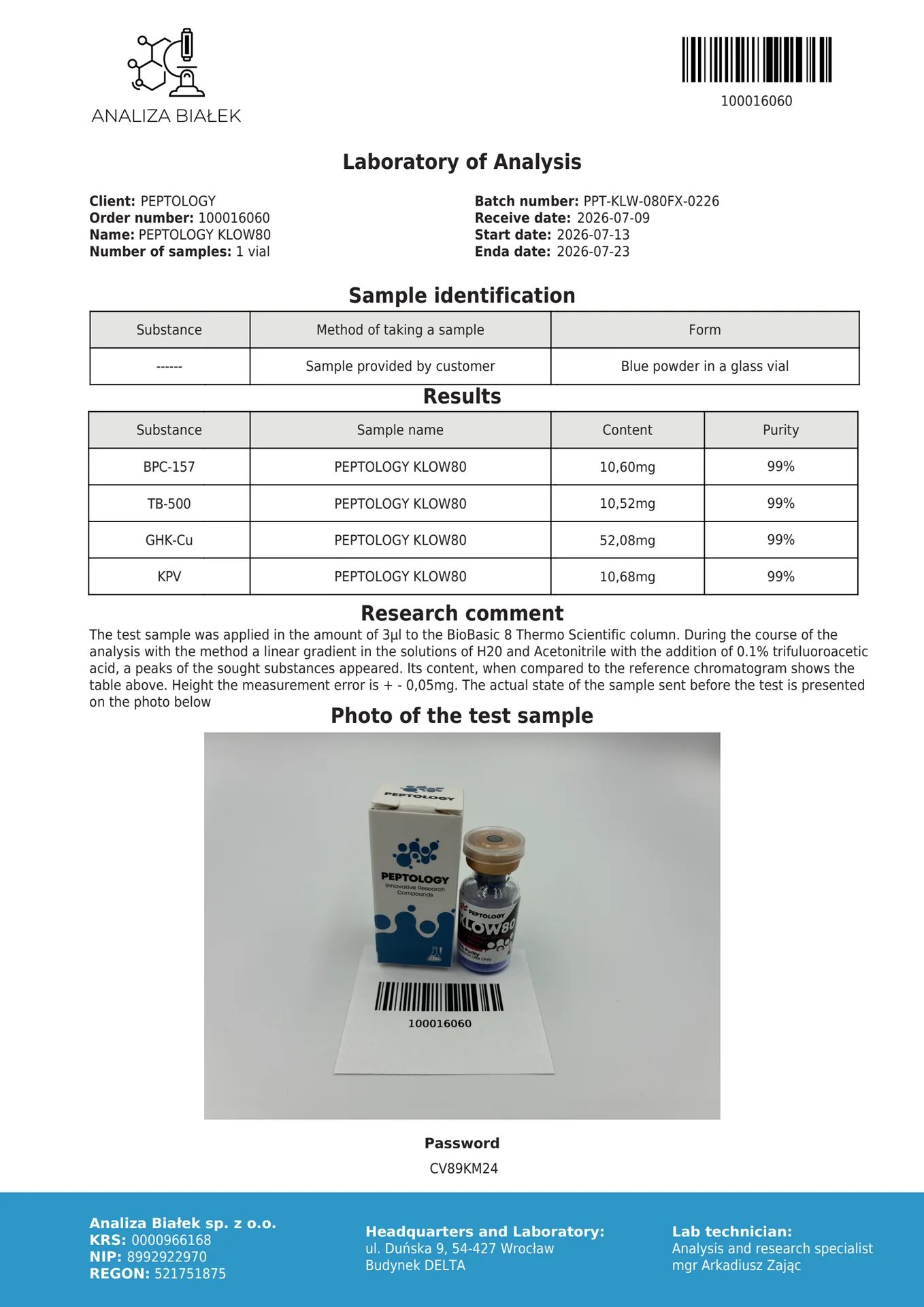
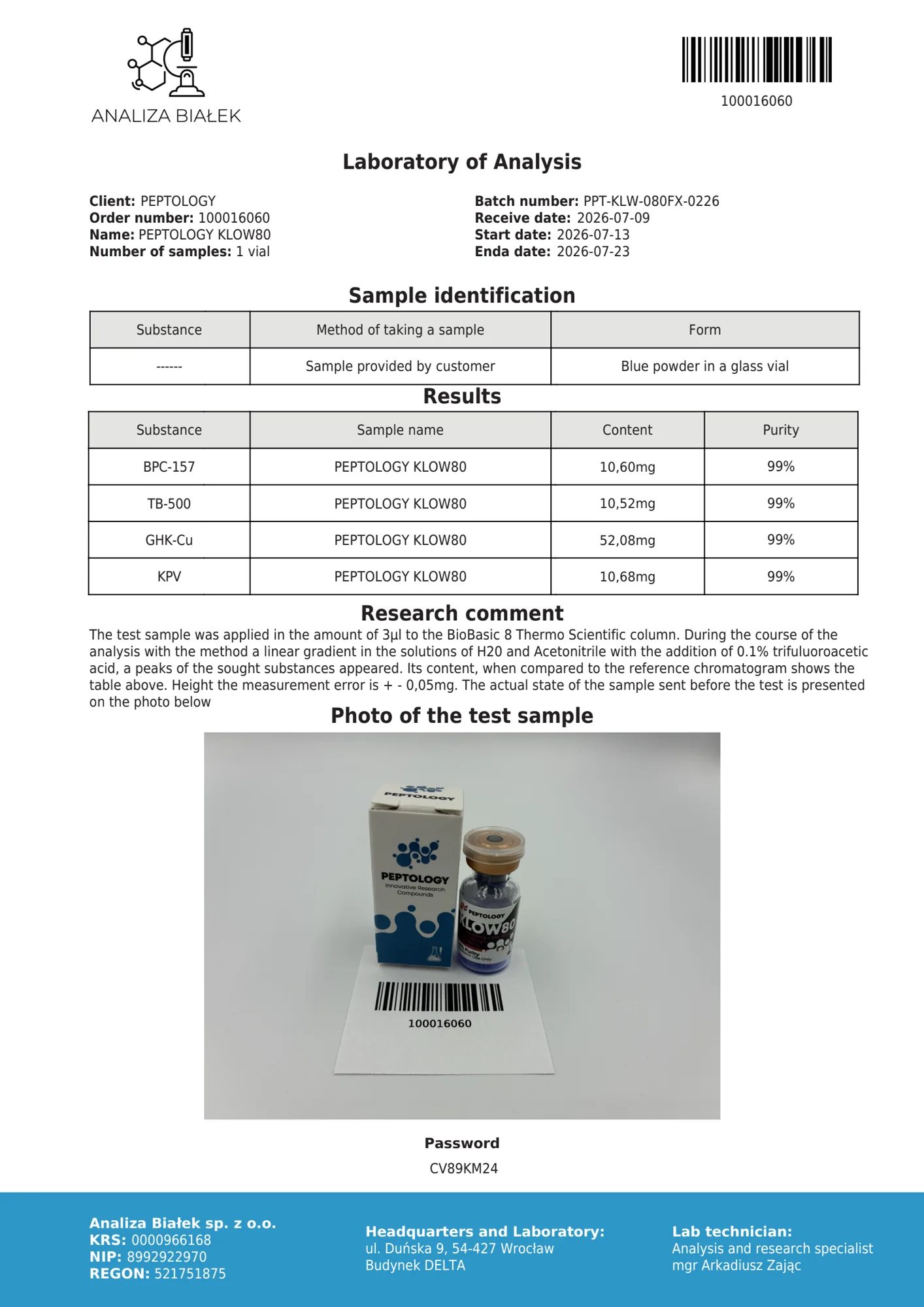
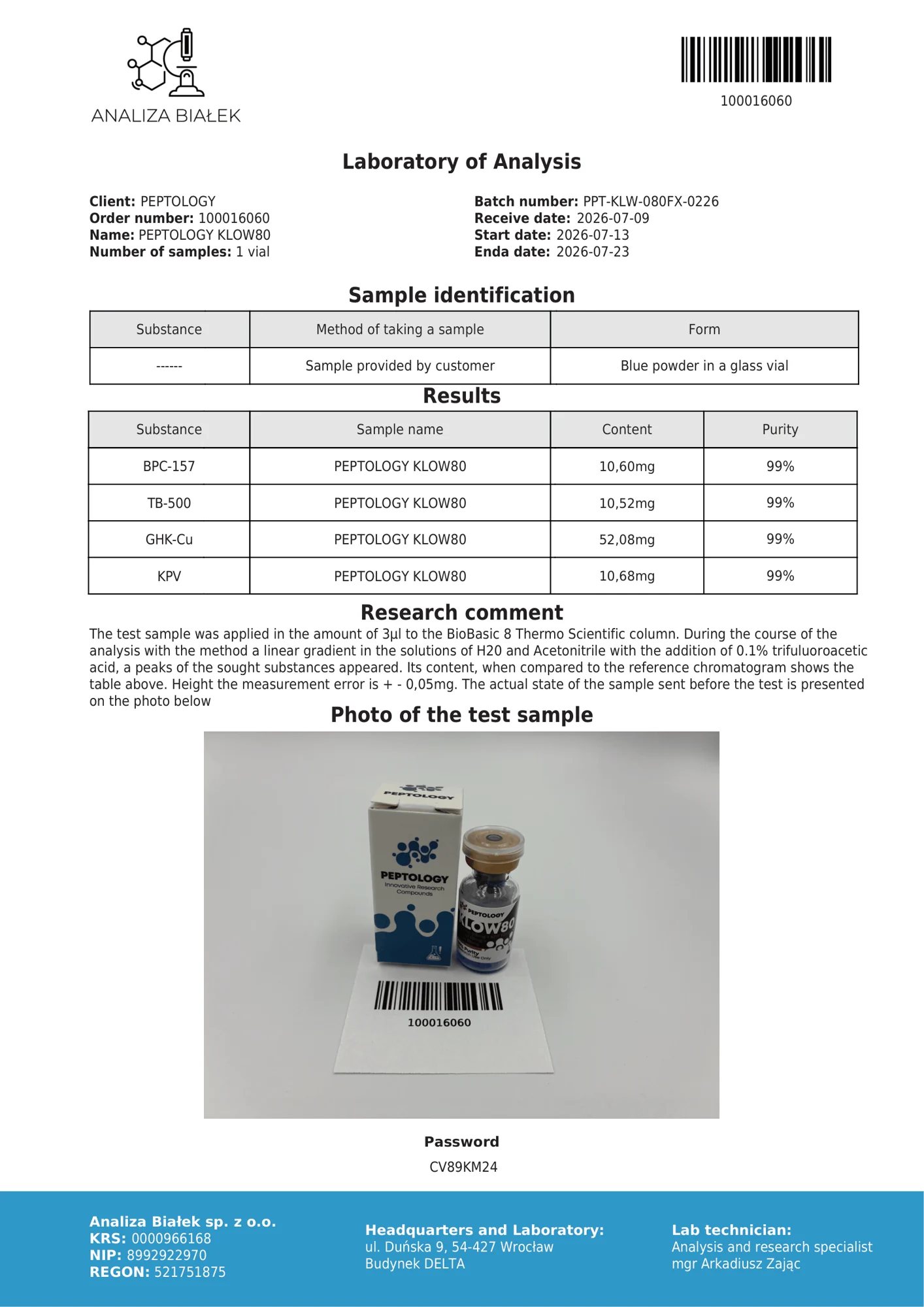
| Purity | >99% |
|---|---|
| Method | HPLC + LC/MS |
| Laboratory | Analiza Białek |
| Batch | 0226 |
What is KLOW80
KLOW80 is a combined research peptide complex in a single vial that unites four well-studied individual peptides: GHK-Cu 50 mg (copper tripeptide), KPV 10 mg (anti-inflammatory tripeptide), BPC-157 10 mg (regenerative pentadecapeptide) and TB-500 10 mg (fragment of Thymosin β-4). The formula belongs to the „GLOW“ family of regenerative complexes (GLOW50, GLOW70), but adds an extra anti-inflammatory axis via KPV.
The concept behind the combination is that the four components cover complementary pathways studied in regenerative biology: extracellular matrix and collagen remodeling (GHK-Cu), angiogenesis and tissue recovery (BPC-157), cellular migration and angiogenesis (TB-500) and modulation of inflammation via the NF-κB axis (KPV). Thus, structural regeneration and an anti-inflammatory axis are combined in one vial — an approach that makes KLOW80 a convenient tool for complex research protocols.
It is important to note that currently there is no peer-reviewed study specifically on this four-way combination. Each component has been studied individually — mostly in preclinical models — so the described synergy should be considered a mechanistic hypothesis rather than a proven effect.
In the Peptology version, KLOW80 is supplied as a lyophilized powder with purity above 99%, confirmed by independent laboratory analysis (see the product certificates). The product is intended for research purposes only and is not a medicinal product. See also other peptides for regeneration and cellular energy.
The four components and their mechanisms
Each of the four peptides in KLOW80 has been studied individually in the literature for a different aspect of tissue recovery. Below is the role of each component as described in available studies.
GHK-Cu · 50 mg
Copper tripeptide (Gly-His-Lys-Cu). Studied as a copper carrier and signaling molecule associated with synthesis of collagen, elastin and glycosaminoglycans and with matrix remodeling.
KPV · 10 mg
C‑terminal tripeptide of α-MSH (Lys-Pro-Val). Studied mainly for anti‑inflammatory action through inhibition of NF-κB, without melanocortin activity.
BPC-157 · 10 mg
Synthetic pentadecapeptide. In preclinical models it is associated with angiogenesis (VEGFR2, Akt-eNOS axis) and recovery of tendons, muscles and the gastrointestinal tract.
TB-500 · 10 mg
Active fragment of Thymosin β-4. Binds G-actin and supports cellular migration; in preclinical data it is associated with angiogenesis and tissue regeneration.
GHK-Cu — collagen and matrix
GHK-Cu is a natural copper tripeptide that in the literature is associated with increased collagen, elastin and glycosaminoglycans, as well as with extracellular matrix remodeling. It delivers copper in a biologically available form — a cofactor for collagen crosslinking — and is studied for antioxidant and anti‑inflammatory effects, including modulation of gene expression toward a more „youthful“ profile.
KPV — anti-inflammatory axis
KPV is the C-terminal tripeptide of α-MSH. It is mainly studied for suppression of pro‑inflammatory signaling via the NF-κB pathway, without activating melanocortin receptors (i.e., without effects on pigmentation or appetite). This component distinguishes KLOW80 from standard GLOW blends — it adds an independent anti‑inflammatory axis to the regenerative complex.
BPC-157 — angiogenesis and tissue regeneration
BPC-157 is a synthetic pentadecapeptide, derived from a partial sequence of a gastric protein. In preclinical models it is associated with pro‑angiogenic activity (upregulation of VEGFR2 and the Akt-eNOS axis), fibroblast migration, collagen synthesis and recovery of tendons, muscles, bones and the gastrointestinal tract.
TB-500 — cellular migration
TB-500 is a synthetic analogue of the active region of Thymosin β-4. It binds G-actin and maintains a reserve for rapid cytoskeletal reorganization, driving cellular migration. Preclinical data also link it to VEGF-mediated angiogenesis and recruitment of stem/progenitor cells to repair sites.
Why this specific combination
The logic of the „GLOW + KPV“ blends is that GHK-Cu, BPC-157 and TB-500 act on structural regeneration (matrix, angiogenesis, cellular migration), while KPV adds an independent anti‑inflammatory axis. In a research context this allows simultaneous study of structural recovery and inflammatory response — four peptides that address different but overlapping stages of tissue regeneration.
We reiterate that there is no clinical study on the four‑component formula itself. The described synergy is a mechanistic hypothesis built on preclinical data for the individual components, not a proven combined effect.
Composition of the KLOW80 vial
| Component | Amount | Research axis |
|---|---|---|
| GHK-Cu | 50 mg | Collagen / ECM remodeling |
| KPV | 10 mg | Anti‑inflammation (NF-κB) |
| BPC-157 | 10 mg | Angiogenesis / tissue regeneration |
| TB-500 | 10 mg | Cellular migration / angiogenesis |
KLOW80 vs GLOW70 and BB20
The table below compares KLOW80 with the two closest regenerative blends in the Peptology catalog. The main difference is that KLOW80 adds KPV as a separate anti‑inflammatory axis and offers the highest total content of active peptides in the group.
| KLOW80 | GLOW70 | BB20 | |
|---|---|---|---|
| BPC-157 | 10 mg | 10 mg | 10 mg |
| TB-500 | 10 mg | 10 mg | 10 mg |
| GHK-Cu | 50 mg | 50 mg | — |
| KPV | 10 mg | — | — |
| Anti‑inflammatory axis (NF-κB) | ✓ | — | — |
| Total active substances | 80 mg | 70 mg | 20 mg |
The comparison is by vial composition and is provided for scientific reference. It does not constitute a claim of comparative efficacy between products, as there are no direct comparative studies.
Properties and characteristics
- Type: combined regenerative peptide complex (4‑in‑1) in one vial
- Composition: GHK-Cu 50 mg + KPV 10 mg + BPC-157 10 mg + TB-500 10 mg
- Total active substances: 80 mg
- Form: lyophilized powder for reconstitution
- Purity: above 99%, with CoA for each batch
- Family: „GLOW“ regenerative complexes + added KPV axis
- Intended use: strictly research (in vitro / laboratory models)
Research focus
- Tissue repair — the combination is studied in the context of tendons, ligaments, muscles and skin (preclinical models of the components).
- Collagen and matrix — the contribution of GHK-Cu is associated with collagenogenesis and structural remodeling.
- Inflammatory response — the added KPV is studied for modulation of pro‑inflammatory cytokines.
- Angiogenesis — BPC-157 and TB-500 are investigated for new vessel formation and cellular migration.
The indicated directions reflect published preclinical studies on the individual components and do not represent a claim of effect for the combined product or a recommendation for use.
Research dosing protocols
Important: The information below summarizes ranges observed in the literature and among researchers for similar „GLOW“ blends. It is provided for scientific reference only and is not a recommendation for individual use, medical advice or an application guide.
- An 80 mg vial is typically reconstituted with ~3–4 mL of liquid under laboratory conditions.
- In research protocols for similar blends, approximately 2–2.5 mg/day for a period of about 4 weeks followed by a 2–4 week break is cited.
- The specific concentration is determined by the reconstitution volume and the aims of the experiment.
Safety and regulatory note
KLOW80 contains BPC-157, which in the US has been the subject of regulatory attention (FDA 503A list) due to insufficient safety data in humans. This underlines that the product is intended solely for laboratory/research purposes and not for consumption by humans or animals. When working with lyophilized peptides, standard laboratory safety practices are recommended.
Storage and reconstitution
Proper storage is important to preserve the stability of the four peptides during laboratory work.
- Before reconstitution: lyophilized, store at −20 °C, protected from light and moisture.
- After reconstitution: store refrigerated at 2–8 °C, typically up to ~30 days; do not refreeze.
- Reconstitution: add the liquid slowly down the side of the vial; swirl gently, do not shake.
Laboratory tip: for reconstitution we recommend Peptide Matrix Water™ — a stabilizing solution formulated for working with reconstituted research peptides. Alternatively you may add bacteriostatic water to your order.
Frequently asked questions about KLOW80
What is the difference between KLOW80 and GLOW70?
Both are regenerative blends based on BPC-157 + GHK-Cu + TB-500. KLOW80 adds KPV (10 mg) as a separate anti‑inflammatory axis, which is why the total amount of active substances is 80 mg.
Is there a study on the combination itself?
No. The individual components have been studied separately in preclinical models, but there is no peer‑reviewed study specifically on the four‑component formula. The synergy is a mechanistic hypothesis.
What should KLOW80 be reconstituted with?
We recommend Peptide Matrix Water™ as the stabilizing reconstitution medium; bacteriostatic water is an alternative. After reconstitution store refrigerated, do not refreeze.
How should KLOW80 be stored?
The lyophilized vial is stored frozen at −20 °C. After reconstitution — refrigerated at 2–8 °C, do not refreeze.
Is a prescription required?
No. It is offered for research purposes and does not require a prescription.
Related products
GLOW70
BPC-157 + GHK-Cu + TB-500
BB20
BPC-157 10 mg + TB-500 10 mg
KPV
Anti‑inflammatory tripeptide
Peptide Matrix Water™
Stabilizing solution for reconstitution
See the full catalog: Peptides for regeneration and cellular energy · Peptides for recovery · Blog
Research warning: KLOW80 is offered solely for scientific research purposes and in vitro applications. The product is not approved for clinical use, is not a medicine and is not intended for consumption by humans or animals. The information presented reflects published preclinical studies on the individual components (GHK-Cu, KPV, BPC-157, TB-500) and is for scientific reference only. It does not constitute medical advice or a recommendation for use. Before starting any research consult a qualified specialist and the applicable regulatory framework. Peptology is not responsible for unauthorized use of research peptides.
Laboratory reconstitution
Laboratory protocol — reconstitution, research protocols, storage
Standardized protocol valid for all research peptides in the Peptology catalogue. To calculate the solution concentration (mg/mL) for each vial, use the peptide reconstitution calculator.
60-second protocol
1. SOLVENT
2. RECONSTITUTION
Add the solvent against the vial wall, do not shake, wait 10–15 minutes.
3. CALCULATION
Calculator → concentration mg/mL
4. STORAGE
+2 °C to +8 °C, up to 60 days with Peptide Matrix Water
Quick reference
| Parameter | Value |
|---|---|
| Form | Lyophilized powder |
| Solvent | Peptide Matrix Water |
| Volume for reconstitution | 1–3 mL — maximum 3 mL (capacity of a standard vial) |
| Storage before reconstitution | Room temperature, protected from direct light (refrigeration not required) |
| After reconstitution | Up to 60 days at +2 °C to +8 °C with Peptide Matrix Water |
What you need
Precision pipette
Calibrated, 100–1000 µL — for accurately measuring the volume of solvent added to the vial.
70% alcohol swabs
Two swabs — to disinfect the peptide vial and the solvent vial.
Stabilised solvent for lyophilized peptides. Why this one.
Five rules for reconstitution
| ✅ Correct | ❌ Incorrect |
|---|---|
| Disinfect the vial caps and the work surface with 70% alcohol; wear gloves | Working without disinfection |
| Add the solvent slowly against the vial wall | Direct jet onto the powder — foaming and denaturation |
| Gentle rolling between the palms | Shaking — foam that denatures peptides |
| 10–15 minutes wait at room temperature | Mechanical stirring or heating |
| Visual check: clear, particle-free | Working with cloudy or coloured solution |
Calculating concentration
⚠️ Maximum 3 mL solvent. The standard vial does not hold a larger volume — do not exceed when reconstituting.
- Concentration (mg/mL) = mg in the vial ÷ mL solvent
- Volume per sample (mL) = amount per sample (mg) ÷ concentration (mg/mL)
- 1 mg/mL = 1 µg/µL · 1 mL = 1000 µL
👉 For any vial and solvent volume — use the calculator. It calculates the concentration (mg/mL, µg/µL) and the volume per sample (mL, µL).
Storage
BEFORE RECONSTITUTION
Room temperature, protected from direct light, in original packaging. Refrigeration not required.
AFTER RECONSTITUTION
+2 °C to +8 °C, up to 60 days with Peptide Matrix Water. Discard any remainder after this period.
FREEZING
Not recommended. Freeze/thaw cycles degrade peptide structure.
Four mistakes to avoid
1. Shaking “to dissolve faster”
Foam = denaturation. Only gentle rolling between the palms.
2. Unsuitable solvent
For peptide stability use only a sterile, specially formulated solvent — recommended Peptide Matrix Water.
3. Ignoring slight cloudiness
Not fully clear = the sample does not meet criteria for use.
4. Removing from the refrigerator “for an hour–two”
Short periods out accumulate and compromise stability.
Research status: All products from Peptology are intended for laboratory and research use only. They are not medicinal products, are not approved for human or veterinary use and do not replace medical advice. The described protocol is standard laboratory practice for working with lyophilized peptides.
Shipping information
🚚 Shipping information
-
Products in our warehouse – orders placed by 15:00 on working days are dispatched the same day, later orders on the next working day.
-
Delivery with GLS to your address in 3–5 working days.
-
Shipping costs €5 and is free from €50.
Frequently Asked Questions (FAQ)
Is KLOW80 better than GLOW70?
KLOW80 builds on GLOW70 (BPC‑157 + GHK‑Cu + TB‑500) by adding KPV 10 mg – a separate anti-inflammatory axis. A total of 80 mg of active peptides. Which is more appropriate depends on the research objective – there is no direct comparative study between the two blends.
What is KLOW80 studied for?
The complex is investigated in the context of tissue regeneration, collagen and matrix, angiogenesis and inflammation – based on preclinical data for the four individual components (GHK‑Cu, KPV, BPC‑157, TB‑500).
Is there a study on the combination itself?
No. The components have been studied individually in preclinical models, but there is a no peer-reviewed study specifically on the four-component formula. The described synergy is a mechanistic hypothesis.
Is it suitable for administration to humans?
No. KLOW80 is intended solely for:
-
laboratory and research use
-
in vitro applications
The product is not for administration to humans or animals and contains BPC‑157, which is subject to regulatory restrictions in several countries.
How is it stored and reconstituted?
Lyophilized – stored frozen at −20 °C. It is reconstituted with ~3–4 mL bacteriostatic water; afterwards it is kept refrigerated at 2–8 °C for up to ~30 days, without refreezing.
Is a prescription required?
No. Supplied for research purposes, without the need for a prescription.
Where can I buy KLOW80 in Europe and what does it cost?
You can buy KLOW80 in Europe online from Peptology, from 169,00 €. Delivery with GLS in 3–5 working days. Shipping is free from 50,00 €. Payment by card. Purity 99%+, with an HPLC report for every batch.
Laboratory Analysis
KLOW80 - 80 mg - Batch - 0226 - Purity