🇪🇺 Fast delivery (3–5 working days) with GLS ✅ Card or bank transfer 📦 Free shipping from €50

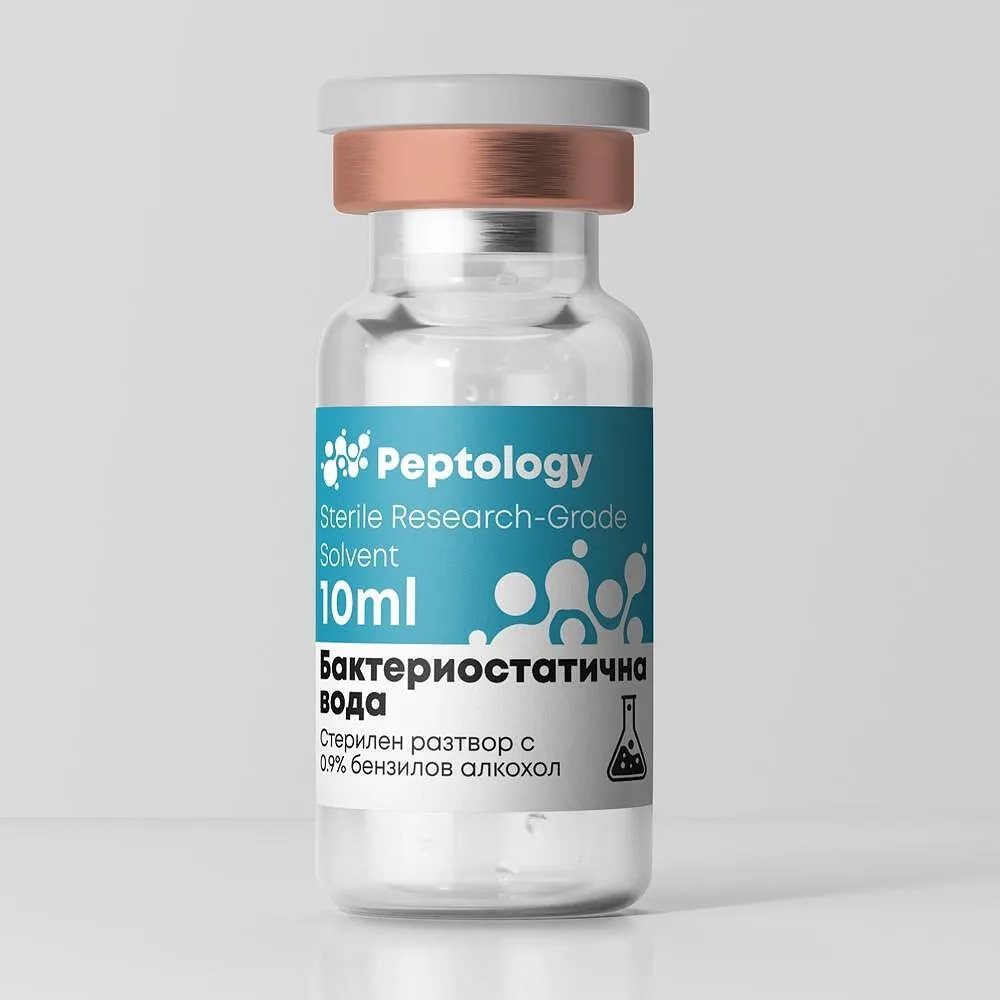
Bacteriostatic water
Bacteriostatic water - 10ml.
Peptology Ltd. · Solutions for peptides
Bacteriostatic Water 10 mL is a sterile, non-pyrogenic solution with 0.9 % benzyl alcohol (9 mg/mL), intended for multiple dilutions and reconstitution of lyophilised peptides and other research substances in the laboratory. Benzyl alcohol acts as a powerful preservative that inhibits bacterial growth and provides sterility up to 28 days after opening.
📦 The product is in our EU warehouse – delivery within 3–5 working days.
8,00 € · In stock
For research use only / Not a medicine
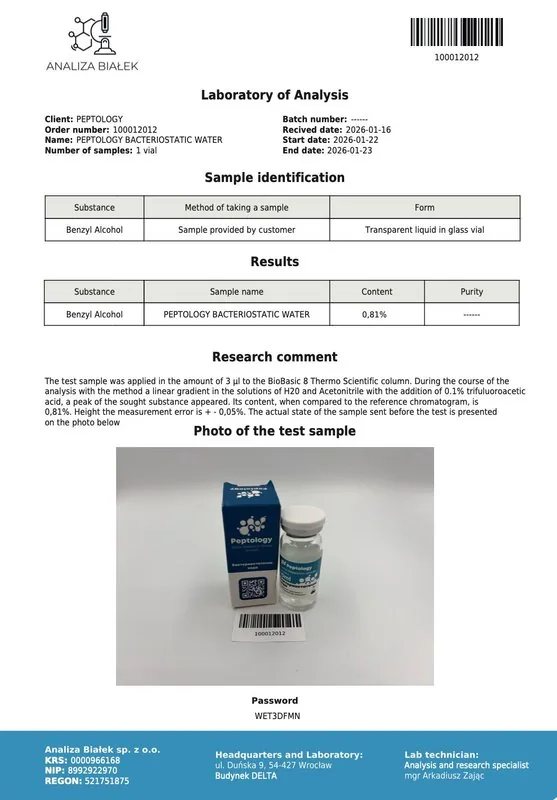
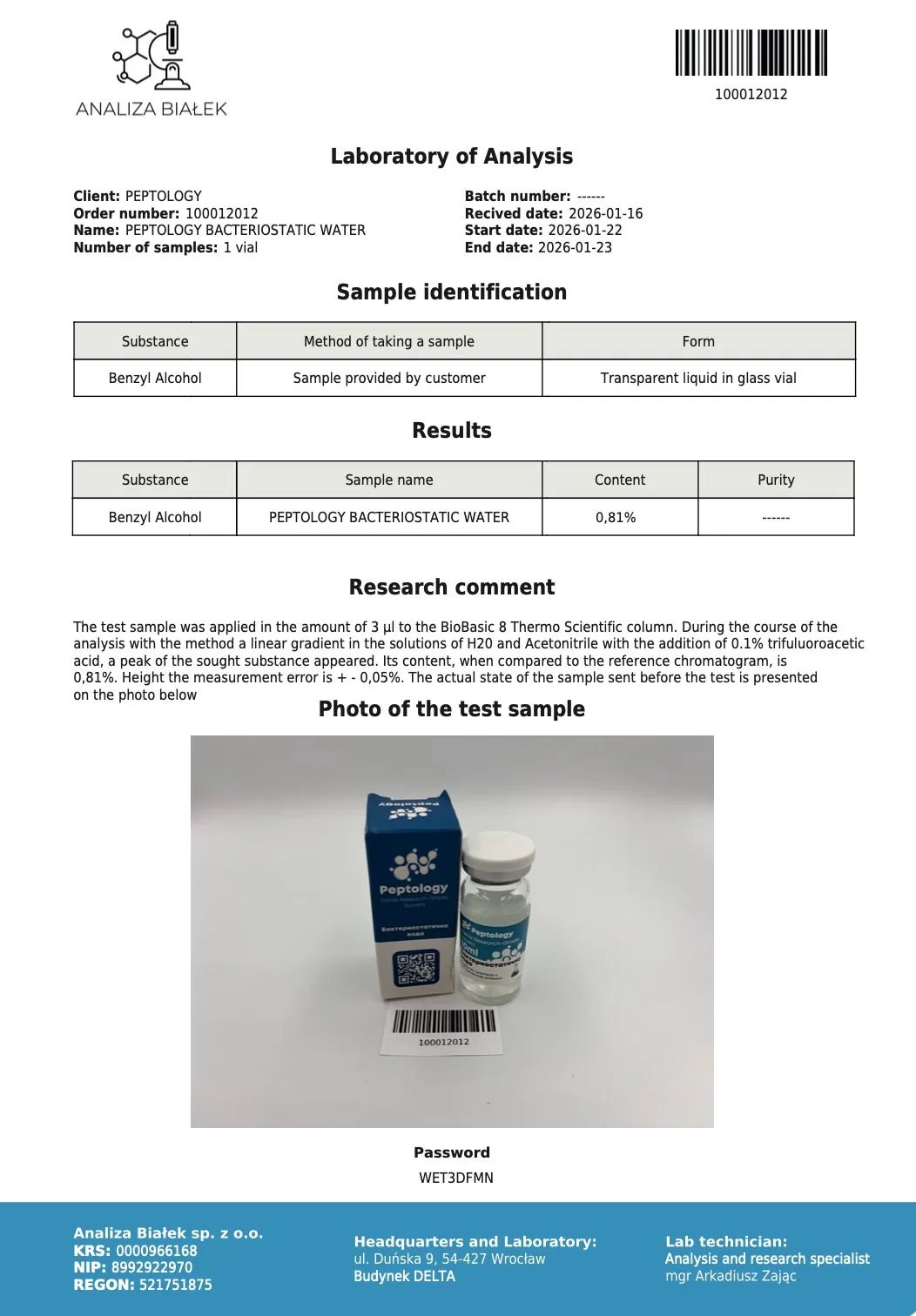
| Purity | >99% |
|---|---|
| Method | HPLC + LC/MS |
| Laboratory | Analiza Białek |
What is bacteriostatic water (Bacteriostatic Water) 10 ml?
Bacteriostatic water is a sterile, non-pyrogenic (pyrogen-free) solution containing 0.9% benzyl alcohol (9 mg/ml), intended for the reconstitution and repeated dilution of peptides, hormones and other injectable research substances. Benzyl alcohol acts as a preservative — it inhibits bacterial growth and allows the solution to be drawn repeatedly from the same vial for up to 28 days after opening.
Bacteriostatic water belongs to the category solutions for peptides — the basic auxiliary solutions necessary for the correct preparation of peptides. It is the most commonly used solvent for multi-dose vials, though for the longest stability of the reconstituted peptide we recommend Peptide Matrix Water™.
Important: The product is a diluent/solvent — it is not intended for standalone use. It is a research material, not a medicinal product.
In the version offered by Peptology, bacteriostatic water is available in a 10 ml package of confirmed quality and sterility (laboratory analysis for every batch). The product is intended exclusively for scientific research and laboratory applications.
Variant and composition: 10 ml (0.9% benzyl alcohol)
Bacteriostatic water is offered in a single volume — a 10 ml vial. This is a multi-dose solution that allows the reconstitution and dilution of many vials of research peptides.
VOLUME
10 ml of sterile, non-pyrogenic solution in a multi-dose vial.
PRESERVATIVE
0.9% benzyl alcohol (9 mg/ml) — inhibits bacterial growth.
pH and SHELF LIFE
pH ~5.7 (range 4.5–7.0); up to 28 days after opening.
How bacteriostatic water works
The key is the small addition of benzyl alcohol, which turns ordinary water for injection into a multi-dose solution. Below are the three most important functions.
PRESERVATION
Benzyl alcohol inhibits bacterial growth, maintaining sterility through repeated withdrawal from the vial.
RECONSTITUTION
Dissolves lyophilized peptides and hormones into a clear, homogeneous working solution.
MULTI-DOSE USE
Allows repeated drawing from a single vial over a period of up to 28 days — convenient for series.
Why it is the standard solvent
Bacteriostatic water is the most common laboratory solvent for peptides — it combines simplicity and multi-dose preservation. For protocols requiring longer stability of the reconstituted peptide, it is worth considering a premium stabilized alternative: Peptide Matrix Water™, which extends the solution's lifespan to as much as 60 days. Benzyl alcohol also has mild local anesthetic properties — but it does not replace lidocaine and is not indicated for pain relief.
Technical specification
The most important parameters of the solution relevant when planning reconstitution:
- Composition: water for injection + 0.9% benzyl alcohol (9 mg/ml) as a preservative
- Characteristics: sterile, non-pyrogenic (pyrogen-free), clear, colorless
- pH: ~5.7 (range 4.5–7.0)
- Volume: 10 ml (multi-dose vial)
- Shelf life after opening: usually up to 28 days (CDC/FDA standard for multi-dose vials)
- Function: diluent/solvent — not for standalone use
Comparison: Bacteriostatic water vs Peptide Matrix Water™ vs Acetic acid
In the category solutions for peptides there are three main solvents. Each works best in a different scenario — from standard multi-dose reconstitution to poorly soluble peptides.
| Bacteriostatic water (this page) | Peptide Matrix Water™ ★ RECOMMENDED BY PEPTOLOGY |
Acetic acid 0.6% | |
|---|---|---|---|
| Active component | 0.9% benzyl alcohol | Premium stabilizing formula | 0.6% acetic acid |
| Best for | Standard multi-dose reconstitution | Max stability and longer storage | Poorly soluble peptides |
| Preservation (repeated draws) | Yes (up to 28 days) | Yes (up to 60 days) | Limited |
| Stability after reconstitution | Standard | Extended (premium) | Variable |
| Volume | 10 ml | 10 ml | 10 ml |
Bacteriostatic water is the universal standard for multi-dose reconstitution, Peptide Matrix Water™ is the premium choice for maximum stability, and acetic acid 0.6% helps with poorly soluble peptides. This comparison is indicative in nature.
Our recommendation: for most research protocols we recommend Peptide Matrix Water™. It is our preferred solvent — the stabilized formula extends the lifespan of the reconstituted peptide to as much as 60 days (more than twice as long as bacteriostatic water), better protecting the purity and structure of the sample. Bacteriostatic water remains an excellent, economical standard — but if you care about maximum durability and solution quality, choose Peptide Matrix Water™.
Application — with which peptides
Correct reconstitution using the right solvent affects the stability, purity and safety of research solutions. Bacteriostatic water is often used with peptides such as:
- Regenerative peptides: BPC-157, TB-500, GHK-Cu
- Growth-hormone-related peptides (GH): GHRP-2, CJC-1295, Ipamorelin
- GLP-1 agonists: Semaglutide, Tirzepatide
Some substances may be incompatible with benzyl alcohol — you should follow the peptide manufacturer's recommendations. For maximum stability of the reconstituted solution, consider Peptide Matrix Water™.
Product profile at a glance
- Sterile, non-pyrogenic solution with 0.9% benzyl alcohol
- Multi-dose vial — repeated drawing from a single vial for up to 28 days
- Standard solvent for the reconstitution of research peptides and hormones
- Premium alternative for longer stability: Peptide Matrix Water™ (up to 60 days)
- Another solution in the category: acetic acid 0.6% for poorly soluble peptides
- Every batch with laboratory analysis confirming quality and sterility
How to use — peptide reconstitution
Standard laboratory practice for dissolving lyophilized peptides with bacteriostatic water:
- Disinfect the vial caps and the work surface with 70% alcohol; wear gloves
- Measure the appropriate volume of bacteriostatic water with a calibrated precision pipette (100–1000 µL)
- Add the solvent slowly down the vial wall — do not direct the stream onto the powder
- Wait 10–15 min, gently rolling the vial between your palms. Do not shake (foam → denaturation)
- Check visually: the solution should be clear, without particles
- Calculate the concentration (mg/mL) and the volumes in the peptide calculator (max. 3 mL per standard peptide vial)
More on solvent selection in the article Bacteriostatic water vs acetic acid vs matrix water.
Precautions and safety
Bacteriostatic water is a research material. Below are key technical notes regarding work with the solution.
Contraindications
- Do not use in newborns (risk of benzyl alcohol toxicity)
- Not suitable for epidural or intrathecal administration
Technical note
- Do not administer intravenously as monotherapy — solutions must be isotonic (risk of hemolysis)
- Possible incompatibility with some substances
Quality control
- Visual inspection before use
- Do not use if the solution is cloudy, contains particles or the stopper is damaged
Benzyl alcohol has mild local anesthetic properties, but it does not replace lidocaine and is not indicated for pain relief. This information is technical in nature and does not constitute an instruction for medical use.
Storage and shelf life
To preserve the sterility and quality of the solution:
- Temperature: 20–25 °C (controlled room temperature)
- Freezing: do not freeze
- After first opening: usually use within 28 days, unless the manufacturer has specified a different period (CDC/FDA standard for multi-dose vials)
- Sterility: discard if loss of sterility is suspected or the solution is cloudy
- Storage: in the original packaging, protect from direct light
Tip: If you need a longer stability period for the reconstituted peptide (up to 60 days), consider Peptide Matrix Water™ as a premium alternative.
Frequently asked questions
What is bacteriostatic water?
It is a sterile, non-pyrogenic solution with 0.9% benzyl alcohol, used to dissolve and dilute lyophilized peptides and research hormones. Benzyl alcohol acts as a preservative, enabling repeated draws from the vial.
How long can it be used after opening?
Usually up to 28 days from first opening (CDC/FDA standard for multi-dose vials), unless the manufacturer has specified otherwise. Store at 20–25 °C, do not freeze.
How does it differ from Peptide Matrix Water™ and acetic acid?
Bacteriostatic water is the standard for multi-dose reconstitution (up to 28 days). Peptide Matrix Water™ is the premium choice for maximum stability (up to 60 days), and acetic acid 0.6% helps with poorly soluble peptides.
With which peptides is bacteriostatic water used?
It is a universal solvent for most research peptides — including BPC-157, TB-500, Ipamorelin or GLP-1 agonists. Possible incompatibility with benzyl alcohol should be taken into account.
Where to buy bacteriostatic water?
Peptology offers bacteriostatic water 10 ml as a research material of confirmed quality with laboratory analysis for every batch. Fast shipping and discreet packaging. See also the other solutions for peptides.
Related products in the Peptology catalog
Bacteriostatic water is the first step in preparing peptides. Complete your kit with the other laboratory solutions or the peptides you want to reconstitute:
Peptide Matrix Water™
Premium stabilizing solution — up to 60 days
Acetic acid 0.6%
For poorly soluble peptides
TB-500
Regenerative peptide
Ipamorelin
Growth hormone secretagogue
GHK-Cu
Copper peptide — skin and regeneration
Semaglutide
GLP-1 agonist
See the full catalog: Solutions for peptides · Recovery and anabolic peptides · All peptides · Blog on peptide research
Research warning: Bacteriostatic water is offered exclusively for scientific research and laboratory purposes as a diluent/solvent. It is not a medicinal product, is not approved for use in humans or animals, and does not replace medical advice. The product is not intended for standalone use. All information is provided for scientific, informational and technical purposes.
Laboratory reconstitution
Laboratory protocol — reconstitution, research protocols, storage
Standardized protocol applicable to all research peptides in the Peptology catalogue. To calculate the solution concentration (mg/mL) for each vial, use the peptide reconstitution calculator.
60-second protocol
1. SOLVENT
2. RECONSTITUTION
Add the solvent down the side of the vial, without shaking, wait 10–15 min.
3. CALCULATION
Calculator → concentration mg/mL
4. STORAGE
+2 °C to +8 °C, up to 60 days with Peptide Matrix Water
Quick reference
| Parameter | Value |
|---|---|
| Form | Sterile solution (liquid solvent) |
| Solvent | Peptide Matrix Water |
| Reconstitution volume | 1–3 mL — maximum 3 mL (capacity of the standard vial) |
| Storage before reconstitution | Room temperature, protected from direct light (refrigeration not required) |
| After reconstitution | Up to 60 days at +2 °C to +8 °C with Peptide Matrix Water |
What you need
Precision pipette
Calibrated, 100–1000 µL — for accurately measuring the volume of solvent added to the vial.
70% alcohol swabs
Two swabs — to disinfect the peptide vial and the solvent vial.
Stabilized solvent for lyophilized peptides. Why this one.
Five rules for reconstitution
| ✅ Correct | ❌ Mistake |
|---|---|
| Disinfect the vial caps and the work surface with 70% alcohol; wear gloves | Working without disinfection |
| Add the solvent slowly along the vial wall | Direct jet onto the powder — foaming and denaturation |
| Gentle rolling between the palms | Shaking — foam, which denatures peptides |
| 10–15 minutes waiting at room temperature | Mechanical mixing or heating |
| Visual check: clear, particle-free | Working with a cloudy or discolored solution |
Calculating concentration
⚠️ Maximum 3 mL solvent. The standard vial does not accommodate larger volumes — do not exceed during reconstitution.
- Concentration (mg/mL) = mg in the vial ÷ mL of solvent
- Volume per sample (mL) = amount per sample (mg) ÷ concentration (mg/mL)
- 1 mg/mL = 1 µg/µL · 1 mL = 1000 µL
👉 For any vial and solvent volume — use the calculator. It calculates the concentration (mg/mL, µg/µL) and the volume per sample (mL, µL).
Storage
BEFORE RECONSTITUTION
Room temperature, protected from direct light, in original packaging. Refrigerator not required.
AFTER RECONSTITUTION
+2 °C to +8 °C, up to 60 days with Peptide Matrix Water. Discard any remainder after this period.
FREEZING
Not recommended. Freeze/thaw cycles degrade peptide structure.
Four mistakes to avoid
1. Shaking "to dissolve faster"
Foam = denaturation. Only gentle rolling between the palms.
2. Inappropriate solvent
For peptide stability use only sterile, specially formulated solvent — recommended Peptide Matrix Water.
3. Ignoring slight turbidity
Not fully clear = the sample does not meet the criteria for use.
4. Taking it out of the refrigerator "for an hour–two"
Short exposures add up and compromise stability.
Research status: All Peptology products are intended for laboratory and research use only. They are not medicinal products, not approved for human or veterinary use and do not substitute medical advice. The described protocol is standard laboratory practice for working with lyophilized peptides.
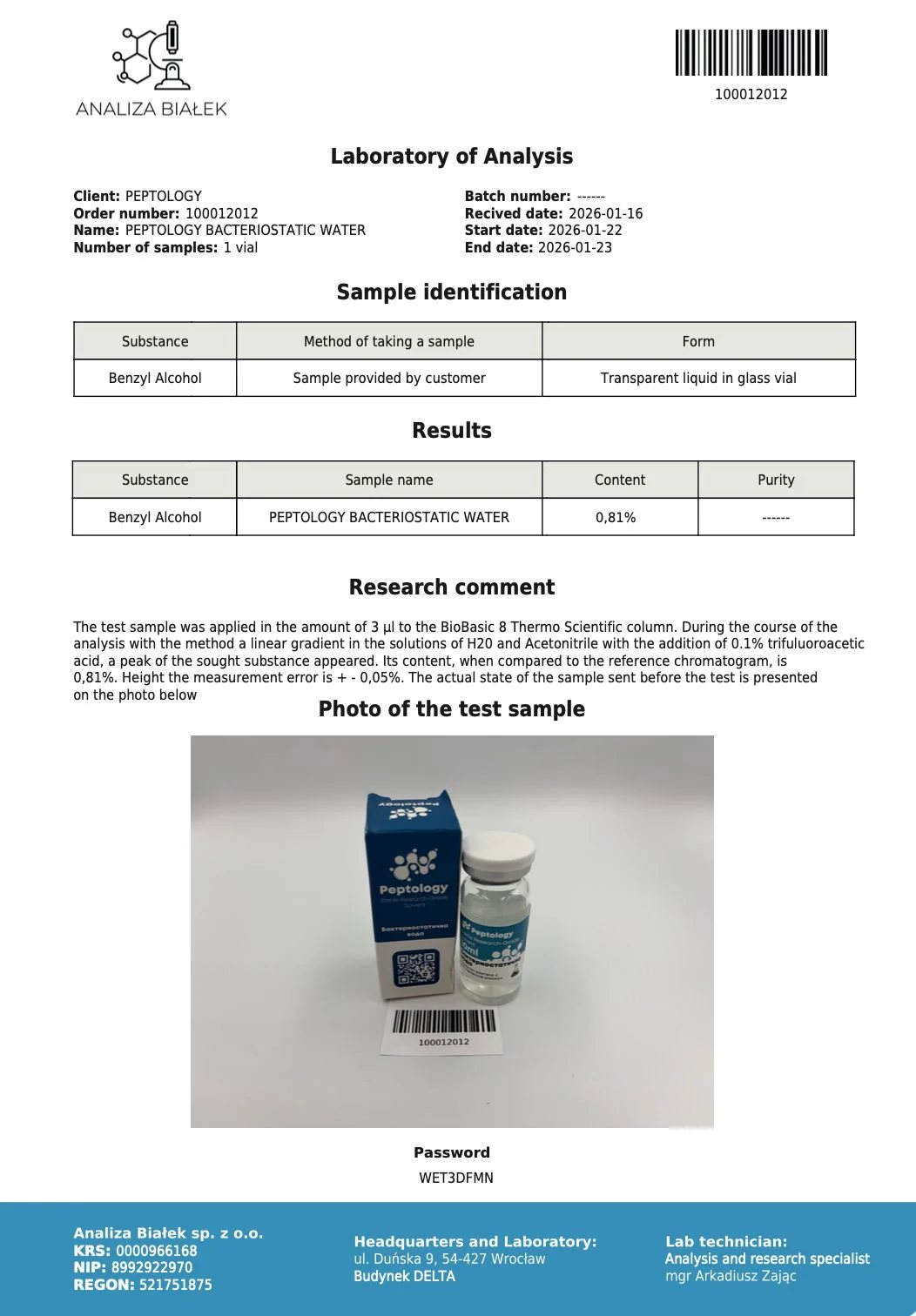
Laboratory Analysis
Shipping information
🚚 Shipping information
-
Products in our warehouse – orders placed by 15:00 on working days are dispatched the same day, later orders on the next working day.
-
Delivery with GLS to your address in 3–5 working days.
-
Shipping costs €5 and is free from €50.
Frequently Asked Questions (FAQ)
What is bacteriostatic water?
Bacteriostatic water is a sterile, non-pyrogenic aqueous solution containing 0.9% (9 mg/mL) benzyl alcohol as a preservative. Benzyl alcohol inhibits the growth of bacteria, which allows repeated withdrawal from the same vial. In laboratory conditions it is the most commonly used medium for the reconstitution (dissolving) of lyophilized research peptides.
How does it differ from sterile water for injection (SWFI)?
Sterile water for injection (SWFI) contains no preservative and is intended for single use – after the stopper is pierced, the risk of microbiological contamination rises. Bacteriostatic water contains benzyl alcohol, which inhibits the growth of bacteria and allows repeated withdrawal from the same vial for about 28 days.
What is bacteriostatic water used for?
It is used for the reconstitution of lyophilized (freeze-dried) research peptides and compounds – the solvent converts the powder into a working solution for laboratory purposes. It is the classic „gold standard” for dissolving stable peptides.
How long is the solution stable after opening?
After the stopper is first pierced, bacteriostatic water inhibits the growth of bacteria for about 28 days when stored in the refrigerator (2–8 °C). For comparison, Peptide Matrix Water™ extends the lifespan of the reconstituted solution to ~60 days.
How should bacteriostatic water be stored?
Before opening, it should be stored at room temperature (20–25 °C), protected from direct light. Do not freeze. After opening and reconstitution – in the refrigerator, at a temperature of 2–8 °C, without refreezing. Reconstituted peptide solutions are also stored in the refrigerator.
How do bacteriostatic water, acetic acid and Peptide Matrix Water differ?
All three are laboratory solvents with different profiles: bacteriostatic water is the standard choice for stable peptides; acetic acid 0.6% is intended for poorly soluble, hydrophobic or strongly basic peptides; and Peptide Matrix Water™ is a premium, multi-component formula with active pH stabilization and protection against aggregation (up to 60 days). You will find a detailed comparison in the article Bacteriostatic water vs acetic acid vs matrix water.
How is it used for the reconstitution of peptides?
The solvent is added slowly down the wall of the vial with the peptide, without vigorous shaking; the vial is gently swirled until fully dissolved. For a precise calculation of volume and concentration, use the peptide calculator. A standard vial usually holds a maximum of ~3 mL of solvent.
Is a prescription required, and who is it for?
No. Bacteriostatic water is offered for laboratory and research purposes, without the need for a prescription. The product is not a medicine and is not intended for administration to humans or animals. See also the other peptide solutions.
Where can I buy Bacteriostatic water in Europe and what does it cost?
You can buy Bacteriostatic water in Europe online from Peptology, from 8,00 €. Delivery with GLS in 3–5 working days. Shipping is free from 50,00 €. Payment by card.