🇪🇺 Fast delivery (3–5 working days) with GLS ✅ Card or bank transfer 📦 Free shipping from €50


AICAR
AICAR 50 mg – AMPK activator for metabolic and mitochondrial research
Peptology Ltd. · Peptides for energy and regeneration
AICAR 50 mg – a classic AMPK activator and exercise mimetic, used for models of metabolic adaptation, mitochondrial biogenesis and insulin signaling. Reconstitution: 1 mL BAC → 50 mg/mL; easy calculation of working volumes.
📦 The product is in our EU warehouse – delivery within 3–5 working days.
40,00 € · Out of stock
For research use only / Not a medicine
What is AICAR (50 mg)?
AICAR (5-aminoimidazole-4-carboxamide ribonucleoside; AICAr) is a classic AMPK activator — the cellular energy sensor. In the research literature it is called an "exercise mimetic", because in models it mimics the effect of endurance training on skeletal muscle and oxidative metabolism. After entering the cell, it is phosphorylated to ZMP — an AMP mimetic, which activates AMPK.
A clarification is worthwhile: AICAR is not a peptide, but a small molecule (a ribonucleoside). In the Peptology catalog it is assigned to the category peptides for skin, sleep and libido because of its application area; functionally, however, it belongs to the group of metabolic and mitochondrial compounds — alongside the mitochondrial peptide MOTS-c and the NNMT inhibitor 5-Amino-1MQ.
It is a research compound — it is not a medicinal product and holds no authorization for clinical use. It has no approved indications (no phase III); AICAR is used primarily as a research tool and is on the list of substances banned by anti-doping organizations (WADA). The product offered by Peptology is a research-grade reagent.
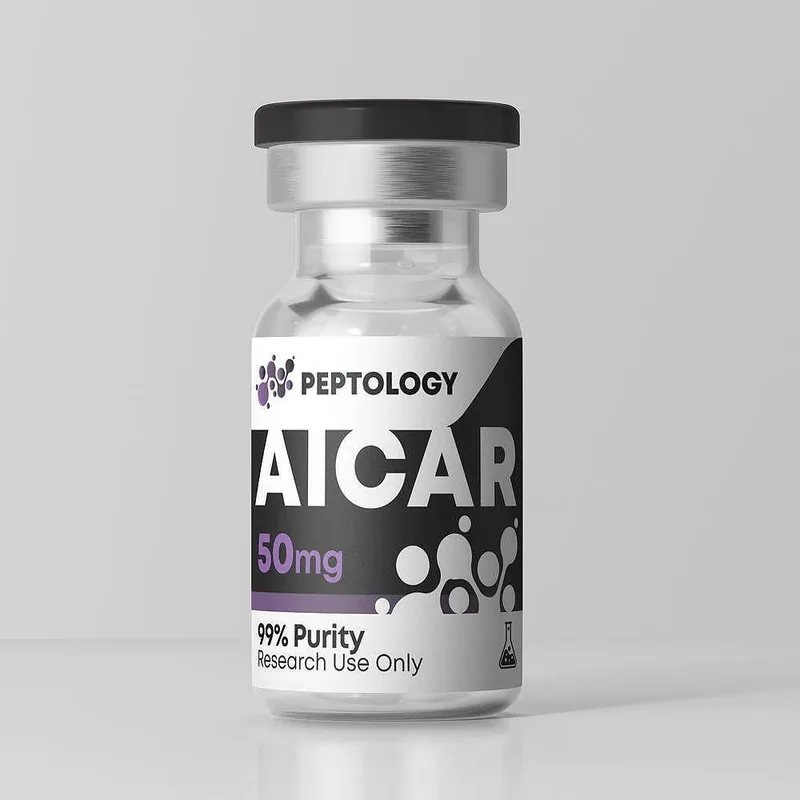
In the version offered by Peptology, AICAR is available in a 50 mg vial as a lyophilized powder with purity ≥ 99%, confirmed by independent laboratory analysis (CoA for every batch). The product is intended exclusively for scientific research and in vitro applications.
Variant: AICAR 50 mg
This page concerns one dosage variant — AICAR 50 mg. Each vial contains 50 mg of the lyophilized compound. A typical working reconstitution is 1 mL → 50 mg/mL; this is a large, "cycle-sized" amount that makes it easier to measure working doses in a metabolic protocol.
VIAL · 50 MG
AICAR (AMPK activator)
50 mg of lyophilized compound, purity ≥ 99% confirmed by CoA for every batch.
REFERENCE CONCENTRATION
50 mg/mL (at 1 mL)
Large dose — calculate volumes precisely in the calculator.
AICAR is offered in the 50 mg variant. Related metabolic compounds are MOTS-c (mitochondrial peptide, also AMPK) and 5-Amino-1MQ (NNMT/NAD⁺); energy biology is also addressed by the coenzyme NAD+.
How AICAR works — the AMPK mechanism
In the research literature, AICAR is described as a direct activator of AMPK via an AMP mimetic. Below are the three most frequently studied elements.
ZMP → AMPK
Inside the cell it is phosphorylated to ZMP (an AMP mimetic), which activates AMPK — the energy sensor.
"TRAINING" PROGRAM
Activation of transcriptional programs (PGC-1α / oxidative genes) similar to endurance training.
OXIDATIVE METABOLISM
↑ fatty acid oxidation, ↑ mitochondrial function, autophagic/catabolic processes.
Why an "exercise mimetic"
In rodents, AICAR increased endurance and the oxidative capacity of muscles even without training — through activation of AMPK and transcriptional programs similar to those triggered by endurance exercise. Hence the term "exercise mimetic". This is an observation from research models, not a promise of an effect of the research-grade product.
AICAR does have significant pharmacological limitations, however: low oral bioavailability and a short plasma half-life, which is why research looks for carriers/schedules with controlled exposure. The AMPK mechanism links it with the peptide MOTS-c. This data comes from studies and does not constitute a claim about the effect of the product.
Pharmacokinetics and pharmacodynamics (research framework)
AICAR is a small molecule with fast AMPK activation but short action. The most important research characteristics:
- Class: small molecule (AICAr ribonucleoside), AMPK activator — not a peptide
- Targets: intracellular ZMP (AMP mimetic) → AMPK → PGC-1α / oxidative genes
- Oral bioavailability: low — parenteral forms required in the clinic
- Half-life: short in plasma — limits systemic action
- Status: no phase III / approved indications; substance banned in sport (WADA)
- Route of administration in protocols: per the research protocol (after reconstitution of the lyophilizate)
Comparison: AICAR vs MOTS-c vs 5-Amino-1MQ
Within the same category, it is worth comparing AICAR with two other metabolic compounds — the mitochondrial peptide MOTS-c and the NNMT inhibitor 5-Amino-1MQ. AICAR and MOTS-c share the AMPK pathway, but differ in structure and route.
| AICAR (this page) | MOTS-c | 5-Amino-1MQ | |
|---|---|---|---|
| Compound type | Small molecule (ribonucleoside) | Mitochondrial peptide (16 aa) | Small molecule (NNMT inhibitor) |
| Main mechanism | Direct AMPK activation (ZMP) | AMPK activation (its own pathway) | NNMT inhibition → ↑ NAD⁺ |
| Main research area | Endurance, mitochondria ("exercise mimetic") | Metabolism, endurance, aging | Fat metabolism, NAD⁺ |
| Dose (this version) | 50 mg | 10 / 50 mg | 50 mg |
| Best for research on | Aerobic adaptation / mitochondrial biogenesis | Mitochondrial metabolic control | NAD⁺ + fat metabolism |
AICAR activates AMPK directly (via ZMP), MOTS-c through its own mitochondrial pathway, and 5-Amino-1MQ raises NAD⁺ through NNMT inhibition. The comparison is indicative in nature and does not constitute a recommendation for use.
Areas of research on AICAR
AICAR is an established research tool for AMPK activation. Below are the most frequently explored directions — with the caveat that there are no approved clinical indications.
Aerobic adaptation and mitochondria
The main direction of research on AICAR concerns mitochondrial biogenesis and the oxidative phenotype of muscle — models of "exercise mimicry" through activation of AMPK and PGC-1α.
Metabolism and insulin signaling
AICAR is studied in the context of fat metabolism, autophagy and insulin sensitivity (AMPK-dependent pathways), as well as in vascular/endothelial models (relaxation, anti-inflammatory action in vitro/in vivo).
Limitations and status
There are no approved phase III indications; the short t½ and low oral bioavailability limit systemic use. AICAR is also of interest to anti-doping organizations (banned substance). This is a research tool, not a confirmed therapeutic application.
Note: The information is presented for scientific and informational purposes and is based mainly on the preclinical literature. It does not constitute medical advice, a recommendation for use or a claim about the effect of the research-grade product offered by Peptology.
AICAR profile at a glance
- Classic AMPK activator (small molecule) — an established research tool, not a peptide
- "Exercise mimetic" — mimics the adaptations of endurance training (models)
- Oxidative programs (PGC-1α) — mitochondrial biogenesis, fat oxidation
- Limitations: low oral bioavailability, short plasma t½
- Related compounds: MOTS-c (AMPK), 5-Amino-1MQ (NAD⁺), NAD+
- Every batch with a CoA and purity ≥ 99%
All information provided refers to the research literature on AICAR and should not be interpreted as a promise of effect, an instruction for use or a claim about the effect of the research-grade product offered by Peptology. Substance banned in sport (WADA).
Research dosing protocols
Important: The information below describes schedules used in research on AICAR. It is provided for scientific and informational purposes and does not constitute a recommendation for individual use, medical advice or administration instructions. The research-grade AICAR offered by Peptology is not a registered drug and is a substance banned in sport.
In research protocols, AICAR is used after reconstitution of the lyophilizate:
- Working reconstitution: 1 mL → 50 mg/mL; calculate precise volumes in the peptide calculator
- Due to the short t½ and low oral bioavailability, models often use parenteral administration or controlled exposure
- Schedules are usually spread over time, in the context of metabolic / training protocols
- The large 50 mg vial allows many smaller portions or longer series (max. 3 mL of solvent)
In combined designs, AICAR is sometimes paired with other metabolic/mitochondrial compounds, such as MOTS-c, 5-Amino-1MQ or the coenzyme NAD+. These schedules come from the research literature and do not constitute a recommendation for self-administration.
Side effects and safety
The safety profile of AICAR is dominated by pharmacological limitations and effects at high exposure. The data concern research on the molecule.
Pharmacological limitations
- Low oral bioavailability
- Short plasma half-life
At high exposure
- Hypoglycemia
- Bradycardia (reported in clinical settings)
To consider
- ROS-dependent apoptosis at high concentrations (in vitro)
- Substance banned in sport (WADA)
- No established safety in humans
At high systemic exposure, hypoglycemia and bradycardia were reported, and in cells at high concentrations — ROS-dependent apoptosis. AICAR is a substance banned in sport. This information is scientific in nature and does not constitute an instruction for use.
Storage and reconstitution
AICAR is supplied as a lyophilized (freeze-dried) powder in a vial. In lyophilized form it is stable at room temperature, protected from light and moisture — refrigeration before reconstitution is not mandatory. After reconstitution, stability depends on the solvent used, with Peptide Matrix Water™ significantly extending the solution's lifespan.
- Before reconstitution: room temperature, in the original packaging, protected from light and moisture. A refrigerator is not mandatory.
- After reconstitution with Peptide Matrix Water™: stability in the refrigerator +2 °C to +8 °C for up to 60 days under appropriate laboratory conditions — the stabilizing formula extends the solution's lifespan relative to standard solvents.
- After reconstitution with bacteriostatic or sterile water: stability in the refrigerator +2 °C to +8 °C for up to 28 days under appropriate conditions. Do not refreeze the reconstituted solution.
- Reconstitution: in a laboratory setting, Peptide Matrix Water™, bacteriostatic water or sterile water for injection is usually used, depending on the protocol.
- Volume: maximum 3 mL of solvent (capacity of a standard vial). For a precise calculation of volume and units, use the peptide calculator.
- Homogenization: add the solvent slowly down the vial wall, without vigorous shaking, then wait 10–15 min. Swirl gently, do not shake.
Laboratory tip: With your order, you can add Peptide Matrix Water™ to the cart — a stabilizing solution designed for working with reconstituted research compounds. More in the article Bacteriostatic water vs acetic acid vs matrix water.
Frequently asked questions about AICAR
Is AICAR a peptide?
No — it is a small molecule (AICAr ribonucleoside), an AMPK activator, not a peptide. It is in the Peptology catalog because of its metabolic area, alongside MOTS-c and 5-Amino-1MQ.
What does "exercise mimetic" mean?
In rodents, AICAR increased endurance and oxidative capacity without training — through activation of AMPK and transcriptional programs similar to those triggered by endurance exercise.
Are there limitations to oral administration?
Yes — AICAR has low oral bioavailability and a short plasma half-life, which limits systemic action and, in research, requires the use of specific carriers/schedules.
Is AICAR permitted in sport?
No — AICAR is on the list of substances banned by anti-doping organizations (WADA) as an AMPK activator. It is an exclusively research compound, without approved therapeutic indications (no phase III).
How is AICAR stored and reconstituted?
The lyophilized vial is stored at room temperature, protected from light and moisture. After reconstitution, stability depends on the solvent: with Peptide Matrix Water™ — up to 60 days in the refrigerator +2 °C to +8 °C; with bacteriostatic or sterile water — up to 28 days. Avoid refreezing.
Where to buy AICAR for research?
Peptology offers AICAR (50 mg) as a research compound with confirmed purity ≥ 99% and independent laboratory analysis for every batch. Fast shipping, discreet packaging and certificates of purity with the product. For scientific background, also see the article Peptides — what they are, how they work, main categories and safety profile.
Related products in the Peptology catalog
Researchers working with AICAR often also consider related metabolic and mitochondrial compounds. Each of the products below has a certificate of purity (CoA):
MOTS-c
Mitochondrial peptide — AMPK, metabolism
5-Amino-1MQ
NNMT inhibitor — NAD⁺, fat metabolism
NAD+
Coenzyme of cellular energy
SS-31
Mitochondrial peptide — membrane antioxidant
AOD-9604
Lipolytic hGH fragment (176-191)
Peptide Matrix Water™
Stabilizing solution for reconstitution
See the full catalog: Peptides for skin, sleep and libido · Peptides for energy and regeneration · Peptides for weight loss · All peptides · Blog on peptide research
Research warning: AICAR is offered exclusively for scientific research and in vitro purposes. It is not a medicinal product, is not approved for use in humans or animals, and does not replace medical advice. There are no approved indications (no phase III), and AICAR is a substance banned in sport (WADA). All information comes from the research literature and is provided for scientific and informational purposes; it does not constitute a claim about the effect of the research-grade product offered by Peptology.
Laboratory reconstitution
Laboratory protocol — reconstitution, research protocols, storage
Standardized protocol applicable to all research peptides in the Peptology catalogue. To calculate the solution concentration (mg/mL) for each vial, use the peptide reconstitution calculator.
60-second protocol
1. SOLVENT
2. RECONSTITUTION
Add the solvent down the side of the vial, without shaking, wait 10–15 min.
3. CALCULATION
Calculator → concentration mg/mL
4. STORAGE
+2 °C to +8 °C, up to 60 days with Peptide Matrix Water
Quick reference
| Parameter | Value |
|---|---|
| Form | Lyophilized powder |
| Solvent | Peptide Matrix Water |
| Reconstitution volume | 1–3 mL — maximum 3 mL (capacity of the standard vial) |
| Storage before reconstitution | Room temperature, protected from direct light (refrigeration not required) |
| After reconstitution | Up to 60 days at +2 °C to +8 °C with Peptide Matrix Water |
What you need
Precision pipette
Calibrated, 100–1000 µL — for accurately measuring the volume of solvent added to the vial.
70% alcohol swabs
Two swabs — to disinfect the peptide vial and the solvent vial.
Stabilized solvent for lyophilized peptides. Why this one.
Five rules for reconstitution
| ✅ Correct | ❌ Mistake |
|---|---|
| Disinfect the vial caps and the work surface with 70% alcohol; wear gloves | Working without disinfection |
| Add the solvent slowly along the vial wall | Direct jet onto the powder — foaming and denaturation |
| Gentle rolling between the palms | Shaking — foam, which denatures peptides |
| 10–15 minutes waiting at room temperature | Mechanical mixing or heating |
| Visual check: clear, particle-free | Working with a cloudy or discolored solution |
Calculating concentration
⚠️ Maximum 3 mL solvent. The standard vial does not accommodate larger volumes — do not exceed during reconstitution.
- Concentration (mg/mL) = mg in the vial ÷ mL of solvent
- Volume per sample (mL) = amount per sample (mg) ÷ concentration (mg/mL)
- 1 mg/mL = 1 µg/µL · 1 mL = 1000 µL
Reconstitution per vial — solvent: Peptide Matrix Water. Concentration after adding the solvent (1 mg/mL = 1 µg/µL):
| Vial | + 1 mL | + 2 mL | + 3 mL |
|---|---|---|---|
| 50 mg | 50 mg/mL | 25 mg/mL | 16.67 mg/mL |
👉 For any vial and solvent volume — use the calculator. It calculates the concentration (mg/mL, µg/µL) and the volume per sample (mL, µL).
Storage
BEFORE RECONSTITUTION
Room temperature, protected from direct light, in original packaging. Refrigerator not required.
AFTER RECONSTITUTION
+2 °C to +8 °C, up to 60 days with Peptide Matrix Water. Discard any remainder after this period.
FREEZING
Not recommended. Freeze/thaw cycles degrade peptide structure.
Four mistakes to avoid
1. Shaking "to dissolve faster"
Foam = denaturation. Only gentle rolling between the palms.
2. Inappropriate solvent
For peptide stability use only sterile, specially formulated solvent — recommended Peptide Matrix Water.
3. Ignoring slight turbidity
Not fully clear = the sample does not meet the criteria for use.
4. Taking it out of the refrigerator "for an hour–two"
Short exposures add up and compromise stability.
Research status: All Peptology products are intended for laboratory and research use only. They are not medicinal products, not approved for human or veterinary use and do not substitute medical advice. The described protocol is standard laboratory practice for working with lyophilized peptides.
Shipping information
🚚 Shipping information
-
Products in our warehouse – orders placed by 15:00 on working days are dispatched the same day, later orders on the next working day.
-
Delivery with GLS to your address in 3–5 working days.
-
Shipping costs €5 and is free from €50.
Frequently Asked Questions (FAQ)
AICAR and „exercise mimetic“ – what does it mean?
In rodents AICAR increases endurance and oxidative capacity without training – activates AMPK and transcriptional programs similar to those seen with endurance exercise.
Is there a limitation for oral administration?
Yes – low bioavailability; exposure after oral administration is low, and plasma t½ is short, which limits systemic use and necessitates specific carriers in research.
Are there established therapeutic indications?
No – no Phase III with approved indications; AICAR is mainly used as a research tool and is of interest in anti-doping.
What distinguishes AICAR from other AMPK agonists?
AICAR is an AMP-mimetic (ZMP) with rapid cellular activation of AMPK; new small molecules are being developed aiming for better stability/selectivity.
Where can I buy AICAR in Europe and what does it cost?
You can buy AICAR in Europe online from Peptology, from 40,00 €. Delivery with GLS in 3–5 working days. Shipping is free from 50,00 €. Payment by card. Purity 99%+, with an HPLC report for every batch.