🇪🇺 Fast delivery (3–5 working days) with GLS ✅ Card or bank transfer 📦 Free shipping from €50


Vilon
Vilon 20 mg – Bioregulatory dipeptide (Lys-Glu) for research
Peptology Ltd. · Peptides for immunity and hormonal balance
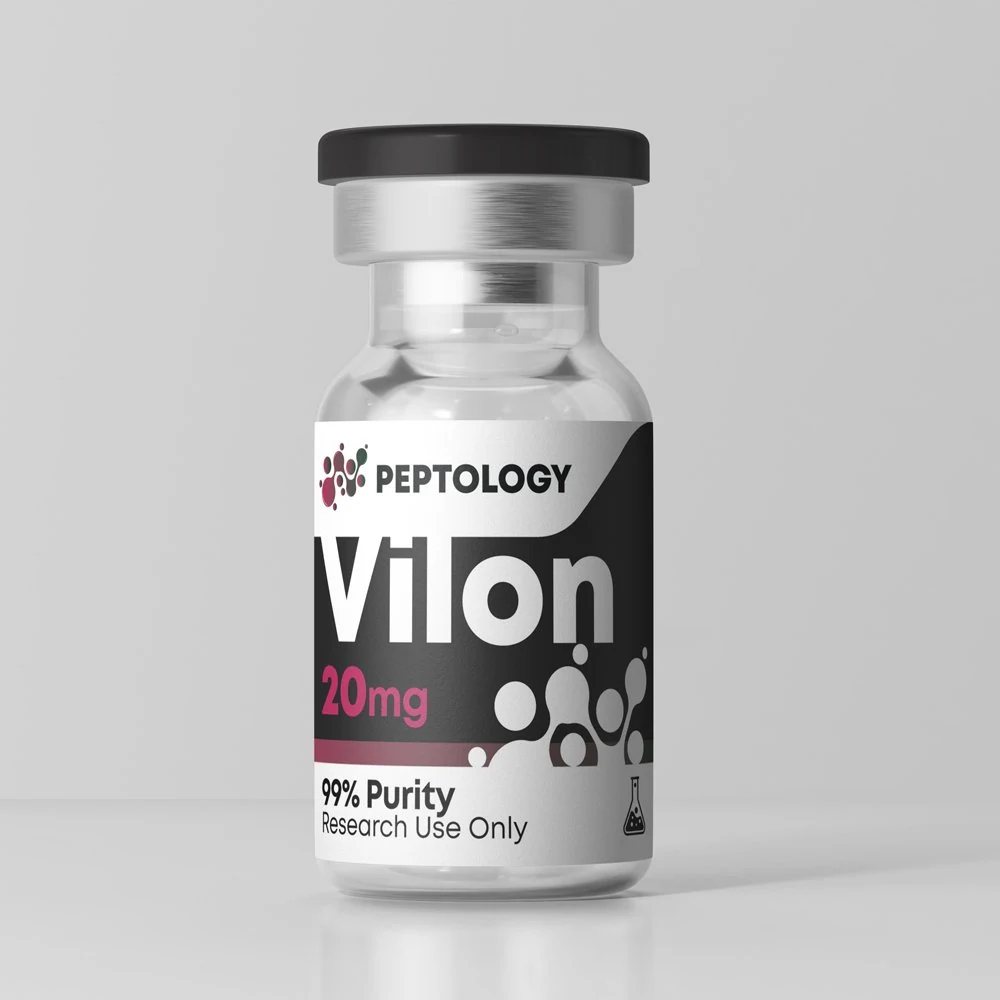
Vilon 20 mg – bioregulatory dipeptide Lys-Glu (KE) for research on immune modulation and longevity. One of the short peptide bioregulators of the Khavinson school – thymic/immune profile, associated with T-lymphocyte maturation and gene expression. Purity over 99 %. For research purposes only.
📦 The product is in our EU warehouse – delivery within 3–5 working days.
40,00 € · In stock
For research use only / Not a medicine
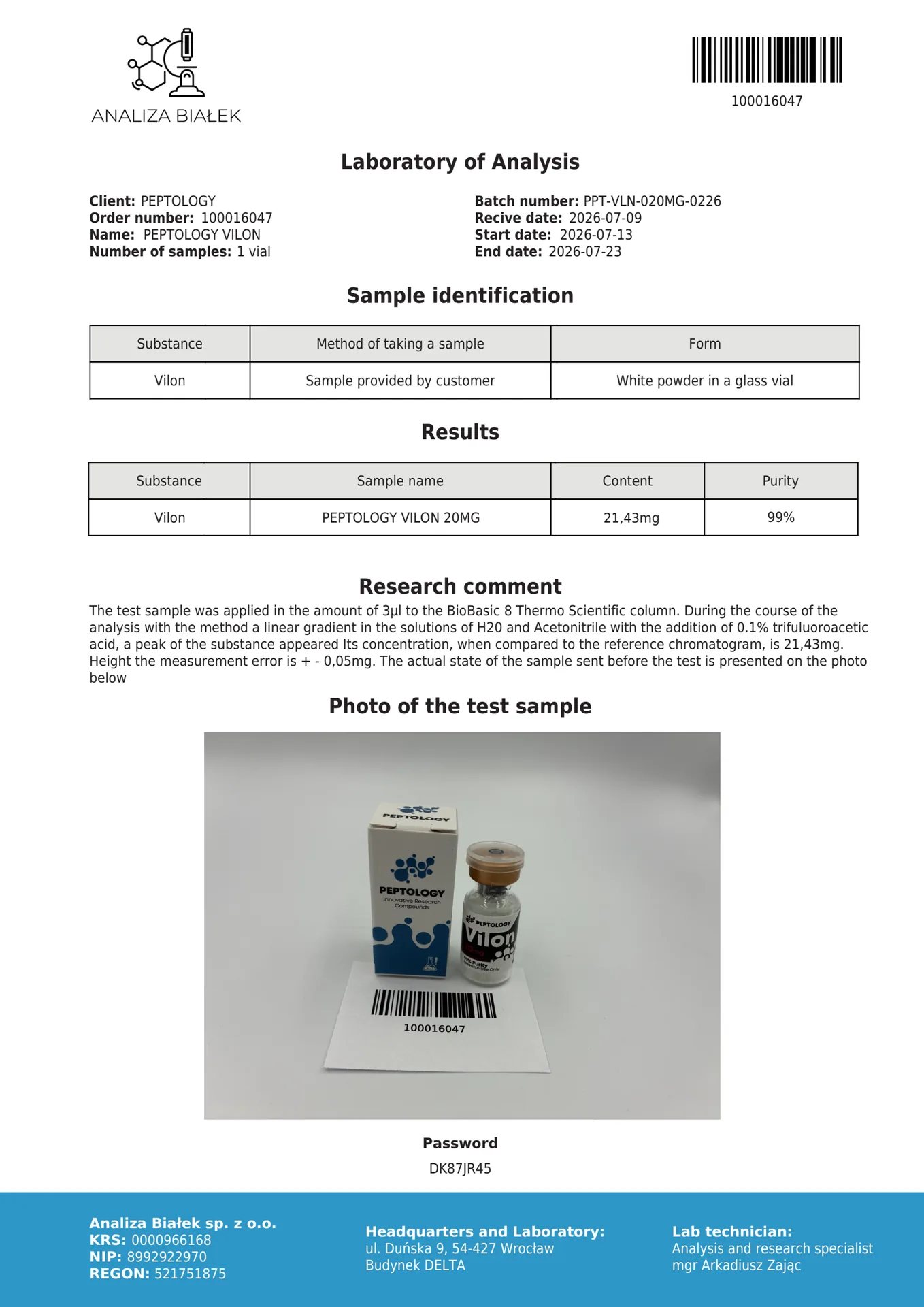
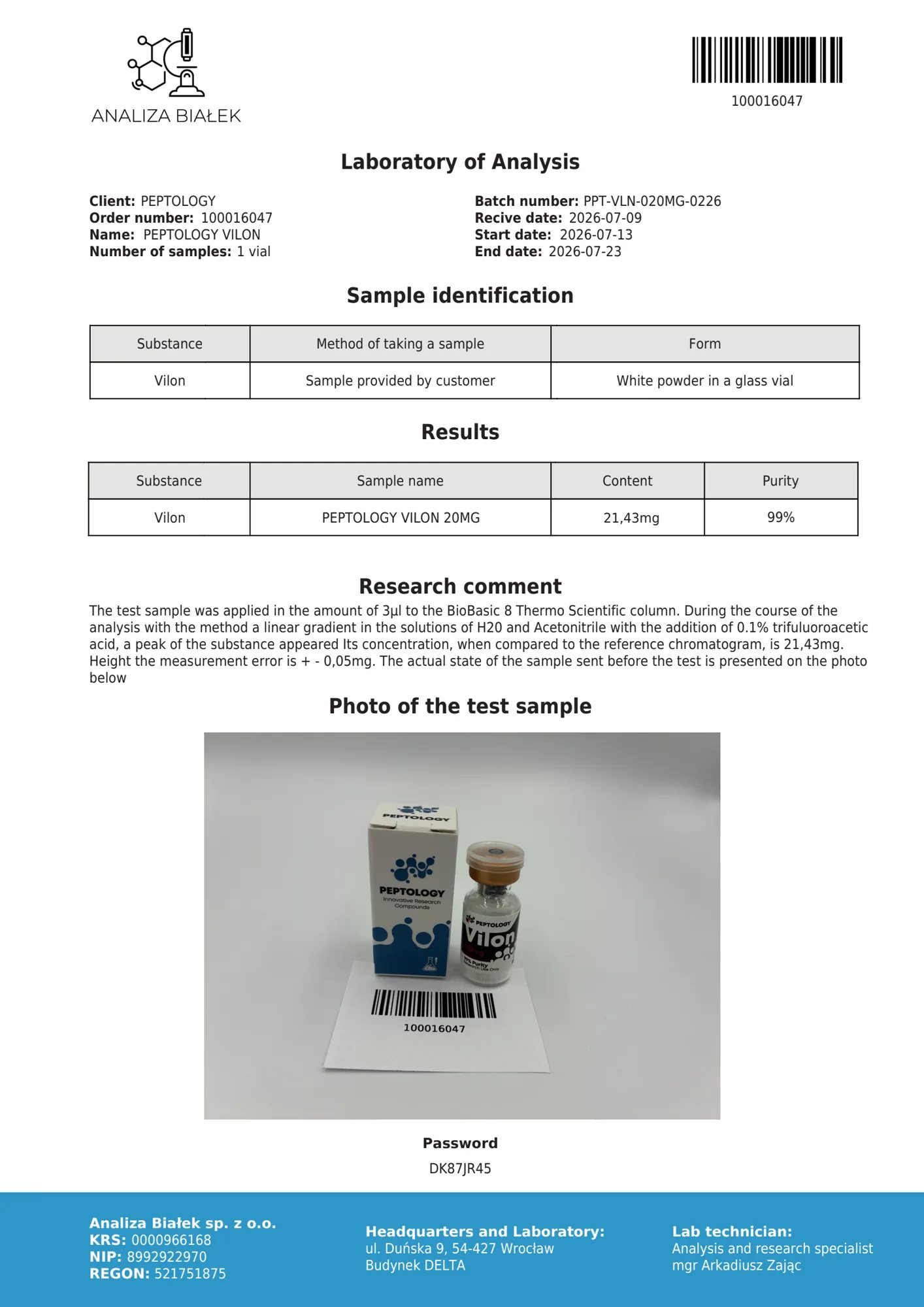
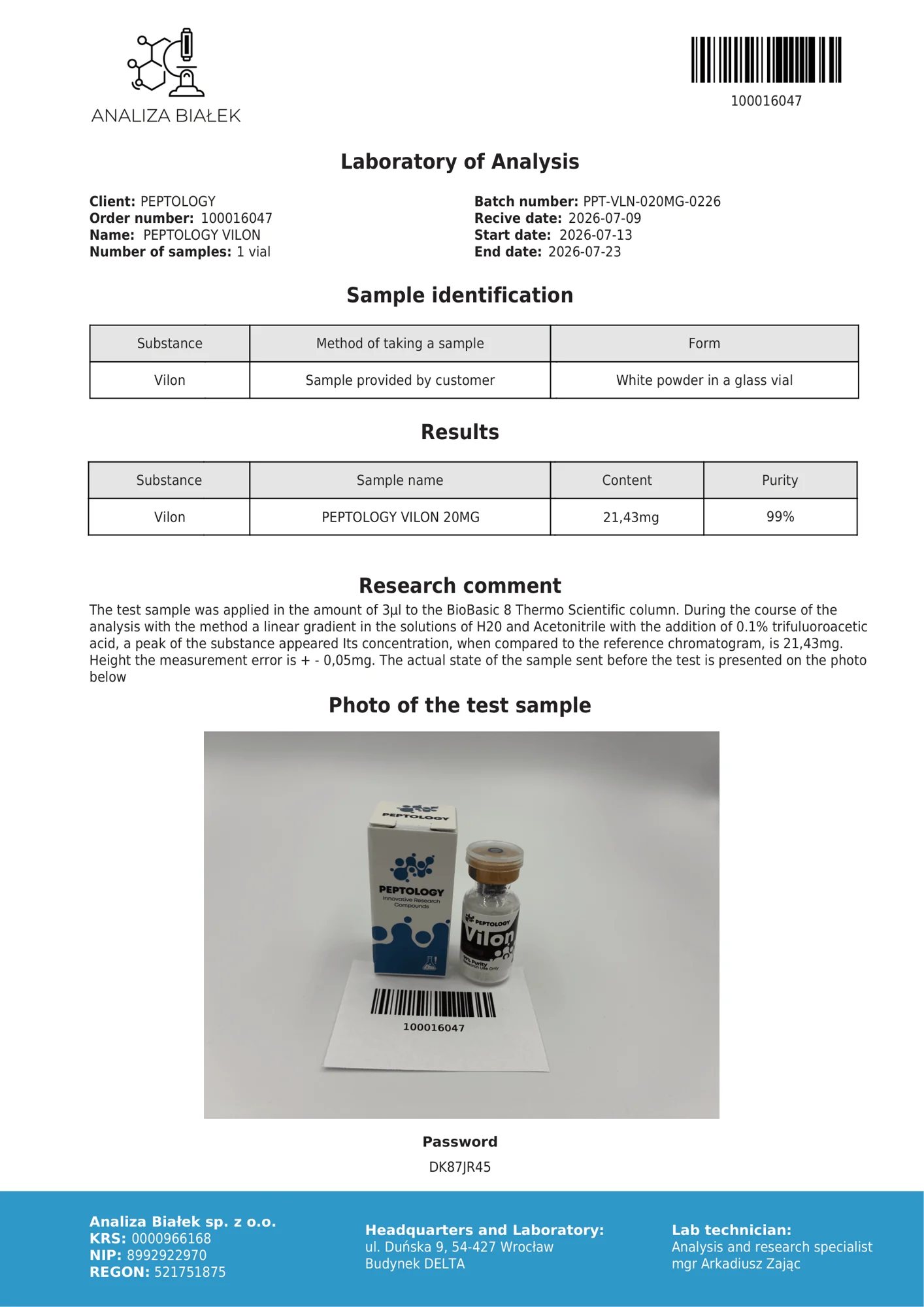
| Purity | >99% |
|---|---|
| Method | HPLC + LC/MS |
| Laboratory | Analiza Białek |
| Batch | 0226 |
What is Vilon (Vilon)?
Vilon is a synthetic Lys-Glu dipeptide (lysyl-glutamic acid, also designated KE), one of the short bioregulatory peptides from the school of Prof. Khavinson (St. Petersburg Institute of Bioregulation and Gerontology). It is cited as one of the shortest peptides with documented biological activity — just two amino acids.
Bioregulators are a class of short peptides studied for tissue-specific regulation of gene expression. Vilon is the thymic/immune representative of this family and is studied mainly for the modulation of immune function and in the context of longevity. The same group also includes Epithalon (a telomere/pineal bioregulator) and thymic peptides such as Thymulin.
In the Peptology version, Vilon is supplied as a lyophilized research peptide with purity above 99%, confirmed by independent laboratory analysis (see the product certificates). The product is intended exclusively for scientific research purposes and is not a medicinal product. See also the category peptides for immunity and hormonal balance.
How Vilon is studied — mechanism
In the literature of the Khavinson school, Vilon is described as a bioregulator that acts at the level of gene expression in immune cells. The three axes below summarize the main directions in which the dipeptide is studied.
IMMUNE REGULATION
Studied as a thymic/immune bioregulator, associated with the function and maturation of T lymphocytes.
GENE EXPRESSION
Modulation of gene expression is described through "deheterochromatinization" — activation of "dormant" genes in aging cells.
GERONTOLOGY
Considered in the context of bioregulation and restoration of function during aging.
The concept of peptide bioregulation
The hypothesis of the Khavinson school holds that very short peptides can penetrate the cell and nucleus and bind to specific DNA segments, influencing which genes are active. During aging, some genes become "silenced" by chromatin condensation; according to this concept, bioregulators like Vilon may "open" such segments (deheterochromatinization) and restore their expression — a mechanism studied mainly in immune and thymic cells.
Why the thymus specifically
The thymus is the organ in which T lymphocytes mature, and it gradually shrinks with age (involution), which is associated with a weakening of the immune response. Vilon is studied precisely as a thymic bioregulator — in the context of maintaining immune function during aging.
Khavinson bioregulators
The family of short bioregulatory peptides was developed in St. Petersburg and comprises tissue-specific peptides, each targeting a particular organ or system. Below is Vilon's place among them.
VILON (KE)
Thymic/immune bioregulator — Lys-Glu dipeptide.
EPITHALON
Pineal/telomere bioregulator — AEDG tetrapeptide.
THYMIC PEPTIDES
Thymulin, Thymosin — immune regulation and neuroimmune modulation.
Properties and characteristics
- Sequence: Lys-Glu (lysyl-glutamic acid), designated KE
- Class: short bioregulatory peptide (Khavinson school)
- Profile: thymic/immune bioregulator
- Amount: 20 mg per vial, lyophilized powder
- Purity: above 99%, with CoA for every batch
- Schedule: used in short cycles in research protocols
- Use: research only (in vitro / preclinical models)
Vilon among the bioregulators
The table compares Vilon with other bioregulators in terms of sequence and research focus. Each is tissue-specific and addresses a different system.
| Vilon | Epithalon | Thymulin | |
|---|---|---|---|
| Sequence | Lys-Glu (KE) | Ala-Glu-Asp-Gly | peptide + Zn |
| Research axis | Immunity / thymus | Telomeres / longevity | Neuroimmune modulation |
| Length | 2 amino acids | 4 amino acids | larger |
| Schedule | Short cycles | Cycles | Cycles |
The comparison concerns composition and focus and is scientific information in nature. It does not constitute a claim of comparative efficacy between products.
Scientific basis and data availability
Research from the Khavinson school
Most research on Vilon comes from the group of Prof. Khavinson and collaborators. It describes effects concerning the maturation and function of T lymphocytes, immune regulation and markers of aging in animal and cellular models, as well as interactions with components of the NF-κB pathway.
Limitations of the evidence base
Because a large portion of the data comes from a single research group, independent replication is limited. This does not diminish the research value of Vilon, but it requires efficacy data to be interpreted with this caveat — and is the reason the product is offered exclusively for research purposes.
This information is scientific in nature and reflects mainly the research of the Khavinson group. It does not constitute a claim of effect or a recommendation for use.
Research dosing protocols
Important: The information below summarizes ranges observed among researchers and does not constitute a recommendation for individual use, medical advice or administration instructions.
- The 20 mg vial is usually reconstituted with ~3 mL of fluid (~6.67 mg/mL).
- In research protocols, bioregulators are used in short cycles (e.g. ~5–10 days) within a longer period.
- The concentration is set depending on the reconstitution volume and the goals of the study.
Documented research focus
- Immune modulation — T-lymphocyte function and maturation in immune-regulation models.
- Thymus function — bioregulation in the context of age-related thymic involution.
- Gene expression — "deheterochromatinization" and activation of silenced genes in aging cells.
- Longevity — markers of aging in preclinical models.
The indicated directions reflect mainly the research of the Khavinson group and do not constitute a claim of effect or a recommendation for use.
Storage and reconstitution
- Before reconstitution: lyophilized at −20 °C (for long-term storage −80 °C), in darkness and dryness.
- After reconstitution: in the refrigerator 2–8 °C, use within ~a week or aliquot and freeze.
- Reconstitution: add the fluid slowly down the vial wall; swirl gently, do not shake.
Laboratory tip: for reconstitution we recommend Peptide Matrix Water™ — a stabilizing solution for reconstituted research peptides. Alternatively, you can add bacteriostatic water to your order.
Frequently asked questions about Vilon
What are Khavinson bioregulators?
A family of short peptides studied for tissue-specific regulation of gene expression and function during aging. Vilon is the thymic/immune representative.
What is the sequence of Vilon?
Vilon is the Lys-Glu (KE) dipeptide — one of the shortest peptides with documented biological activity.
How reliable is the data?
Most research comes from a single scientific group (Khavinson), so independent replication is limited and efficacy should be considered with caution.
What is it reconstituted with?
We recommend Peptide Matrix Water™ or bacteriostatic water. After reconstitution, store in the refrigerator, without refreezing.
Is a prescription needed?
No. It is offered for research purposes, without the need for a prescription.
Related products
Epithalon
Telomere bioregulator (AEDG)
Thymulin
Neuroimmune modulator
Thymosin Alpha-1
Immunostimulating peptide
Peptide Matrix Water™
Stabilizing solution for reconstitution
See the full catalog: Peptides for immunity and hormonal balance · Blog on peptide research
Research warning: Vilon (Lys-Glu) is offered exclusively for scientific research purposes and in vitro applications. The product is not approved for clinical use, is not a medicine, and is not intended for intake by humans or animals. The information provided reflects mainly the research of the Khavinson group and serves solely as scientific information. It does not constitute medical advice, administration instructions or a recommendation for use. Before starting any research, consult a qualified specialist and the applicable regulations. Peptology accepts no liability for the unauthorized use of research peptides.
Laboratory reconstitution
Laboratory protocol — reconstitution, research protocols, storage
Standardized protocol applicable to all research peptides in the Peptology catalogue. To calculate the solution concentration (mg/mL) for each vial, use the peptide reconstitution calculator.
60-second protocol
1. SOLVENT
2. RECONSTITUTION
Add the solvent down the side of the vial, without shaking, wait 10–15 min.
3. CALCULATION
Calculator → concentration mg/mL
4. STORAGE
+2 °C to +8 °C, up to 60 days with Peptide Matrix Water
Quick reference
| Parameter | Value |
|---|---|
| Form | Lyophilized powder |
| Solvent | Peptide Matrix Water |
| Reconstitution volume | 1–3 mL — maximum 3 mL (capacity of the standard vial) |
| Storage before reconstitution | Room temperature, protected from direct light (refrigeration not required) |
| After reconstitution | Up to 60 days at +2 °C to +8 °C with Peptide Matrix Water |
What you need
Precision pipette
Calibrated, 100–1000 µL — for accurately measuring the volume of solvent added to the vial.
70% alcohol swabs
Two swabs — to disinfect the peptide vial and the solvent vial.
Stabilized solvent for lyophilized peptides. Why this one.
Five rules for reconstitution
| ✅ Correct | ❌ Mistake |
|---|---|
| Disinfect the vial caps and the work surface with 70% alcohol; wear gloves | Working without disinfection |
| Add the solvent slowly along the vial wall | Direct jet onto the powder — foaming and denaturation |
| Gentle rolling between the palms | Shaking — foam, which denatures peptides |
| 10–15 minutes waiting at room temperature | Mechanical mixing or heating |
| Visual check: clear, particle-free | Working with a cloudy or discolored solution |
Calculating concentration
⚠️ Maximum 3 mL solvent. The standard vial does not accommodate larger volumes — do not exceed during reconstitution.
- Concentration (mg/mL) = mg in the vial ÷ mL of solvent
- Volume per sample (mL) = amount per sample (mg) ÷ concentration (mg/mL)
- 1 mg/mL = 1 µg/µL · 1 mL = 1000 µL
Reconstitution per vial — solvent: Peptide Matrix Water. Concentration after adding the solvent (1 mg/mL = 1 µg/µL):
| Vial | + 1 mL | + 2 mL | + 3 mL |
|---|---|---|---|
| 20 mg | 20 mg/mL | 10 mg/mL | 6.67 mg/mL |
👉 For any vial and solvent volume — use the calculator. It calculates the concentration (mg/mL, µg/µL) and the volume per sample (mL, µL).
Storage
BEFORE RECONSTITUTION
Room temperature, protected from direct light, in original packaging. Refrigerator not required.
AFTER RECONSTITUTION
+2 °C to +8 °C, up to 60 days with Peptide Matrix Water. Discard any remainder after this period.
FREEZING
Not recommended. Freeze/thaw cycles degrade peptide structure.
Four mistakes to avoid
1. Shaking "to dissolve faster"
Foam = denaturation. Only gentle rolling between the palms.
2. Inappropriate solvent
For peptide stability use only sterile, specially formulated solvent — recommended Peptide Matrix Water.
3. Ignoring slight turbidity
Not fully clear = the sample does not meet the criteria for use.
4. Taking it out of the refrigerator "for an hour–two"
Short exposures add up and compromise stability.
Research status: All Peptology products are intended for laboratory and research use only. They are not medicinal products, not approved for human or veterinary use and do not substitute medical advice. The described protocol is standard laboratory practice for working with lyophilized peptides.
Shipping information
🚚 Shipping information
-
Products in our warehouse – orders placed by 15:00 on working days are dispatched the same day, later orders on the next working day.
-
Delivery with GLS to your address in 3–5 working days.
-
Shipping costs €5 and is free from €50.
Frequently Asked Questions (FAQ)
What are Khavinson’s bioregulators?
A family of short peptides investigated for tissue-specific regulation of gene expression and functions in aging. Vilon is the thymic/immune representative of the group.
What is the sequence of Vilon?
Vilon is a dipeptide Lys-Glu (KE) — one of the shortest peptides with documented biological activity, only two amino acids.
What is Vilon studied for?
Mainly for immune modulation (function and maturation of T lymphocytes), thymic function and in the context of longevity and gene expression.
How reliable are the data?
The majority of the research comes from one research group (Khavinson), therefore independent replication is limited and efficacy should be interpreted cautiously.
How should it be reconstituted and stored?
We recommend Peptide Matrix Water™ or bacteriostatic water. Lyophilized – store at −20 °C; after reconstitution keep refrigerated at 2–8 °C, use within ~one week, do not refreeze.
Is a prescription required?
No. Supplied for research purposes, no prescription required.
Where can I buy Vilon in Europe and what does it cost?
You can buy Vilon in Europe online from Peptology, from 40,00 €. Delivery with GLS in 3–5 working days. Shipping is free from 50,00 €. Payment by card. Purity 99%+, with an HPLC report for every batch.
Laboratory Analysis
Vilon - 20 mg - Batch - 0226 - Purity