🇪🇺 Fast delivery (3–5 working days) with GLS ✅ Card or bank transfer 📦 Free shipping from €50

FOXO4‑DRI
FOXO4-DRI 10 mg – D-retro-inverso peptide (FOXO4–p53) for research
Peptology Ltd. · Peptides for energy and regeneration
FOXO4-DRI 10 mg – senolytic peptide for research into cellular rejuvenation and longevity. Disrupts the FOXO4–p53 complex and directs selective apoptosis towards senescent („zombie“) cells, sparing healthy ones. The D-Retro-Inverso structure provides protease resistance and stability. Purity above 99 %. For research use only.
📦 The product is in our EU warehouse – delivery within 3–5 working days.
129,00 € · In stock
For research use only / Not a medicine
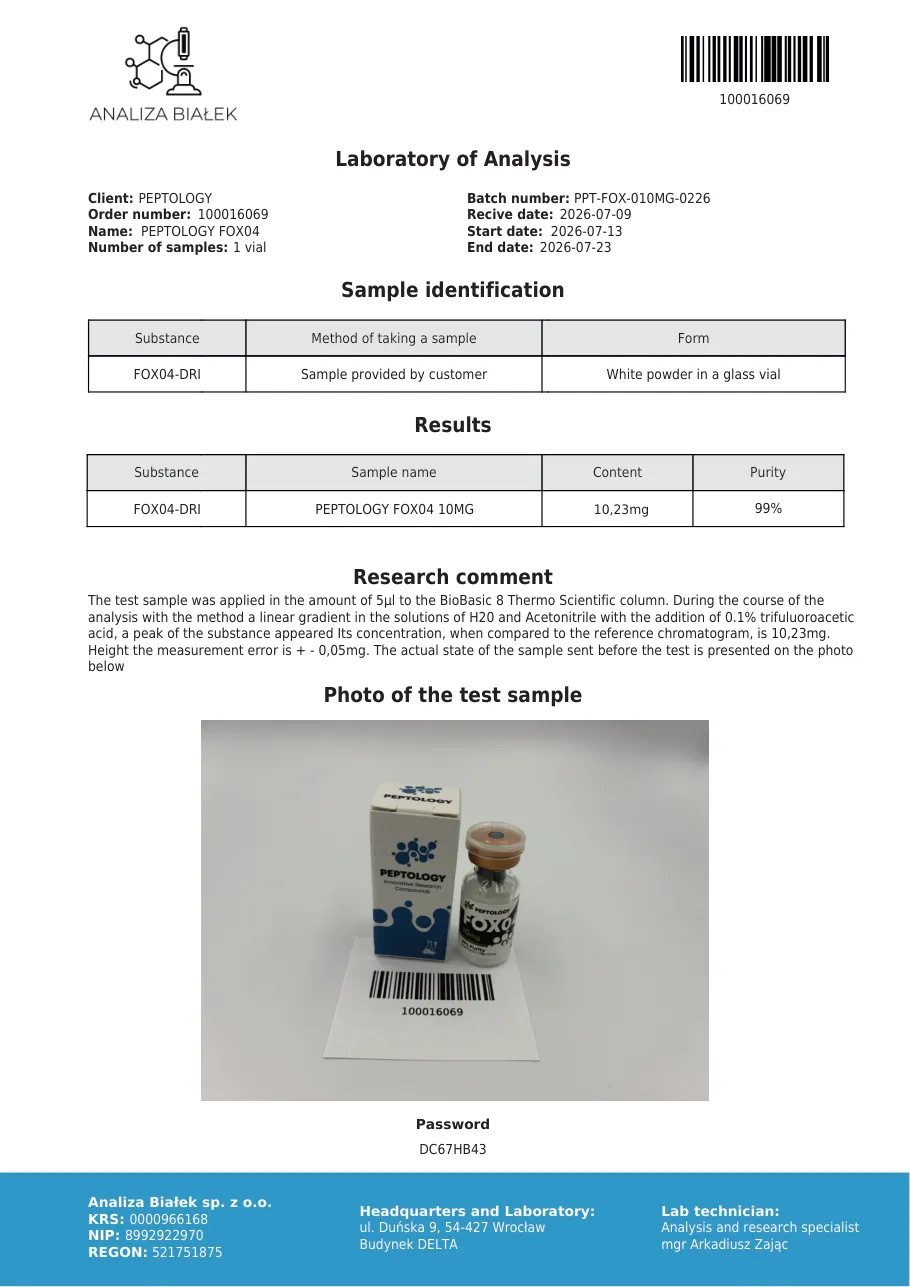
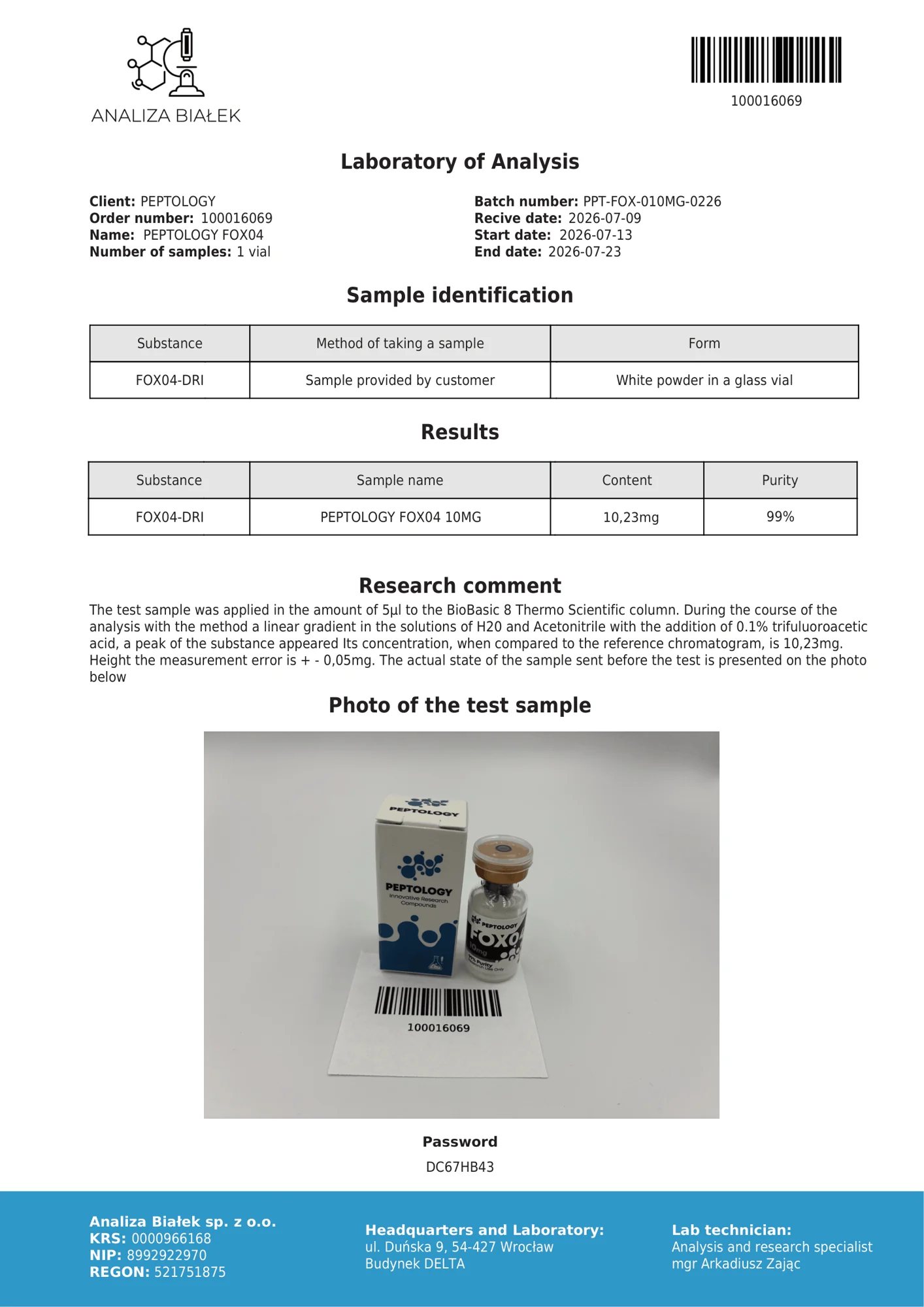
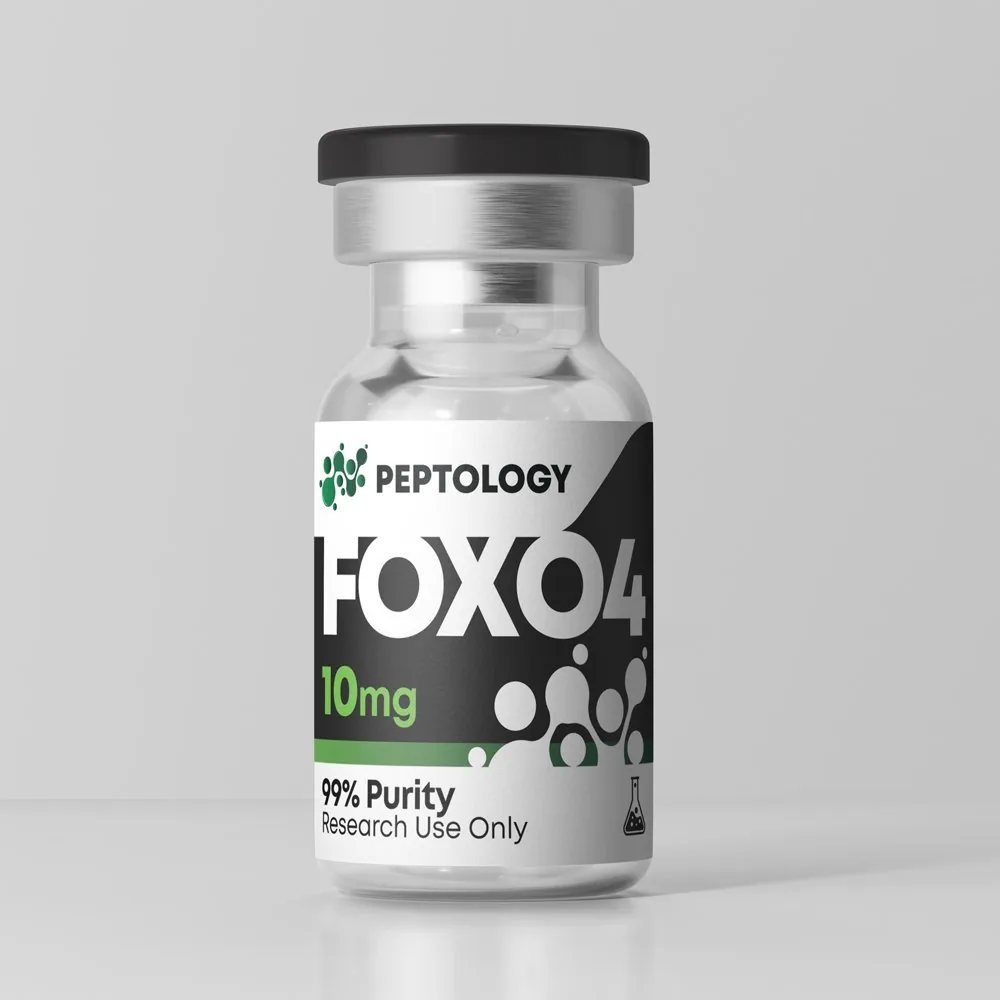
| Purity | 99% |
|---|---|
| Laboratory | Analiza Białek |
| Batch | 0226 |
Last updated: 19/10/2026
What is FOXO4-DRI?
FOXO4-DRI (D-Retro-Inverso) is a synthetic peptide from the class of senolytics — compounds studied for the selective removal of senescent ("zombie") cells from tissues. The name "FOXO4" in catalogs practically refers to FOXO4-DRI, as this is the only commercially relevant peptide in this family.
"DRI" stands for D-Retro-Inverso — a special design in which the peptide is built from D-amino acids arranged in a reversed sequence. This preserves the spatial conformation required for target binding while making the molecule resistant to proteases and significantly more stable intracellularly compared to a regular L-peptide. This resistance enables FOXO4-DRI to reach its intracellular target and remain active long enough.
Senolytics are one of the most discussed areas in the biology of aging. With age, senescent cells accumulate in tissues; these cells stop dividing but remain metabolically active and secrete pro-inflammatory signals (the so-called SASP). FOXO4-DRI is being studied as a tool to selectively eliminate these cells while sparing healthy ones.
In the Peptology version FOXO4-DRI is supplied as a lyophilized research peptide with purity above 99%, confirmed by independent laboratory analysis (see the product certificates). The product is intended for research use only and is not a medicinal product. See also other peptides for regeneration and cellular energy.
How FOXO4-DRI works — mechanism
In senescent cells the protein FOXO4 binds and retains the tumor suppressor p53 in the nucleus, which blocks programmed cell death and keeps these cells alive. FOXO4-DRI is studied as a peptide that competitively disrupts the FOXO4–p53 complex, releasing p53 toward the mitochondrial apoptosis pathway — selectively in senescent cells without affecting healthy ones.
FOXO4–p53
The target is the FOXO4–p53 interaction, which in senescent cells retains p53 in the nucleus and blocks apoptosis.
SENOLYSIS
Released p53 translocates to the mitochondria and triggers selective apoptosis of senescent cells.
DRI STABILITY
The D-retro-inverso structure provides resistance to degradation and a longer intracellular lifetime for the peptide.
Selectivity for senescent cells
The key idea behind FOXO4-DRI is selectivity. Healthy cells do not rely on the FOXO4–p53 axis for survival, while senescent cells use this interaction specifically to avoid apoptosis. Therefore, disrupting the complex primarily affects senescent cells — a principle described in studies as "targeted apoptosis of senescent cells".
Why the D-Retro-Inverso design matters
Regular peptides are rapidly degraded by enzymes. The DRI modification (D-amino acids in reversed order) preserves the necessary three-dimensional orientation of side chains for binding while making the peptide resistant to proteolysis. The result is a longer intracellular half-life and a higher probability that the molecule will reach its nuclear target — a critical requirement for senolytic action.
What are senescent ("zombie") cells
Cellular senescence is a state in which a cell stops dividing but does not die. These cells remain metabolically active and secrete a cocktail of pro-inflammatory molecules — the so-called SASP (Senescence-Associated Secretory Phenotype). With age they accumulate and are associated in studies with chronic low-grade inflammation, impaired tissue function, and a range of age-related processes.
CELL CYCLE ARREST
The cell loses the ability to divide but remains alive and active.
SASP SIGNALS
Secrete pro-inflammatory cytokines that affect neighboring cells.
ACCUMULATION
Their number increases with age, which is a topic of aging research.
Senolytics like FOXO4-DRI are researched specifically to "clear" accumulated senescent cells and study their impact on tissue function in preclinical models.
Properties and characteristics
- Type: senolytic peptide (D-Retro-Inverso)
- Target: the FOXO4–p53 complex in senescent cells
- Design: D-amino acids in reversed sequence — protease resistance
- Quantity: 10 mg per vial, lyophilized powder
- Purity: above 99%, with CoA for each batch
- Regimen: in models applied intermittently (in cycles), not daily long-term
- Application: strictly research (in vitro / preclinical models)
FOXO4-DRI among longevity peptides
The table compares FOXO4-DRI with other peptides studied in the context of aging and cellular energy. Each works by a different mechanism — FOXO4-DRI is the only true senolytic in the group.
| FOXO4-DRI | Epithalon | NAD+ | |
|---|---|---|---|
| Class | Senolytic | Telomeric peptide | Cofactor / energy |
| Mechanism | FOXO4–p53 | Telomerase | Mitochondria |
| Target | Senescent cells | Telomeres / rhythm | Cellular energy |
| Regimen | Intermittent | Cyclic | Periodic |
The comparison is by mechanism and is provided for scientific reference. It does not constitute a claim of comparative efficacy, as direct comparative studies are lacking.
Scientific basis and research
Foundational study — Cell, 2017
The publication by Baar et al. in Cell (2017) — "Targeted apoptosis of senescent cells restores tissue homeostasis" — is foundational for FOXO4-DRI. In naturally aged and chemotherapy-induced aged mice the authors reported improved physical endurance, increased fur density, and improved renal markers after peptide treatment. This study put FOXO4-DRI on the map of senolytic research.
Structural data — Nature Communications, 2025
More recent structural studies (2025) describe in greater detail how FOXO4-DRI binds the transactivation domain of p53, clarifying the molecular mechanism of disrupting the FOXO4–p53 complex.
Other models
Subsequent studies examine FOXO4-DRI in contexts such as keloid fibroblasts, chondrocytes, endothelial senescence, and brain aging — expanding its preclinical application in aging science.
All available information is from preclinical (animal and cellular) models. There are no clinical data on safety and efficacy in humans — therefore all statements are strictly in a research context.
Research protocols for dosing
Important: There is no established human protocol. The approaches described below reflect preclinical models and are provided for scientific reference only; they do not constitute a recommendation for individual use, medical advice, or instructions for administration.
- Lyophilized; reconstitute with a stabilizing solution according to the protocol.
- In models FOXO4-DRI is applied intermittently (in cycles) — a characteristic approach for senolytics in which treatment periods alternate with pauses instead of continuous daily administration.
- Concentration is determined based on the reconstitution volume and the aims of the study.
Documented research focus
- Senolytic research — selective removal of senescent cells in aging models.
- p53 biology — study of apoptosis regulation and the FOXO4–p53 axis.
- Tissue homeostasis — impact of "clearing" senescent cells on tissue function.
- Longevity and biohacking — aging markers in preclinical models.
The provided guidelines reflect published preclinical research and do not represent a claim of effect or a recommendation for use.
Storage and reconstitution
Proper storage is important to preserve peptide stability during laboratory work.
- Before reconstitution: lyophilized, frozen (−20 °C), protected from light and moisture.
- After reconstitution: refrigerate at 2–8 °C; do not refreeze.
- Reconstitution: add the solvent slowly down the side of the vial; swirl gently, do not shake.
Laboratory tip: for reconstitution we recommend Peptide Matrix Water™ — a stabilizing solution formulated for working with reconstituted research peptides. Alternatively you may add bacteriostatic water to your order.
Frequently asked questions about FOXO4-DRI
What is a senolytic?
A compound studied for the selective elimination of senescent cells, which stop dividing but remain metabolically active and secrete pro-inflammatory signals (SASP).
What does "DRI" mean?
D-Retro-Inverso — a design of D-amino acids in reversed sequence that makes the peptide resistant to proteases and more stable in the cell.
Are there human clinical data?
No. All available information is from preclinical (animal/cell) models; safety in humans is not established.
What should it be reconstituted with?
We recommend Peptide Matrix Water™ as a stabilizing medium; alternatively — bacteriostatic water. After reconstitution store refrigerated, do not refreeze.
Is a prescription required?
No. It is offered for research purposes without the need for a prescription.
Related products
Epithalon
Telomeric anti-aging peptide
NAD+
Cellular energy and mitochondria
SS-31
Mitochondrial antioxidant
Peptide Matrix Water™
Stabilizing solution for reconstitution
See the full catalog: Peptides for regeneration and cellular energy · Peptide research blog
Research warning: FOXO4-DRI is supplied for scientific-research and in vitro applications only. The product is not approved for clinical use, is not a medicinal product, and is not intended for consumption by humans or animals. All presented information reflects preclinical research (including Cell, 2017) and is for scientific reference only. It does not constitute medical advice, instructions for use, or a recommendation for application. Before starting any research consult a qualified specialist and the applicable regulatory framework. Peptology is not responsible for unregulated use of research peptides.
Molecule identity
| CAS number | 2460055-10-9 |
|---|---|
| Molecular weight | 5358 g/mol |
| Molecular formula | C228H388N86O64 |
| Class | D-retro-inverso peptide (FOXO4–p53) |
| Form | Lyophilised powder in a glass vial |
| Storage | Lyophilisate: 2–8 °C, dry and protected from light · after reconstitution: 2–8 °C |
References
- Baar MP et al. Targeted Apoptosis of Senescent Cells Restores Tissue Homeostasis in Response to Chemotoxicity and Aging. Cell. 2017;169:132–147.
- Bourgeois B et al. The disordered p53 transactivation domain is the target of FOXO4 and the senolytic compound FOXO4-DRI. Nat Commun. 2025;16:5672.
Laboratory reconstitution
Laboratory protocol — reconstitution, research protocols, storage
Standardized protocol applicable to all research peptides in the Peptology catalogue. To calculate the solution concentration (mg/mL) for each vial, use the peptide reconstitution calculator.
60-second protocol
1. SOLVENT
2. RECONSTITUTION
Add the solvent down the side of the vial, without shaking, wait 10–15 min.
3. CALCULATION
Calculator → concentration mg/mL
4. STORAGE
+2 °C to +8 °C, up to 60 days with Peptide Matrix Water
Quick reference
| Parameter | Value |
|---|---|
| Form | Lyophilized powder |
| Solvent | Peptide Matrix Water |
| Reconstitution volume | 1–3 mL — maximum 3 mL (capacity of the standard vial) |
| Storage before reconstitution | Room temperature, protected from direct light (refrigeration not required) |
| After reconstitution | Up to 60 days at +2 °C to +8 °C with Peptide Matrix Water |
What you need
Precision pipette
Calibrated, 100–1000 µL — for accurately measuring the volume of solvent added to the vial.
70% alcohol swabs
Two swabs — to disinfect the peptide vial and the solvent vial.
Stabilized solvent for lyophilized peptides. Why this one.
Five rules for reconstitution
| ✅ Correct | ❌ Mistake |
|---|---|
| Disinfect the vial caps and the work surface with 70% alcohol; wear gloves | Working without disinfection |
| Add the solvent slowly along the vial wall | Direct jet onto the powder — foaming and denaturation |
| Gentle rolling between the palms | Shaking — foam, which denatures peptides |
| 10–15 minutes waiting at room temperature | Mechanical mixing or heating |
| Visual check: clear, particle-free | Working with a cloudy or discolored solution |
Calculating concentration
⚠️ Maximum 3 mL solvent. The standard vial does not accommodate larger volumes — do not exceed during reconstitution.
- Concentration (mg/mL) = mg in the vial ÷ mL of solvent
- Volume per sample (mL) = amount per sample (mg) ÷ concentration (mg/mL)
- 1 mg/mL = 1 µg/µL · 1 mL = 1000 µL
Reconstitution per vial — solvent: Peptide Matrix Water. Concentration after adding the solvent (1 mg/mL = 1 µg/µL):
| Vial | + 1 mL | + 2 mL | + 3 mL |
|---|---|---|---|
| 10 mg | 10 mg/mL | 5 mg/mL | 3.33 mg/mL |
👉 For any vial and solvent volume — use the calculator. It calculates the concentration (mg/mL, µg/µL) and the volume per sample (mL, µL).
Storage
BEFORE RECONSTITUTION
Room temperature, protected from direct light, in original packaging. Refrigerator not required.
AFTER RECONSTITUTION
+2 °C to +8 °C, up to 60 days with Peptide Matrix Water. Discard any remainder after this period.
FREEZING
Not recommended. Freeze/thaw cycles degrade peptide structure.
Four mistakes to avoid
1. Shaking "to dissolve faster"
Foam = denaturation. Only gentle rolling between the palms.
2. Inappropriate solvent
For peptide stability use only sterile, specially formulated solvent — recommended Peptide Matrix Water.
3. Ignoring slight turbidity
Not fully clear = the sample does not meet the criteria for use.
4. Taking it out of the refrigerator "for an hour–two"
Short exposures add up and compromise stability.
Research status: All Peptology products are intended for laboratory and research use only. They are not medicinal products, not approved for human or veterinary use and do not substitute medical advice. The described protocol is standard laboratory practice for working with lyophilized peptides.
Shipping information
🚚 Shipping information
-
Products in our warehouse – orders placed by 15:00 on working days are dispatched the same day, later orders on the next working day.
-
Delivery with GLS to your address in 3–5 working days.
-
Shipping costs €5 and is free from €50.
Frequently Asked Questions (FAQ)
What is a senolytic?
A compound investigated for selective elimination of senescent cells that stop dividing but remain metabolically active and secrete pro-inflammatory signals (SASP).
How does FOXO4-DRI work?
It disrupts the FOXO4–p53 complex in senescent cells. This releases p53 to the mitochondrial apoptosis pathway and leads to selective senolysis — affecting only senescent cells without impacting healthy ones.
What does „DRI“ mean?
D-Retro-Inverso — a design of D-amino acids in reversed sequence that preserves the binding conformation but makes the peptide protease-resistant and more stable in the cell.
Are there clinical data in humans?
No. All available information is from preclinical (animal and cell) models, including the foundational study in Cell (2017). Safety in humans has not been established.
What is it reconstituted with and how is it stored?
We recommend Peptide Matrix Water™ or bacteriostatic water. Lyophilized – frozen at −20 °C; after reconstitution, store refrigerated at 2–8 °C, do not re-freeze.
Is a prescription required?
No. Supplied for research purposes, no prescription required.
Where can I buy FOXO4‑DRI in Europe and what does it cost?
You can buy FOXO4‑DRI in Europe online from Peptology, from 129,00 €. Delivery with GLS in 3–5 working days. Shipping is free from 50,00 €. Payment by card. Purity 99%+, with an HPLC report for every batch.
Laboratory Analysis
FOXO4‑DRI - 10 mg - Batch - 0226 - Purity