🇪🇺 Fast delivery (3–5 working days) with GLS ✅ Card or bank transfer 📦 Free shipping from €50


CS20
CS20 (Cagrilintide 10 mg + Semaglutide 10 mg) — dual GLP-1 / amylin agonist
Peptology Ltd. · Peptides for weight loss
CS20 (Cagrilintide + Semaglutide) is a dual peptide formulation in dual strength – 10 mg + 10 mg in one vial. It combines an amylin analogue and a GLP-1 receptor agonist: research peptides with 99%+ purity and an HPLC/MS report for every batch.
📦 The product is in our EU warehouse – delivery within 3–5 working days.
119,00 € · In stock
For research use only / Not a medicine
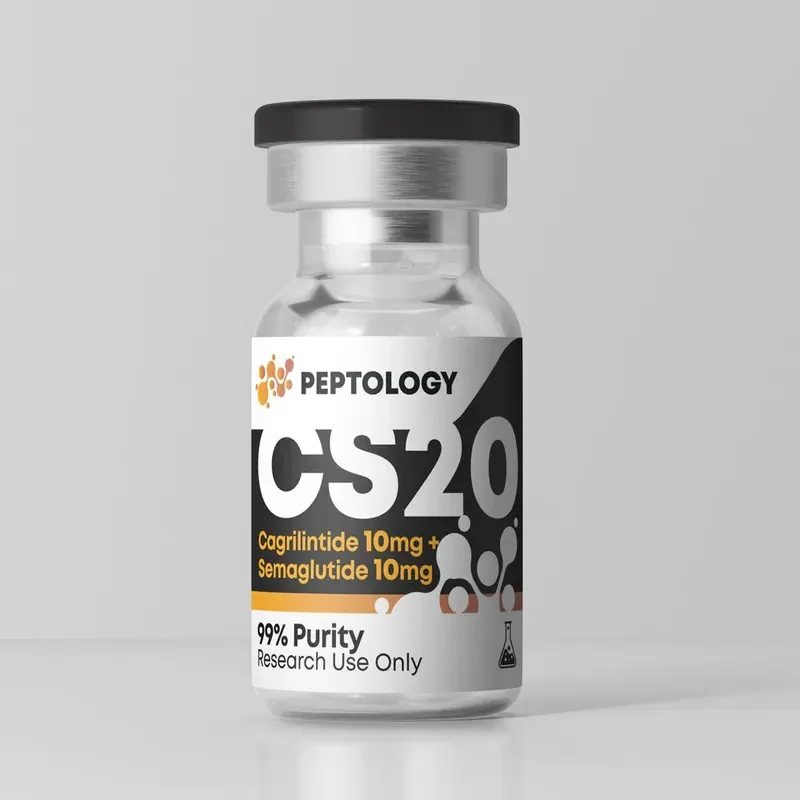
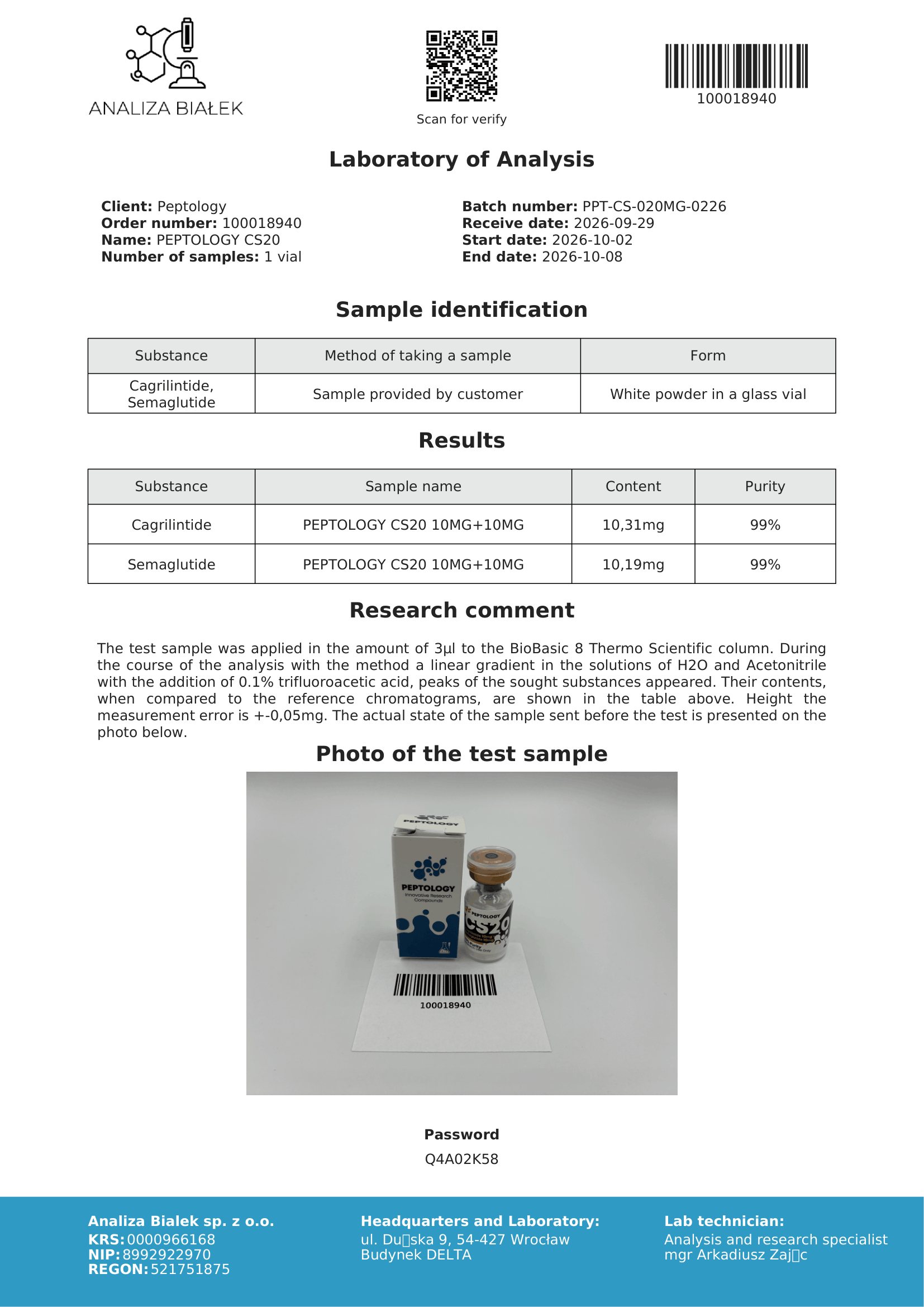
| Purity | 99% |
|---|---|
| Method | HPLC + LC/MS |
| Laboratory | Analiza Białek |
| Batch | 0226 |
Last updated: 19/10/2026
CS20 (Cagrilintide 10 mg + Semaglutide 10 mg) — dual GLP-1 / amylin agonist
CS20 is the high-concentration format of the amylin + incretin combination: 10 mg Cagrilintide and 10 mg Semaglutide in a single lyophilized vial — 20 mg of peptide substance in total, at a fixed 1:1 ratio.
The logic of the formula is simple: two hormone analogs, two different receptor systems, one vial. Semaglutide works along the incretin axis (GLP-1), cagrilintide along the amylin axis. Because the signals travel on independent pathways, they do not compete — and this is why CS20 is conceptually different from multi-receptor single molecules such as Tirzepatide and Retatrutide, which combine incretin receptors within one chain.
The difference between CS20 and the smaller CS10 lies solely in the amount of peptide in the vial — the ratio, the purity and the mechanism are identical. CS20 is intended for longer series, for protocols with higher target concentrations, and for laboratories that prefer fewer vials and fewer reconstitution cycles.
The combination remains experimental: the REDEFINE clinical program (obesity and type 2 diabetes) is complete, and no registration — including in the EU — exists to date. See also the other peptides for weight loss (GLP-1).
In the version offered by Peptology, CS20 is supplied as a lyophilized research peptide with purity above 99% (HPLC/MS) and independent laboratory analysis (CoA) for every batch. The product is intended exclusively for scientific research and in vitro applications and is not a medicinal product.
Vial composition: 10 mg + 10 mg = 20 mg
CS20 contains both peptides pre-blended in lyophilized form. On reconstitution they enter solution simultaneously — no separate measuring and no mixing of two vials is required.
CAGRILINTIDE 10 MG
Amylin analog
A long-acting amylin analog; it activates the amylin receptors (AMY1, AMY3) and the calcitonin receptor. Single product →
SEMAGLUTIDE 10 MG
GLP-1 agonist
The most extensively studied GLP-1 agonist; it activates the GLP-1 receptor and is studied for glucose-dependent insulin secretion and gastric emptying. Single product →
The 1:1 ratio matches the proportion used in the clinical program for the combination. Every batch carries a laboratory certificate with confirmed purity > 99%.
CS20 or CS10 — which format for which protocol
Both formats are the same formula at a different scale. The choice depends on the length of the series and the target concentration of the working solution, not on the composition.
| CS20 | CS10 | |
|---|---|---|
| Cagrilintide | 10 mg | 5 mg |
| Semaglutide | 10 mg | 5 mg |
| Total peptide per vial | 20 mg | 10 mg |
| Ratio and mechanism | 1:1, amylin + GLP-1 | 1:1, amylin + GLP-1 |
| Typical choice for | Long series, higher concentrations, fewer vials | Shorter protocols, lower total consumption |
Both formats take a maximum of ~3 mL of solvent (the capacity of a standard vial), so with CS20 the resulting solution is twice as concentrated at the same volume.
Mechanism: two independent receptor systems
Incretins and amylin are two separate hormonal lines with their own receptors: the GLP-1 receptor and the amylin receptors (AMY1, AMY3) together with the calcitonin receptor. CS20 addresses both at once.
THE INCRETIN LINE
Semaglutide activates the GLP-1 receptor; the literature links this to slowed gastric emptying and glucose-dependent insulin secretion.
THE AMYLIN LINE
Cagrilintide acts on the amylin receptors (AMY1, AMY3) and the calcitonin receptor — a pathway independent of the incretins.
EFFECTS ADD UP
Because the receptors differ, the effects do not overlap. In REDEFINE 1 this meant a 20.4% reduction for the combination versus 14.9% and 11.5% for the individual components.
A combination of two molecules versus one multi-receptor molecule
There are two routes to combined action. The first is to design a single chain that activates several incretin receptors — this is how Tirzepatide (GLP-1 / GIP) and Retatrutide (GLP-1 / GIP / glucagon) work. The second is to pair two finished molecules from different hormonal families — the CS20 approach. It allows each axis to be titrated within the studied regimen and makes the combination a practical model for studying additivity between the amylin and incretin signals.
The data below come from controlled clinical trials of the cagrilintide + semaglutide combination and do not constitute a claim about the effect of the research-grade product.
Pharmacokinetic profile
Both peptides are acylated — a fatty-acid residue is attached to the chain, reversibly binding them to albumin in the blood. This slows renal clearance and results in a half-life on the order of one week. The practical consequence: the two components have kinetics similar enough to be administered on the same weekly rhythm.
- Semaglutide half-life: ~7 days (about 168 hours)
- Cagrilintide half-life: ~7–8 days (about 180 hours)
- Extension mechanism: acylation and reversible albumin binding
- Studied regimen: once weekly subcutaneously, with gradual titration
- Phase 3 doses (combination): cagrilintide 2.4 mg + semaglutide 2.4 mg weekly as the target dose
- CS20 content: 10 mg + 10 mg — an amount that covers a longer research cycle at the same regimen
The combination versus each component alone
The cleanest comparison comes from REDEFINE 1, where the combination, cagrilintide, semaglutide and placebo were studied in parallel within one and the same trial — in the same population and over the same duration. The values below are therefore directly comparable.
| CS20 (combination) | Semaglutide | Cagrilintide | |
|---|---|---|---|
| Hormonal family | Amylin + incretin | Incretin (GLP-1) | Amylin |
| Number of receptor systems | 2 | 1 | 1 |
| Weight reduction (REDEFINE 1, 68 weeks) | ~20.4% | ~14.9% | ~11.5% |
| Half-life | ~7 days (both components) | ~7 days | ~7–8 days |
| In the Peptology catalog | Lyophilized powder · 10 + 10 mg · research use only | Lyophilized powder · 5/10 mg · research use only | Lyophilized powder · 5/10 mg · research use only |
The values come from REDEFINE 1 (obesity, n≈3417) and REDEFINE 2 (type 2 diabetes, n≈1206), published in the NEJM in 2025. The table is scientific and referential in nature and is not a claim about the effect of the research product CS20.
What the REDEFINE program shows
For a research peptide, the combination is unusually well documented — two completed phase 3 trials with more than 4600 participants in total. Below are the key results, presented in a scientific and referential context.
The basis: both components have their own programs
Semaglutide went through the STEP (body weight) and SUSTAIN (type 2 diabetes) series — tens of thousands of participants. Cagrilintide was studied separately in phase 2 in obesity. Combining them is not improvisation but a logical continuation: two already characterized molecules brought together into a single weekly regimen.
REDEFINE 1 — obesity without diabetes
About 3417 adults, 68 weeks. Mean body-weight reduction with the combination was 20.4%, versus 3.0% with placebo. Approximately 60% of participants lost 20% or more of their baseline weight, and about 23% achieved a reduction of 30% or more. The comparison against the single-component arms (14.9% and 11.5%) is precisely what defines the combination as additive.
REDEFINE 2 — type 2 diabetes
About 1206 adults with type 2 diabetes and overweight or obesity, also over 68 weeks. Body-weight reduction was −15.7% versus −3.1% with placebo, accompanied by a significant improvement in glycemic control. The 15% reduction threshold was reached by 51.6% of participants.
Note: The results cited concern the clinical cagrilintide + semaglutide combination, not a specific research-grade product. The information is scientific and referential and does not constitute medical advice, a recommendation for use or a guarantee of effect.
CS20 in numbers
- Double the content of CS10 at an identical ratio — fewer vials for a long series
- Two independent receptor systems in one vial, with no need to mix two products
- 20.4% mean weight reduction over 68 weeks in phase 3 — above the result of either component alone
- ~60% of participants with a ≥ 20% reduction, about 23% with ≥ 30% (REDEFINE 1)
- −15.7% in type 2 diabetes with improved glycemic control (REDEFINE 2)
- Similar half-lives (~7 days) — one shared weekly rhythm for both components
All figures relate to published clinical trials of the combination and should not be interpreted as a promise of outcome, an instruction for administration or a claim about the effect of the research-grade product.
Regimens used in the studies
Important: This section describes parameters from published clinical protocols for the cagrilintide + semaglutide combination. It is a scientific reference, not a recommendation for individual use, medical advice or administration instructions. Research-grade CS20 is not a registered medicine and is not intended for use in humans or animals.
The logic of the studied regimens is consistent: a low starting dose, a slow increase, a weekly interval. In the protocols, titration serves to improve tolerability.
- Administration: once weekly, subcutaneously, both components together
- Phase 3 target dose: cagrilintide 2.4 mg + semaglutide 2.4 mg weekly
- Titration: a gradual increase over several weeks up to the target dose
- Reconstitution: a single shared reconstitution — the ratio stays fixed at every dilution
- With CS20, one vial covers a longer period than with CS10 at the same regimen
Because CS20 is twice as concentrated, calculating the reconstitution volume matters all the more. For precise values, use the peptide reconstitution calculator.
Storage and reconstitution
CS20 is supplied as a lyophilized powder containing both components. In dry form the peptides are stable at room temperature, protected from light and moisture — refrigeration before reconstitution is not required. The critical moment comes after reconstitution: from that point, stability depends entirely on the solvent chosen.
- Before reconstitution: room temperature, original packaging, away from light and moisture.
- After reconstitution with Peptide Matrix Water™: up to 60 days in the refrigerator at +2 °C to +8 °C under appropriate laboratory conditions — the stabilizing formula extends lifespan relative to standard solvents.
- After reconstitution with bacteriostatic or sterile water: up to 28 days in the refrigerator at +2 °C to +8 °C. Do not refreeze.
- Volume: a maximum of ~3 mL of solvent per vial. With 20 mg of peptide in total, this gives a noticeably more concentrated solution than 10 mg does — calculate the values in advance with the peptide reconstitution calculator.
- Technique: direct the solvent slowly down the vial wall. Gentle swirling, no shaking — mechanical stress damages the peptide structure.
- Homogenization: wait for the powder to dissolve completely before assessing the solution visually.
Laboratory tip: you can add Peptide Matrix Water™ to your order — a stabilizing solution for working with reconstituted research peptides, including GLP-1 / amylin combinations. The differences between solvents are explained in the article Bacteriostatic water vs acetic acid vs matrix water.
Frequently asked questions about CS20
What is the difference between CS20 and CS10?
The amount only. CS20 contains 10 mg cagrilintide + 10 mg semaglutide (20 mg in total), while CS10 contains 5 mg of each component. The 1:1 ratio, the purity and the mechanism are the same. CS20 is the logical choice for longer series and more concentrated working solutions.
Why two peptides rather than one multi-receptor molecule?
Because amylin and GLP-1 belong to different hormonal families and cannot be merged into a single chain the way GLP-1 and GIP are merged in Tirzepatide. Pairing two finished molecules is the way to activate both systems at once.
Are both components reconstituted together?
Yes. Cagrilintide and semaglutide are pre-blended in lyophilized form, so a single reconstitution is enough. The 1:1 ratio is preserved at every subsequent dilution of the solution.
What results were reported in the clinical trials?
In REDEFINE 1 (obesity, 68 weeks) mean body-weight reduction was 20.4%; in REDEFINE 2 (type 2 diabetes) it was −15.7% versus −3.1% with placebo. These are data on the clinical combination from controlled trials, not a guarantee of outcome.
How long does the solution last?
It depends on the solvent: with Peptide Matrix Water™ — up to 60 days in the refrigerator; with bacteriostatic or sterile water — up to 28 days. Avoid refreezing in both cases.
Where to buy CS20 for research?
Peptology offers CS20 (Cagrilintide 10 mg + Semaglutide 10 mg) with confirmed purity above 99% (HPLC/MS) and independent laboratory analysis for every batch, with fast delivery and discreet packaging. For general scientific context, see the article Peptides — what they are, how they work, main categories and safety profile.
Related products in the catalog
If you work with CS20, you are likely also interested in both of its components separately, in the smaller format of the same formula, or in the other incretin agonists. Every product below has confirmed purity above 99%:
CS10
The same formula, 5 mg + 5 mg
Cagrilintide
The amylin component on its own
Semaglutide
The GLP-1 component on its own
Tirzepatide
Dual GLP-1 / GIP agonist
Retatrutide
Triple GLP-1 / GIP / glucagon agonist
Peptide Matrix Water™
Stabilizing solution for reconstitution
See the full catalog: Peptides for weight loss (GLP-1) · Solutions for peptides · Blog on peptide research
Research warning: CS20 (Cagrilintide 10 mg + Semaglutide 10 mg) is offered exclusively for scientific research and in vitro purposes. It is not a medicinal product and not an approved medicine. The product is not intended for use in humans or animals and does not replace medical advice. The clinical-trial information cited concerns the cagrilintide + semaglutide combination and is provided for scientific and informational purposes; it does not constitute a claim about the effect of the research-grade product offered by Peptology.
References
- Garvey WT et al. Coadministered Cagrilintide and Semaglutide in Adults with Overweight or Obesity. N Engl J Med. 2025;393:635–647.
- Davies MJ et al. Cagrilintide–Semaglutide in Adults with Overweight or Obesity and Type 2 Diabetes. N Engl J Med. 2025;393:648–659.
Laboratory reconstitution
Laboratory protocol — reconstitution, research protocols, storage
Standardized protocol applicable to all research peptides in the Peptology catalogue. To calculate the solution concentration (mg/mL) for each vial, use the peptide reconstitution calculator.
60-second protocol
1. SOLVENT
2. RECONSTITUTION
Add the solvent down the side of the vial, without shaking, wait 10–15 min.
3. CALCULATION
Calculator → concentration mg/mL
4. STORAGE
+2 °C to +8 °C, up to 60 days with Peptide Matrix Water
Quick reference
| Parameter | Value |
|---|---|
| Form | Lyophilized powder |
| Solvent | Peptide Matrix Water |
| Reconstitution volume | 1–3 mL — maximum 3 mL (capacity of the standard vial) |
| Storage before reconstitution | Room temperature, protected from direct light (refrigeration not required) |
| After reconstitution | Up to 60 days at +2 °C to +8 °C with Peptide Matrix Water |
What you need
Precision pipette
Calibrated, 100–1000 µL — for accurately measuring the volume of solvent added to the vial.
70% alcohol swabs
Two swabs — to disinfect the peptide vial and the solvent vial.
Stabilized solvent for lyophilized peptides. Why this one.
Five rules for reconstitution
| ✅ Correct | ❌ Mistake |
|---|---|
| Disinfect the vial caps and the work surface with 70% alcohol; wear gloves | Working without disinfection |
| Add the solvent slowly along the vial wall | Direct jet onto the powder — foaming and denaturation |
| Gentle rolling between the palms | Shaking — foam, which denatures peptides |
| 10–15 minutes waiting at room temperature | Mechanical mixing or heating |
| Visual check: clear, particle-free | Working with a cloudy or discolored solution |
Calculating concentration
⚠️ Maximum 3 mL solvent. The standard vial does not accommodate larger volumes — do not exceed during reconstitution.
- Concentration (mg/mL) = mg in the vial ÷ mL of solvent
- Volume per sample (mL) = amount per sample (mg) ÷ concentration (mg/mL)
- 1 mg/mL = 1 µg/µL · 1 mL = 1000 µL
👉 For any vial and solvent volume — use the calculator. It calculates the concentration (mg/mL, µg/µL) and the volume per sample (mL, µL).
Storage
BEFORE RECONSTITUTION
Room temperature, protected from direct light, in original packaging. Refrigerator not required.
AFTER RECONSTITUTION
+2 °C to +8 °C, up to 60 days with Peptide Matrix Water. Discard any remainder after this period.
FREEZING
Not recommended. Freeze/thaw cycles degrade peptide structure.
Four mistakes to avoid
1. Shaking "to dissolve faster"
Foam = denaturation. Only gentle rolling between the palms.
2. Inappropriate solvent
For peptide stability use only sterile, specially formulated solvent — recommended Peptide Matrix Water.
3. Ignoring slight turbidity
Not fully clear = the sample does not meet the criteria for use.
4. Taking it out of the refrigerator "for an hour–two"
Short exposures add up and compromise stability.
Research status: All Peptology products are intended for laboratory and research use only. They are not medicinal products, not approved for human or veterinary use and do not substitute medical advice. The described protocol is standard laboratory practice for working with lyophilized peptides.
Shipping information
🚚 Shipping information
-
Products in our warehouse – orders placed by 15:00 on working days are dispatched the same day, later orders on the next working day.
-
Delivery with GLS to your address in 3–5 working days.
-
Shipping costs €5 and is free from €50.
Frequently Asked Questions (FAQ)
What is the difference between CS20 and CS10?
The amount only: CS20 contains 10 mg cagrilintide + 10 mg semaglutide (20 mg in total), while CS10 – 5 mg of each component. The 1:1 ratio and the mechanism are identical.
Why a combination of two peptides rather than one?
Amylin and GLP-1 act through different receptor pathways. Because they do not overlap, both receptor systems can be addressed at the same time.
Are both components reconstituted together?
Yes – they are pre-blended in lyophilized form. A single reconstitution is enough and the 1:1 ratio is preserved at every dilution.
Is a prescription required?
No. The product is for laboratory and research purposes only and is not a registered medicine.
Where can I buy CS20 in Europe and what does it cost?
You can buy CS20 in Europe online from Peptology, from 119,00 €. Delivery with GLS in 3–5 working days. Shipping is free from 50,00 €. Payment by card. Purity 99%+, with an HPLC report for every batch.
Laboratory Analysis
CS20 (Cagrilintide + Semaglutide) - 10mg + 10mg - Batch - 0226 - Purity
