🇪🇺 Fast delivery (3–5 working days) with GLS ✅ Card or bank transfer 📦 Free shipping from €50


DSIP
DSIP 5 mg – Delta sleep-inducing peptide (neuropeptide) for research
Peptology Ltd. · Peptides for skin, sleep and libido
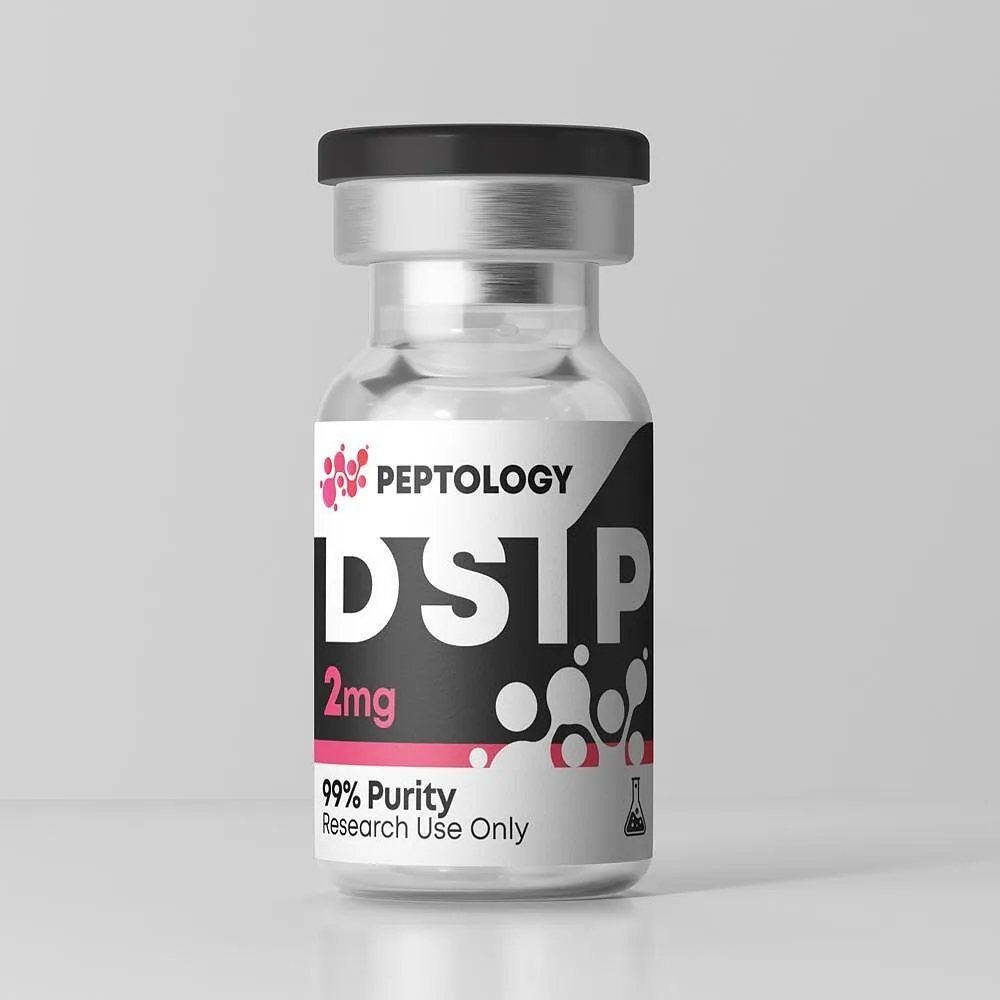
DSIP 5 mg (Delta Sleep-Inducing Peptide) – a nonapeptide (Trp-Ala-Gly-Gly-Asp-Ala-Ser-Gly-Glu), first isolated in the 1970s and studied in sleep and stress-response research; research peptide. Purity 99%+, HPLC/MS report for every batch.
📦 The product is in our EU warehouse – delivery within 3–5 working days.
29,00 € · In stock
For research use only / Not a medicine
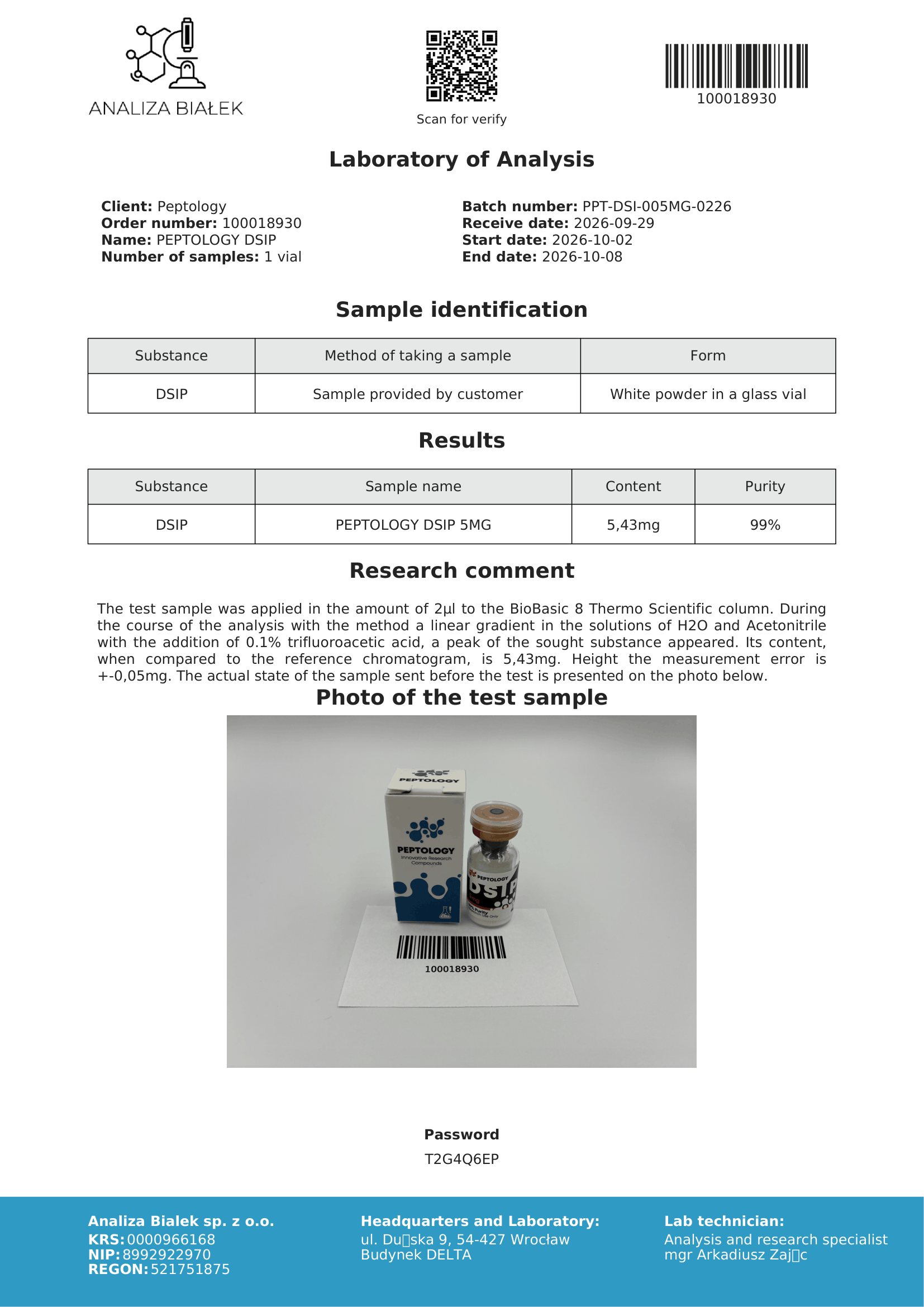
| Purity | >99% |
|---|---|
| Method | HPLC + LC/MS |
| Laboratory | Analiza Białek |
| Batch | 0226 |
What is DSIP (Delta Sleep-Inducing Peptide) 5 mg?
DSIP (Delta Sleep-Inducing Peptide) is a naturally occurring neuropeptide, discovered in the brain in the 1970s. It owes its name to its ability to induce delta waves in the EEG — characteristic of deep, restorative sleep (the NREM phase). In the research literature it is described as a compound supporting sleep, stress modulation and hormonal balance.
DSIP belongs to the category peptides for skin, sleep and libido — in the „sleep" segment, alongside the hormone Melatonin and the anti-aging Epithalon (which also affects melatonin production). DSIP stands out in that it acts at the level of sleep architecture itself, not just the circadian rhythm.
It is a research compound — it is not a medicinal product and holds no registration for clinical use in the EU. The product offered by Peptology is a research-grade reagent, not intended to diagnose or treat any conditions, including sleep disorders.
In the version offered by Peptology, DSIP is available in a 5 mg vial as a lyophilized peptide of high purity, confirmed by independent laboratory analysis (CoA for every batch). The product is intended exclusively for scientific research and in vitro applications.
Variant: DSIP 5 mg
This page concerns a single dose variant — DSIP 5 mg. Each vial contains 5 mg of lyophilized peptide. This is the standard amount for research protocols on sleep and the HPA axis — sufficient for a cycle of administrations, including a rotational schedule (e.g. 2–3 times a week) described in the literature.
VIAL · 5 MG
DSIP (neuropeptide)
5 mg of lyophilized peptide, purity confirmed by CoA for every batch.
REFERENCE CONCENTRATION
5 mg/mL or 2.5 mg/mL
5 mg in 1 mL = 5 mg/mL; in 2 mL = 2.5 mg/mL. Calculate in the calculator.
DSIP is offered exclusively in the 5 mg variant. If you are researching a different sleep-regulation mechanism, check the hormone Melatonin (circadian rhythm) or Epithalon (the pineal axis and melatonin).
How DSIP works — research mechanisms
In the research literature, DSIP is described as a neuropeptide that modulates several pathways related to sleep and stress. Below are the three most frequently studied elements.
DELTA WAVES / NREM SLEEP
Associated with the induction of delta waves and the extension of the deep sleep (NREM) phase in research models.
HPA AXIS / CORTISOL
Studied as a modulator of the stress response — an effect on corticotropin and cortisol levels.
GH AXIS
In some studies associated with support for the sleep-related endogenous secretion of growth hormone.
Why DSIP differs from melatonin
This is an important distinction: Melatonin primarily regulates the circadian rhythm (when the body „feels" it is time to sleep), whereas DSIP is studied for its effect on the architecture and depth of sleep itself (delta wave, NREM phase). That is why in studies they are sometimes combined as complementary — with the caveat of observing the effect on the REM phase.
Importantly, in observations DSIP is not described as a classic sedative — rather as a modulator of nighttime sleep without marked daytime drowsiness. These data come from studies and do not constitute a claim about the effect of the research-grade product offered by Peptology.
Pharmacokinetics and pharmacodynamics (research framework)
DSIP is a small, endogenous neuropeptide. The most important research features:
- Class: endogenous neuropeptide (Delta Sleep-Inducing Peptide)
- Targets: sleep-regulation pathways (delta wave), the HPA axis (cortisol), the GH axis
- Onset of observed action: in protocols usually 30–60 min after administration
- Profile: in studies described as well tolerated, without a daytime sedative effect
- Schedule: used daily or rotationally (2–3 times a week) depending on the protocol
- Route of administration in protocols: most often subcutaneous, per the research protocol
Comparison: DSIP vs Melatonin vs Epithalon
In the skin/sleep/libido category, three compounds concern sleep and regeneration, but at different levels. The table below helps orient you to how DSIP differs from two related products.
| DSIP (this page) | Melatonin | Epithalon | |
|---|---|---|---|
| Compound type | Neuropeptide | Hormone | Tetrapeptide |
| Main mechanism | Sleep architecture (delta wave, NREM) | Circadian rhythm (when to sleep) | Pineal gland, telomeres, melatonin |
| Main research area | Deep sleep, stress (HPA) | Falling asleep, jet lag | Aging, regeneration, sleep |
| Dose (this version) | 5 mg | 10 mg | 50 mg |
| Best for research on | Sleep depth and quality | Regulation of sleep timing | Cell renewal + sleep |
DSIP acts on the structure of sleep itself, Melatonin on its timing, and Epithalon on the broader context of the pineal gland and regeneration. This comparison is indicative in nature and does not constitute a recommendation for use.
Research areas for DSIP
DSIP has been studied since the 1970s, mainly in the context of sleep and the stress response. Below are the most frequently explored directions — all at the research stage, without confirmed indications for the research-grade product.
Sleep and the delta wave
The main direction of research on DSIP concerns sleep regulation — the induction of delta waves, extension of the NREM phase, and reduction of sleep-onset time and the number of nighttime awakenings in research models.
Stress and the HPA axis
DSIP is studied as a modulator of the stress response — through its effect on corticotropin and cortisol. Hence the interest in it in the context of chronic fatigue and elevated cortisol.
Neuroprotection and regeneration
The literature also contains observations regarding the neuroprotective and antioxidant properties of DSIP and its association with sleep-dependent growth hormone secretion. These are research directions, not confirmed therapeutic applications.
Note: The information is presented for scientific and informational purposes and is based on the research literature. It does not constitute medical advice, a recommendation for use or a claim about the effect of the research-grade product offered by Peptology.
DSIP profile at a glance
- Delta-wave-inducing neuropeptide — studied for deep, restorative sleep (NREM)
- Stress modulation: effect on the HPA axis and cortisol levels
- No daytime sedative effect — in observations, improved nighttime sleep without daytime drowsiness
- Different from melatonin: DSIP acts on sleep architecture, Melatonin on the circadian rhythm
- Category: skin, sleep and libido — alongside Epithalon and GHK-Cu
- Every batch with CoA and confirmed laboratory purity
All information provided concerns research literature on DSIP and should not be interpreted as a promise of effect, an instruction for use or a claim about the effect of the research-grade product offered by Peptology.
Research dosing protocols
Important: The information below describes schedules used in research on DSIP. It is provided for scientific and informational purposes and does not constitute a recommendation for individual use, medical advice or administration instructions. The research-grade DSIP offered by Peptology is not a registered medicine.
In research protocols, DSIP is usually administered after reconstitution of the lyophilizate, most often subcutaneously:
- Administration usually before the planned sleep period (action observed after ~30–60 min)
- Daily or rotational schedule (e.g. 2–3 times a week) depending on the protocol
- After reconstituting 5 mg in 1 mL the concentration is 5 mg/mL — calculate precise volumes and units in the peptide calculator
- Maximum 3 mL of solvent per vial
In combination protocols, DSIP is sometimes combined with Melatonin (with observation of the effect on the REM phase) or with GH-axis peptides. These schedules come from the research literature and do not constitute a recommendation for self-administration.
Side effects and safety
In research observations, DSIP is described as well tolerated. Side effects are usually mild and transient. The data concern research on the molecule.
Common (mild)
- Headache or dizziness
- Nausea
- Transient sweating
Less frequent
- Low blood pressure
- Injection-site reaction
- Effect on the REM phase (when combined)
To consider
- Observation with combination therapy
- No clinical data for the research-grade product
- Hypersensitivity to components
Most reported effects are mild and transient. With combination schedules, observation of the effect on sleep structure (the REM phase) is recommended. This information is scientific in nature and does not constitute an instruction for use.
Storage and reconstitution
DSIP is supplied as a lyophilized (freeze-dried) powder in a vial. In lyophilized form it is stable at room temperature, protected from light and moisture — refrigeration before reconstitution is not mandatory. After reconstitution, stability depends on the solvent used, with Peptide Matrix Water™ significantly extending the peptide's lifespan.
- Before reconstitution: room temperature, in the original packaging, protected from light and moisture. A refrigerator is not mandatory.
- After reconstitution with Peptide Matrix Water™: stability in the refrigerator +2 °C to +8 °C for up to 60 days under appropriate laboratory conditions — the stabilizing formula extends the peptide's lifespan relative to standard solvents.
- After reconstitution with bacteriostatic or sterile water: stability in the refrigerator +2 °C to +8 °C for up to 28 days under appropriate conditions. Do not refreeze the reconstituted solution.
- Reconstitution: in a laboratory setting, Peptide Matrix Water™, bacteriostatic water or sterile water for injection is usually used, depending on the protocol.
- Volume: maximum 3 mL of solvent (capacity of a standard vial). For a precise calculation of volume and units, use the peptide calculator.
- Homogenization: add the solvent slowly down the vial wall, without vigorous shaking, then wait 10–15 min. Swirl gently, do not shake.
Laboratory tip: With your order, you can add Peptide Matrix Water™ to the cart — a stabilizing solution designed for working with reconstituted research peptides. More in the article Bacteriostatic water vs acetic acid vs matrix water.
Frequently asked questions about DSIP
What exactly is DSIP?
It is a naturally occurring neuropeptide (Delta Sleep-Inducing Peptide), known for its ability to induce delta waves characteristic of deep sleep. In research it is associated with sleep regulation, stress modulation (the HPA axis) and support for the GH axis. The results come from the research literature.
How long does it take for DSIP to work?
In research protocols, the observed action usually appears within 30–60 minutes of administration, which is why DSIP is administered before the planned sleep period.
Does DSIP cause daytime drowsiness?
In observations, DSIP improves nighttime sleep without a marked daytime sedative effect — daytime drowsiness is rare. This is not, however, a claim about the effect of the research-grade product.
How does DSIP differ from melatonin?
Melatonin regulates sleep timing (the circadian rhythm), while DSIP is studied for the depth and structure of sleep itself (delta wave, NREM). In studies they are sometimes combined, with observation of the effect on the REM phase.
How is DSIP stored and reconstituted?
The lyophilized vial is stored at room temperature, protected from light and moisture. After reconstitution, stability depends on the solvent: with Peptide Matrix Water™ — up to 60 days in the refrigerator +2 °C to +8 °C; with bacteriostatic or sterile water — up to 28 days. Avoid refreezing.
Where to buy DSIP for research?
Peptology offers DSIP (5 mg) as a research peptide of confirmed purity with independent laboratory analysis for every batch. Fast shipping, discreet packaging and certificates of purity with the product. For scientific background, also see the article Peptides — what they are, how they work, main categories and safety profile.
Related products in the Peptology catalog
Researchers working with DSIP often also consider related sleep- and regeneration-regulating compounds from the same category. Each of the products below has a certificate of purity (CoA):
Melatonin
Circadian rhythm regulator — sleep timing
Epithalon
Pineal gland, cell renewal, melatonin
GHK-Cu
Copper peptide — regeneration and skin
Melanotan 2 (MT-2)
Pigmentation + libido (melanocortins)
PT-141 (Bremelanotide)
Libido-targeted peptide
Peptide Matrix Water™
Stabilizing solution for reconstitution
See the full catalog: Peptides for skin, sleep and libido · Peptides for energy and regeneration · Solutions for peptides · Blog on peptide research
Research warning: DSIP (Delta Sleep-Inducing Peptide) is offered exclusively for scientific research and in vitro purposes. It is not a medicinal product, is not approved for use in humans or animals, and does not replace medical advice. It is not intended to treat insomnia or other sleep disorders. All information comes from research literature and is provided for scientific and informational purposes; it does not constitute a claim about the effect of the research-grade product offered by Peptology.
Laboratory reconstitution
Laboratory protocol — reconstitution, research protocols, storage
Standardized protocol applicable to all research peptides in the Peptology catalogue. To calculate the solution concentration (mg/mL) for each vial, use the peptide reconstitution calculator.
60-second protocol
1. SOLVENT
2. RECONSTITUTION
Add the solvent down the side of the vial, without shaking, wait 10–15 min.
3. CALCULATION
Calculator → concentration mg/mL
4. STORAGE
+2 °C to +8 °C, up to 60 days with Peptide Matrix Water
Quick reference
| Parameter | Value |
|---|---|
| Form | Lyophilized powder |
| Solvent | Peptide Matrix Water |
| Reconstitution volume | 1–3 mL — maximum 3 mL (capacity of the standard vial) |
| Storage before reconstitution | Room temperature, protected from direct light (refrigeration not required) |
| After reconstitution | Up to 60 days at +2 °C to +8 °C with Peptide Matrix Water |
What you need
Precision pipette
Calibrated, 100–1000 µL — for accurately measuring the volume of solvent added to the vial.
70% alcohol swabs
Two swabs — to disinfect the peptide vial and the solvent vial.
Stabilized solvent for lyophilized peptides. Why this one.
Five rules for reconstitution
| ✅ Correct | ❌ Mistake |
|---|---|
| Disinfect the vial caps and the work surface with 70% alcohol; wear gloves | Working without disinfection |
| Add the solvent slowly along the vial wall | Direct jet onto the powder — foaming and denaturation |
| Gentle rolling between the palms | Shaking — foam, which denatures peptides |
| 10–15 minutes waiting at room temperature | Mechanical mixing or heating |
| Visual check: clear, particle-free | Working with a cloudy or discolored solution |
Calculating concentration
⚠️ Maximum 3 mL solvent. The standard vial does not accommodate larger volumes — do not exceed during reconstitution.
- Concentration (mg/mL) = mg in the vial ÷ mL of solvent
- Volume per sample (mL) = amount per sample (mg) ÷ concentration (mg/mL)
- 1 mg/mL = 1 µg/µL · 1 mL = 1000 µL
Reconstitution per vial — solvent: Peptide Matrix Water. Concentration after adding the solvent (1 mg/mL = 1 µg/µL):
| Vial | + 1 mL | + 2 mL | + 3 mL |
|---|---|---|---|
| 5 mg | 5 mg/mL | 2.5 mg/mL | 1.67 mg/mL |
👉 For any vial and solvent volume — use the calculator. It calculates the concentration (mg/mL, µg/µL) and the volume per sample (mL, µL).
Storage
BEFORE RECONSTITUTION
Room temperature, protected from direct light, in original packaging. Refrigerator not required.
AFTER RECONSTITUTION
+2 °C to +8 °C, up to 60 days with Peptide Matrix Water. Discard any remainder after this period.
FREEZING
Not recommended. Freeze/thaw cycles degrade peptide structure.
Four mistakes to avoid
1. Shaking "to dissolve faster"
Foam = denaturation. Only gentle rolling between the palms.
2. Inappropriate solvent
For peptide stability use only sterile, specially formulated solvent — recommended Peptide Matrix Water.
3. Ignoring slight turbidity
Not fully clear = the sample does not meet the criteria for use.
4. Taking it out of the refrigerator "for an hour–two"
Short exposures add up and compromise stability.
Research status: All Peptology products are intended for laboratory and research use only. They are not medicinal products, not approved for human or veterinary use and do not substitute medical advice. The described protocol is standard laboratory practice for working with lyophilized peptides.
Shipping information
🚚 Shipping information
-
Products in our warehouse – orders placed by 15:00 on working days are dispatched the same day, later orders on the next working day.
-
Delivery with GLS to your address in 3–5 working days.
-
Shipping costs €5 and is free from €50.
Frequently Asked Questions (FAQ)
In what form is DSIP supplied and how should it be stored?
It is supplied as a lyophilized (freeze-dried) powder in a sealed vial. Store the unopened vial dry and protected from light, ideally at 2–8 °C. After laboratory reconstitution, keep the solution at 2–8 °C and use it within the period stated in the “Laboratory reconstitution” tab (up to 60 days with Peptide Matrix Water).
What purity does DSIP have and how is it tested?
Every batch has a purity of 99% or higher, confirmed by HPLC and mass spectrometry (MS) and documented in a certificate of analysis (CoA). The report for the current batch is shown in the “Laboratory Analysis” tab.
Is a prescription required?
No. The product is for laboratory and research use only.
Where can I buy DSIP in Europe and what does it cost?
You can buy DSIP in Europe online from Peptology, from 29,00 €. Delivery with GLS in 3–5 working days. Shipping is free from 50,00 €. Payment by card. Purity 99%+, with an HPLC report for every batch.
Laboratory Analysis
DSIP - 5mg - Batch - 0226 - Purity
