🇪🇺 Fast delivery (3–5 working days) with GLS ✅ Card or bank transfer 📦 Free shipping from €50


AHK‑Cu
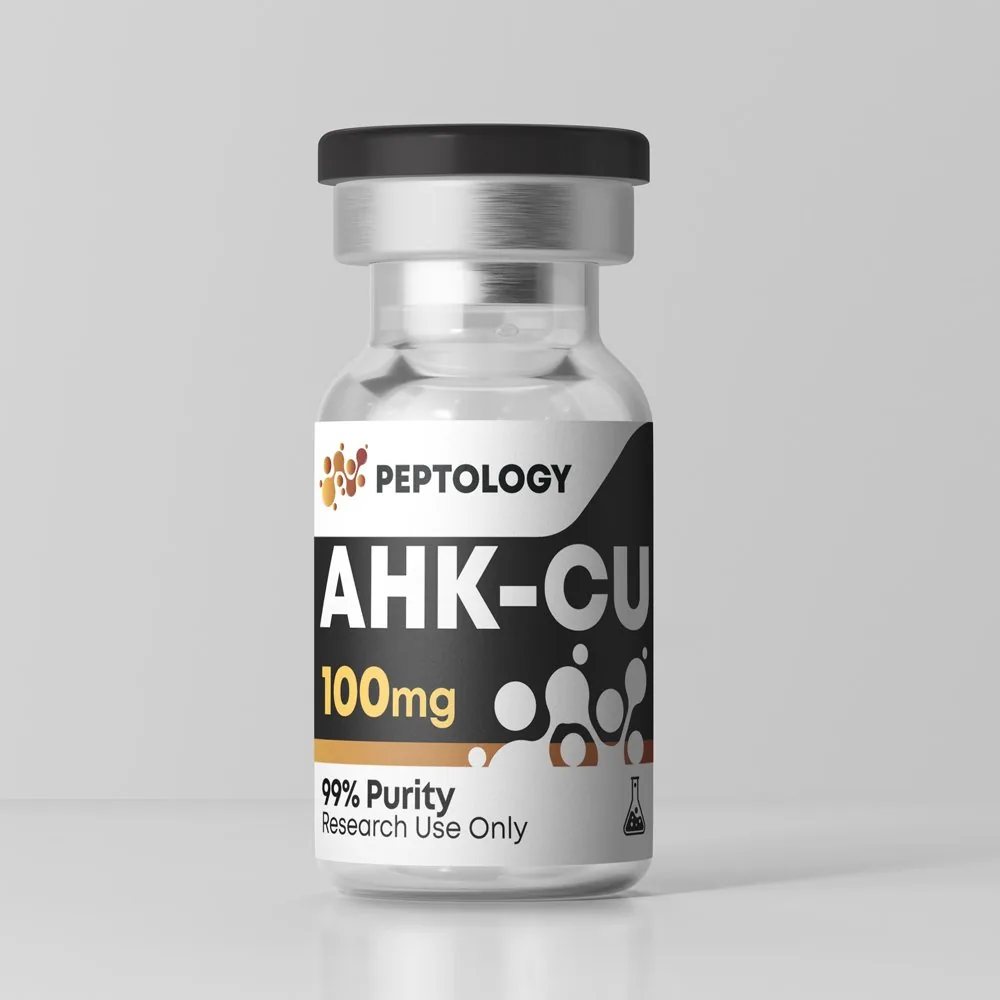
AHK-Cu 100 mg – Copper tripeptide (Ala-His-Lys) for research
Peptology Ltd. · Peptides for skin, sleep and libido
AHK-Cu 100 mg – copper tripeptide (Ala-His-Lys) for studies on hair growth and skin regeneration. Activates dermal papilla cells and is being investigated for prolongation of the anagen phase – a relative of GHK-Cu, but targeted to the hair follicle. Purity over 99 %. Topical research form, for research use only.
📦 The product is in our EU warehouse – delivery within 3–5 working days.
50,00 € · In stock
For research use only / Not a medicine
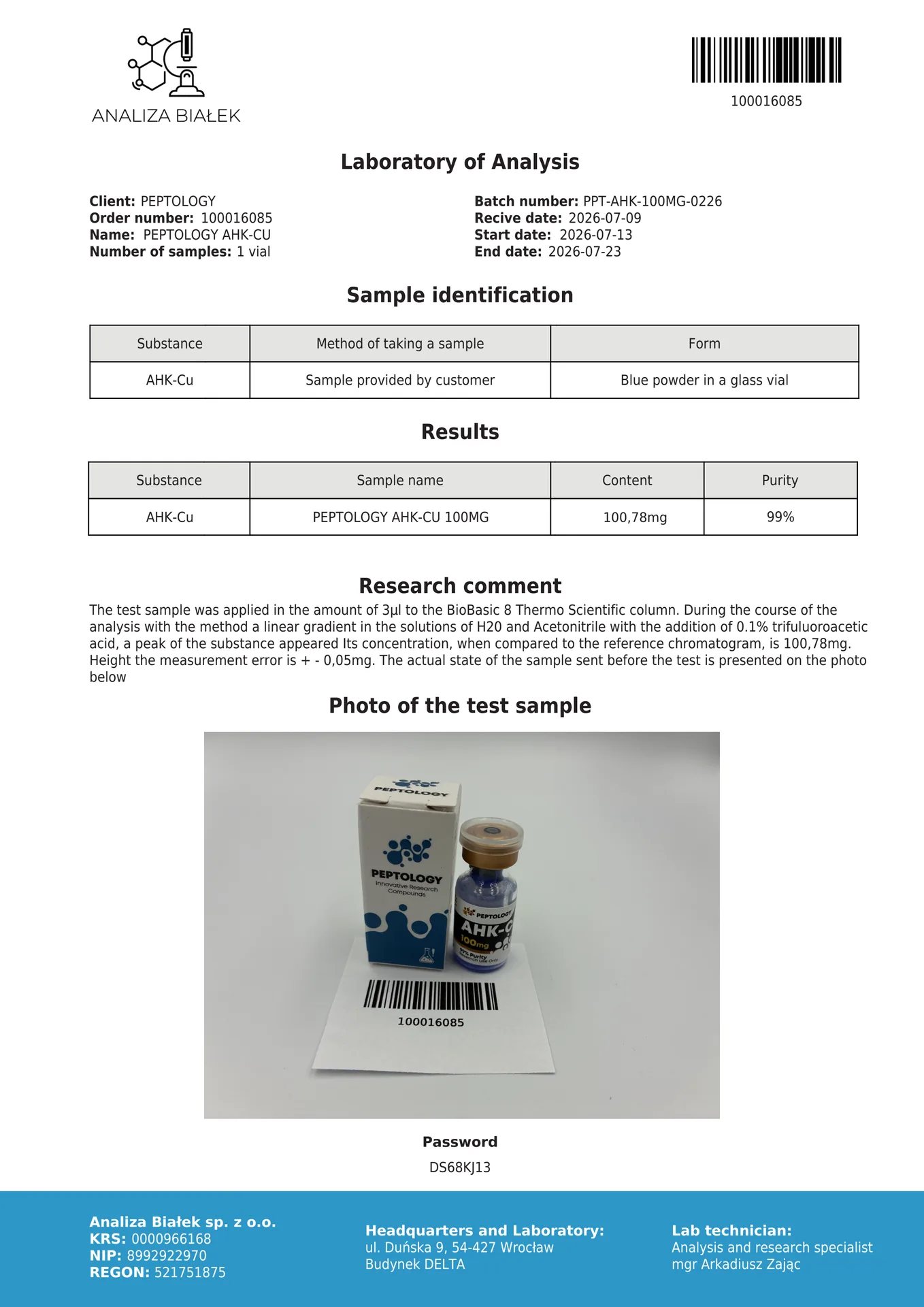
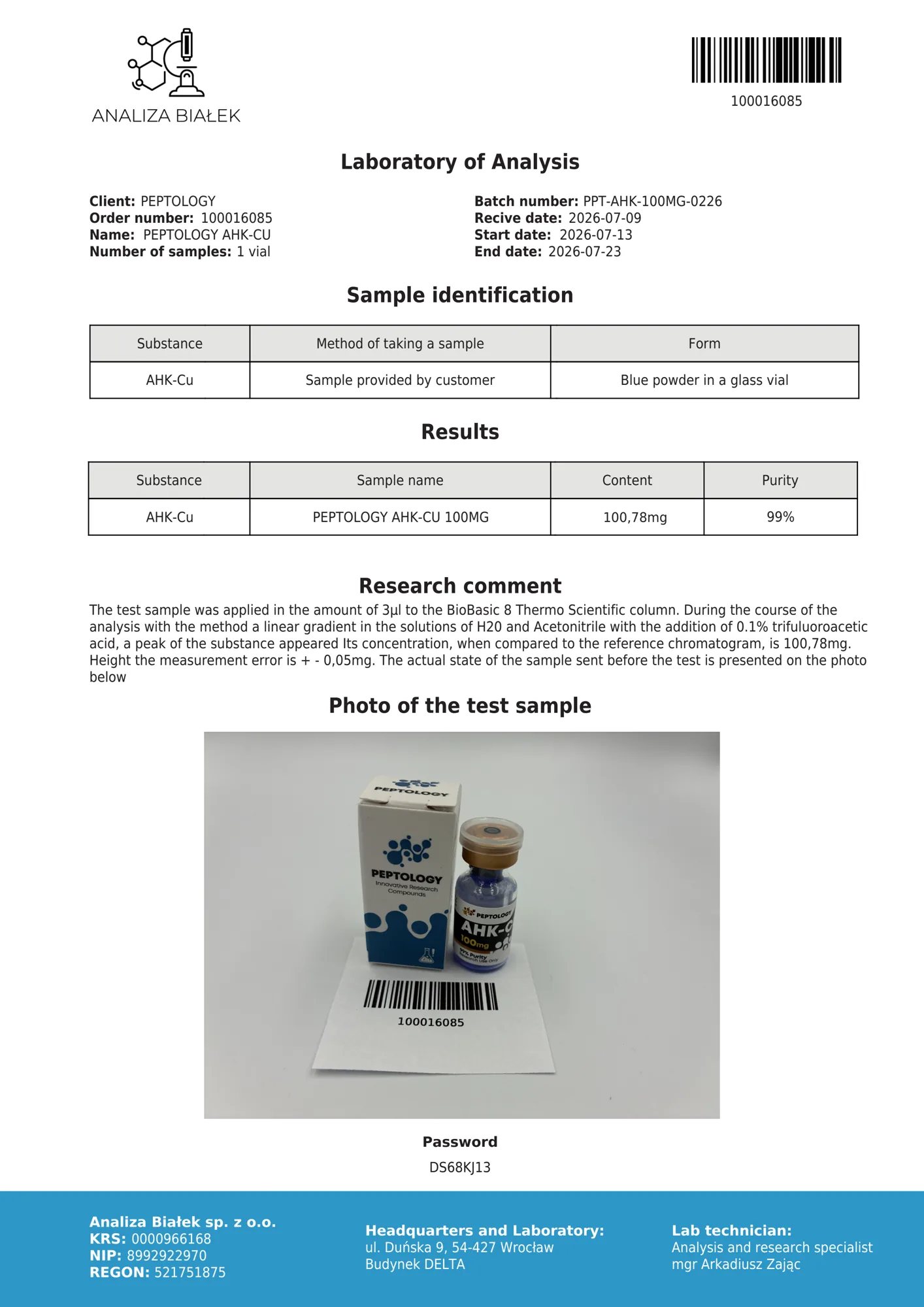
| Purity | >99% |
|---|---|
| Method | HPLC + LC/MS |
| Laboratory | Analiza Białek |
| Batch | 0226 |
Last updated: 23/07/2026
What is AHK-Cu (copper tripeptide)?
AHK-Cu is a copper tripeptide with sequence Ala-His-Lys (alanine-histidine-lysine), complexed with a copper(II) ion. It belongs to the family of copper peptides — short amino acid chains that form a stable complex with copper and act both as a carrier of this trace element and as a signalling molecule in the skin and hair follicle. This group also includes the more extensively studied GHK-Cu, but AHK-Cu is positioned more specifically toward hair growth and hair follicle activation, alongside skin regeneration.
Copper is an essential cofactor for dozens of enzymes involved in the synthesis and crosslinking of collagen and elastin (for example lysyl oxidase), in antioxidant defence and in angiogenesis. Copper peptides such as AHK-Cu are investigated because they deliver copper in a biologically available form while also modulating gene expression and cellular signalling in dermal and follicular cells.
In various sources the compound is inconsistently labelled as „Acetyl Tripeptide-1 Cu“, „Copper Tripeptide-1“ or „Copper Tripeptide-3“, so the exact INCI name varies between suppliers. This discrepancy is important when comparing formulations — different labels often describe the same or a very similar active complex. In the scientific and cosmetic literature AHK-Cu is most often associated with prolongation of the anagen (growth) phase of the hair cycle and with activation of dermal papilla cells.
In the Peptology version AHK-Cu is supplied as a lyophilised powder for research and cosmetic-formulation purposes, with purity above 99%, confirmed by independent laboratory analysis (see the certificates attached to the product). The product is intended solely for scientific research purposes and is not a medicinal or finished cosmetic product. See also the peptides for skin, sleep and libido category.
How AHK-Cu works — mechanism
In research and ex vivo models AHK-Cu is described as a copper peptide that acts on several levels in the skin and follicle simultaneously. The three axes below summarise the main directions in which the compound is studied.
DERMAL PAPILLA
It is studied for stimulation of proliferation and extended survival of dermal papilla cells — the „control centre“ that governs the growth of each hair.
ANAGEN PHASE
Investigated in relation to prolongation of the anagen (growth) phase of the hair cycle and elongation of the hair follicle in organ culture.
COPPER + MATRIX
As a copper peptide it is associated with remodelling of the extracellular matrix (ECM), antioxidant protection and signalling via growth pathways VEGF/HGF.
Why dermal papilla cells are key
The dermal papilla is a small structure at the base of the hair follicle composed of specialised mesenchymal cells. It determines the length of the growth phase, hair shaft thickness and hair density. In studies, reduction in the number and activity of these cells is associated with follicle miniaturisation. Therefore, compounds that support proliferation and survival of papillary cells are of interest in hair growth models — and this is where AHK-Cu is positioned.
The role of copper in the skin
Copper participates in crosslinking collagen and elastin via the enzyme lysyl oxidase, in antioxidant defence via superoxide dismutase and in angiogenesis. By delivering copper in a peptide-bound form, AHK-Cu is studied not only for the direct signalling effects of the tripeptide but also for the contribution of copper itself to the structure and resilience of the dermal matrix. This dual role — signalling molecule plus micronutrient carrier — is characteristic of the entire class of copper peptides.
Hair cycle and where AHK-Cu fits
Each hair follicle undergoes a repeating cycle of three main phases. Understanding them explains why research on AHK-Cu is focused primarily on the anagen phase.
ANAGEN
Active growth phase, lasting years. The longer it is, the longer and thicker the hair shaft. The target of AHK-Cu research.
CATAGEN
Short transitional phase (weeks) during which the follicle regresses and growth stops.
TELOGEN
Resting phase, after which the hair falls out and a new cycle begins. Predominance of this phase is associated with thinning.
In baldness models the balance shifts toward a shorter anagen and longer telogen, leading to follicle miniaturisation. Copper peptides are studied for their ability to prolong the anagen phase and maintain dermal papilla activity — therefore AHK-Cu appears mainly in protocols and formulations aimed at hair density and quality.
Properties and characteristics of AHK-Cu
- Sequence: Ala-His-Lys (alanine-histidine-lysine), complexed with Cu(II)
- Class: copper tripeptide / „copper peptide“; related to GHK-Cu
- INCI (varies): Acetyl Tripeptide-1 Cu / Copper Tripeptide-1 / Copper Tripeptide-3
- Form: lyophilised powder with a bluish to blue hue, typical for copper complexes
- Solubility: water-soluble; for topical formulations it is dissolved in water/bacteriostatic water to the target concentration
- Main application: topical (local) research use — solutions, serums, creams
- Stability: better in lyophilised form; reconstituted solutions are stored cool and protected from light
AHK-Cu vs GHK-Cu
Both are copper tripeptides, but they are studied for different priorities: AHK-Cu is more focused on hair and follicle, whereas GHK-Cu has a broader dataset for skin, collagen and wound healing. In many research protocols the two peptides are viewed as complementary — one targeting the follicle, the other the dermis.
| AHK-Cu | GHK-Cu | |
|---|---|---|
| Sequence | Ala-His-Lys + Cu | Gly-His-Lys + Cu |
| Primary focus | Hair / follicle | Skin / collagen / wounds |
| Key target | Dermal papilla | Fibroblasts / ECM |
| Evidence base | More limited | More extensive |
| Typical form | Local / cosmetic | Local / cosmetic |
Note: the positioning for hair growth is mainly based on an earlier ex vivo hair follicle study and on class-level data for copper peptides. This information is a scientific reference, not a claim of effect or comparative efficacy.
Research forms and concentrations
AHK-Cu is primarily a topical (local) ingredient. The table summarises typical research forms and concentrations used in laboratory and cosmetic-formulation protocols. The choice between solution and cream depends on the goal — solutions absorb faster, while creams provide longer skin retention.
| Form | Concentration | Frequency | Skin absorption* | Note |
|---|---|---|---|---|
| Topical solution | 0.01–0.1% (100–1000 mcg/mL) |
1–2× daily | 15–25% | Most common research form |
| Topical cream | 0.005–0.05% (50–500 mcg/g) |
2× daily | 10–20% | Improved skin retention |
Important: *Skin absorption values are indicative and depend on formulation, vehicle and skin model. The data are summarised for scientific reference and do not constitute a recommendation for individual use, medical advice or application instructions. 100 mg of raw material is typically dissolved for topical formulations, not for injection.
To prepare a research solution 100 mg AHK-Cu can be reconstituted in a specific volume of liquid to reach the desired concentration — for example 100 mg in 100 mL gives 0.1% (1000 mcg/mL), and further dilution allows reaching the lower concentrations from the table. For reconstitution we recommend Peptide Matrix Water™ — a stabilising solution formulated for work with reconstituted research peptides, which helps preserve the stability of the copper complex. Alternatively, bacteriostatic water or sterile water may be used according to protocol.
Scientific basis and research
Ex vivo hair follicle model
A frequently cited earlier ex vivo study reports that AHK-Cu at very low concentrations (in the pico- to nanomolar range) stimulates elongation of isolated hair follicles in organ culture for about two weeks. These models allow direct investigation of the follicle effect isolated from systemic factors and underpin the positioning of AHK-Cu as a hair-targeting peptide.
The class of copper peptides
Broader literature on copper peptides (including GHK-Cu) describes effects on collagenogenesis, angiogenesis, antioxidant defence and modulation of gene expression toward a more „youthful“ profile. Because AHK-Cu shares the copper complex and similar structure, some of these mechanisms are inferred by analogy — but it should be noted that the AHK-Cu-specific evidence base is more limited than that for GHK-Cu.
Skin and collagen
In the context of skin, AHK-Cu is considered alongside other copper peptides for contribution to dermal matrix structure, skin texture and antioxidant balance. These directions make it interesting for cosmetic-formulation research beyond hair growth alone.
Much of the available data are ex vivo or derived by analogy from the copper peptide class. No large clinical trials in humans confirming efficacy and safety exist — therefore all statements are presented in a research context.
Documented research focus
- Hair growth — activation of the dermal papilla and prolongation of the anagen phase in ex vivo models.
- Hair density and quality — investigated for maintenance of follicular activity against miniaturisation.
- Skin regeneration — class-level copper peptide effects on matrix and collagen.
- Antioxidant balance — copper as a cofactor in defence against oxidative stress.
- Scalp care — studied in cosmetic-formulation contexts (serums, sprays, creams).
The listed directions reflect published preclinical and ex vivo studies and do not constitute a claim of effect or a recommendation for use.
Storage and reconstitution
Proper storage is important to maintain the stability of the copper complex during laboratory work.
- Before reconstitution: lyophilised, kept cool and dry, protected from light; for long-term storage freeze (−20 °C).
- After reconstitution: in the fridge 2–8 °C, protected from light; avoid repeated freezing.
- Formulation: dissolve to the target concentration for a topical solution or incorporate into a suitable cream base.
- Handling: clean laboratory conditions and minimal exposure to light and heat are recommended.
Lab tip: when ordering you may add Peptide Matrix Water™ to the cart — we recommend it as a reconstitution medium for research peptides because it improves solution stability.
Frequently asked questions about AHK-Cu
How does AHK-Cu differ from GHK-Cu?
The sequence differs (Ala instead of Gly at the first position). AHK-Cu is studied more specifically for hair/follicle, while GHK-Cu has a larger evidence base for skin and collagen.
Is AHK-Cu for injection?
No — the compound is primarily a local (topical) cosmetic-research ingredient. 100 mg of raw material is typically dissolved for topical formulations. The product is strictly for research purposes.
What concentration is used?
In research solutions typically 0.01–0.1%, and in creams 0.005–0.05%. Values are indicative and depend on the protocol.
Related products
GHK-Cu
Copper peptide for skin and collagen
Epithalon
Anti-aging tetrapeptide
Melatonin
Regulator of sleep and circadian rhythm
See the full catalogue: Peptides for skin, sleep and libido · Peptide research blog
Research warning: AHK-Cu is supplied solely for scientific research and cosmetic-formulation purposes and for in vitro applications. The product is not approved for clinical use, is not a medicine, is not a finished cosmetic product and is not intended for consumption by humans or animals. The information provided (including concentrations and absorption values) reflects preclinical, ex vivo and analog data for the class of copper peptides and is for scientific reference only. It does not constitute medical advice, application instructions or a recommendation for use. Before starting any research consult a qualified specialist and applicable regulatory framework. Peptology is not liable for unauthorised use of research peptides.
Laboratory reconstitution
Laboratory protocol — reconstitution, research protocols, storage
Standardized protocol valid for all research peptides in the Peptology catalogue. To calculate the solution concentration (mg/mL) for each vial, use the peptide reconstitution calculator.
60-second protocol
1. SOLVENT
2. RECONSTITUTION
Add the solvent along the vial wall, do not shake, wait 10–15 min.
3. CALCULATION
Calculator → concentration mg/mL
4. STORAGE
+2 °C to +8 °C, up to 60 days with Peptide Matrix Water
Quick reference
| Parameter | Value |
|---|---|
| Form | Lyophilized powder |
| Solvent | Peptide Matrix Water |
| Reconstitution volume | 1–3 mL — maximum 3 mL (capacity of a standard vial) |
| Storage before reconstitution | Room temperature, protected from direct light (refrigeration not required) |
| After reconstitution | Up to 60 days at +2 °C to +8 °C with Peptide Matrix Water |
What you need
Precision pipette
Calibrated, 100–1000 µL — for accurately measuring the volume of solvent added to the vial.
70% alcohol swabs
Two swabs — for disinfecting the peptide vial and the solvent vial.
Stabilized solvent for lyophilized peptides. Why this one.
Five rules for reconstitution
| ✅ Correct | ❌ Mistake |
|---|---|
| Disinfect the vial caps and the work surface with 70% alcohol; wear gloves | Working without disinfection |
| Add the solvent slowly along the vial wall | Direct jet onto the powder — foaming and denaturation |
| Gentle rolling between the palms | Shaking — foam that denatures peptides |
| 10–15 minutes wait at room temperature | Mechanical stirring or heating |
| Visual check: clear, free of particles | Working with a cloudy or colored solution |
Calculating concentration
⚠️ Maximum 3 mL solvent. The standard vial does not accommodate larger volume — do not exceed when reconstituting.
- Concentration (mg/mL) = mg in the vial ÷ mL solvent
- Volume per sample (mL) = amount per sample (mg) ÷ concentration (mg/mL)
- 1 mg/mL = 1 µg/µL · 1 mL = 1000 µL
Reconstitution per vial — solvent: Peptide Matrix Water. Concentration after adding the solvent (1 mg/mL = 1 µg/µL):
| Vial | + 1 mL | + 2 mL | + 3 mL |
|---|---|---|---|
| 100 mg | 100 mg/mL | 50 mg/mL | 33.33 mg/mL |
👉 For any vial and solvent volume — use the calculator. It calculates the concentration (mg/mL, µg/µL) and the volume per sample (mL, µL).
Storage
BEFORE RECONSTITUTION
Room temperature, protected from direct light, in the original packaging. Refrigeration not required.
AFTER RECONSTITUTION
+2 °C to +8 °C, up to 60 days with Peptide Matrix Water. Dispose of any remainder after this period.
FREEZING
Not recommended. Freeze/thaw cycles degrade peptide structure.
Four mistakes to avoid
1. Shaking “to dissolve faster”
Foam = denaturation. Only gently roll between the palms.
2. Inappropriate solvent
For peptide structural stability use only sterile, specially formulated solvent — recommended Peptide Matrix Water.
3. Ignoring slight cloudiness
Not completely clear = the sample does not meet working criteria.
4. Taking out of the refrigerator “for an hour–two”
Short exposures add up and compromise stability.
Research status: All products from Peptology are intended for laboratory and research use only. They are not medicinal products, are not approved for human or veterinary use, and do not replace medical advice. The described protocol is standard laboratory practice for handling lyophilized peptides.
Shipping information
🚚 Shipping information
-
Products in our warehouse – orders placed by 15:00 on working days are dispatched the same day, later orders on the next working day.
-
Delivery with GLS to your address in 3–5 working days.
-
Shipping costs €5 and is free from €50.
Frequently Asked Questions (FAQ)
How does AHK-Cu differ from GHK-Cu?
Both are copper tripeptides, but the sequence differs (Ala instead of Gly in the first position). AHK-Cu is investigated more specifically for hair and follicle, while GHK-Cu has a broader evidence base for skin, collagen and wound healing.
What is AHK-Cu researched for?
Mainly for hair growth (activation of the dermal papilla and extension of the anagen phase) and for skin regeneration in a cosmetic-formulation context.
Is AHK-Cu for injection?
No. The compound is primarily a local (topical) cosmetic research component. 100 mg of raw material is typically dissolved for topical formulations.
How is AHK-Cu stored?
Store in a cool, dry place, protected from light; frozen for long-term storage. After reconstitution – refrigerate at 2–8 °C, do not refreeze.
Is a prescription required?
No. Supplied for research purposes, without the need for a prescription.
Where can I buy AHK‑Cu in Europe and what does it cost?
You can buy AHK‑Cu in Europe online from Peptology, from 50,00 €. Delivery with GLS in 3–5 working days. Shipping is free from 50,00 €. Payment by card. Purity 99%+, with an HPLC report for every batch.
Laboratory Analysis
AHK‑Cu - 100 mg - Batch - 0226 - Purity