
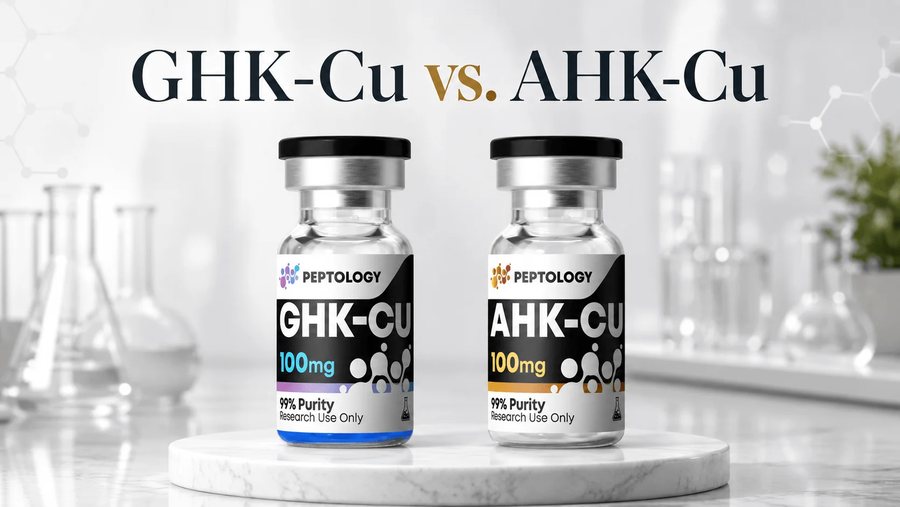
GHK-Cu and AHK-Cu: what is the difference between the two copper tripeptides
A detailed comparative analysis of the two best-known copper peptides – GHK-Cu for skin and collagen regeneration, and AHK-Cu for hair growth. We examine the mechanism, the similarities and differences, the advantages and disadvantages, and when choosing each of them is justified.
Copper peptides are short amino-acid chains that form a stable complex with a copper ion (Cu²⁺) and act simultaneously as a carrier of this essential trace element and as a signalling molecule in the skin, connective tissue and hair follicle. The two best-known representatives are GHK-Cu (Gly-His-Lys) and AHK-Cu (Ala-His-Lys) – almost identical in structure (differing only by one amino acid at the first position), but with a different research focus. GHK-Cu is the more widely studied „universal“ regenerative peptide for skin, collagen and healing, whereas AHK-Cu is positioned more specifically toward hair growth and hair-follicle activation. This article explains what distinguishes the two, when each is more suitable, and how they are used. Both products have a purity above 99%, confirmed by independent laboratory analysis (CoA) for every batch.
1. What is GHK-Cu (Gly-His-Lys)
GHK-Cu (Glycyl-L-histidyl-L-lysine + Cu²⁺; also known as copper tripeptide-1 or Copper Tripeptide-1) is a naturally occurring human tripeptide complexed with copper ions. The molecule was first isolated by Prof. Loren Pickart in 1973 from human plasma, where it is present at concentrations of around 200 ng/mL in young adults. With age these levels decline progressively – to around 80 ng/mL by the age of 60 – and this decline is associated in the literature with the reduced regenerative capacity of skin and tissues.
Functionally, GHK-Cu is a multifunctional regenerative mediator with a particularly strong action on skin, connective tissue and hair. In clinical and experimental studies it is associated with stimulation of collagen and elastin synthesis, activation of DNA-repair genes, antioxidant and anti-inflammatory activity, angiogenesis, stimulation of hair growth and reduction of pigmentation. GHK-Cu is an established cosmetic ingredient (under the INCI name Copper Tripeptide-1) and is present in hundreds of topical dermatological products. As an injectable/research peptide, however, it is not an approved medicinal product and remains a research candidate. It is offered in a 100 mg format.
2. What is AHK-Cu (Ala-His-Lys)
AHK-Cu is a copper tripeptide with the sequence Ala-His-Lys (alanyl-histidyl-lysine), complexed with a copper(II) ion. It belongs to the same family of copper peptides as GHK-Cu, but is positioned more specifically toward hair growth and hair-follicle activation, alongside skin regeneration. In various sources the compound is referred to inconsistently as „Acetyl Tripeptide-1 Cu“, „Copper Tripeptide-1“ or „Copper Tripeptide-3“, so the exact INCI name varies between suppliers.
The main research direction for AHK-Cu is prolongation of the anagen (growth) phase of the hair cycle and activation of the dermal papilla cells – the „control centre“ that governs the growth of each hair. AHK-Cu is predominantly a topical (local) component – 100 mg of raw material is usually dissolved for topical formulations (solutions, serums, creams) rather than for injection. The database specific to AHK-Cu is more limited than that for GHK-Cu and is based mainly on earlier ex vivo studies of the hair follicle and on data for the copper-peptide class as a whole. It is offered in a 100 mg format.
3. Mechanism: how copper peptides work
Both peptides share the common logic of copper complexes: the histidine residue at the second position forms a specific coordination site for Cu²⁺, and copper itself is an essential cofactor for over 100 enzymes – including lysyl oxidase (maturation of collagen and elastin), superoxide dismutase (antioxidant defence) and tyrosinase (pigmentation). The difference lies in the target:
GHK-Cu – fibroblasts and matrix
GHK-Cu acts as a „copper taxi“, delivering Cu²⁺ to fibroblasts and dermal cells. It stimulates the synthesis of collagen, elastin and glycosaminoglycans, and in microarray studies it has been linked to the modulation of over 1000 genes – including those for DNA repair, antioxidant defence and tissue repair.
AHK-Cu – dermal papilla
AHK-Cu is studied for stimulating the proliferation and survival of dermal papilla cells, for prolonging the anagen phase and elongation of the hair follicle in organ culture. As a copper peptide it is also associated with matrix remodelling and signalling along the VEGF/HGF growth pathways.
In other words, both peptides deliver copper and activate similar enzyme systems, but GHK-Cu is directed primarily at the dermis (skin, collagen, wounds), while AHK-Cu targets the follicle (hair, scalp). This is precisely why in many research protocols the two are regarded as mutually complementary rather than as competitors.
4. Table: GHK-Cu vs AHK-Cu – full comparison
| Characteristic | GHK-Cu | AHK-Cu |
|---|---|---|
| Sequence | Gly-His-Lys + Cu²⁺ | Ala-His-Lys + Cu²⁺ |
| Main focus | Skin, collagen, healing | Hair, hair follicle |
| Key target cell | Fibroblasts / ECM | Dermal papilla |
| Origin | Naturally occurring human plasma tripeptide (1973) | Synthetic copper tripeptide |
| Database | Extensive (50+ years of research) | More limited (mainly ex vivo) |
| Routes of administration | Topical / SC / intradermal | Predominantly topical |
| Cosmetic status | Established INCI name (Copper Tripeptide-1) | Varies by INCI name |
| Format | 100 mg | 100 mg |
The data are for scientific reference and are based on published literature. They do not represent a direct head-to-head clinical comparison, nor a claim of effect or comparative efficacy of the research-grade products.
5. Similarities between the two peptides
Despite their different focus, GHK-Cu and AHK-Cu have much in common. Both are copper tripeptides with histidine at the second position, which coordinates Cu²⁺, and they share the common role of copper as a carrier of an essential trace element and a signalling molecule. Both are supplied as a lyophilised powder with a bluish to blue tint (characteristic of copper complexes), with a purity above 99% and a CoA for every batch. Both are used predominantly topically in dermatological and cosmetic-formulation protocols, are dissolved in an aqueous medium to a target concentration, and fall into the Peptides for skin, sleep and libido category in the Peptology catalogue. Neither is an approved medicinal product for injection, and both are offered solely for research purposes. Because of their similar mechanism they are often considered in combination – one directed at the dermis, the other at the follicle.
6. Advantages and disadvantages
- Extensive database – 50+ years of research and decades of cosmetic use.
- Broad spectrum – skin, collagen, wrinkles, wound healing, pigmentation and hair.
- Multiple routes of administration (topical, SC, intradermal).
- Established cosmetic ingredient (Copper Tripeptide-1), widely documented in the literature.
- A large 100 mg format.
- Specific focus on hair – activation of the dermal papilla and the anagen phase.
- Suitable for targeted protocols for hair density and quality.
- More limited research base (mainly ex vivo, without large-scale clinical trials).
- Predominantly topical – not intended for injection.
- Inconsistent INCI name between suppliers – requires attention when making comparisons.
7. Which one when: how to choose
The choice between the two copper peptides depends on the specific research objective:
When GHK-Cu is more suitable: when the focus is on the skin – synthesis of collagen and elastin, reduction of wrinkles, skin texture and density, wound healing or reduction of pigmentation. GHK-Cu is also the logical choice when a molecule with broad scientific validation and flexibility of application (topical, subcutaneous or mesotherapeutic) is sought. Because of its extensive database it is the „more universal“ option for general regenerative and anti-aging protocols.
When AHK-Cu is more suitable: when the main objective is hair growth and density. AHK-Cu is specifically positioned toward activation of the dermal papilla and prolongation of the anagen phase, which makes it a natural choice for trichological formulations – scalp serums and solutions. For research directed exclusively at the follicle, AHK-Cu is the more targeted candidate.
Combining: because of their complementary targets (dermis versus follicle) the two peptides are often considered together in comprehensive skin and hair protocols. GHK-Cu is also combined with regenerative peptides such as Epithalon (anti-aging) in broader protocols for cellular renewal.
8. Reconstitution and storage
Both copper peptides are supplied as a lyophilised powder and require careful reconstitution in order to preserve the stability of the copper complex:
- Solvent: Peptide Matrix Water™ from the Solutions for peptides category is recommended – a stabilising solution that extends the life of the reconstituted peptide. It is added slowly down the wall of the vial, without shaking. The solution should acquire a characteristic light blue-greenish colour – a sign of an intact Cu²⁺ complex.
- Storage: lyophilised – in a cool, dry place, protected from light (for long-term storage −20°C). After reconstitution – in a refrigerator at 2–8°C, for up to 60 days with Peptide Matrix Water™; without refreezing.
- Important: avoid contact with EDTA and other chelating agents – they can destabilise the copper complex and reduce activity.
- Concentration calculation: for accurate values with any given vial and volume, use the peptide reconstitution calculator.
Choose the right copper peptide for your research
Both peptides have a purity above 99% and independent laboratory analysis for every batch, with discreet delivery in 3–5 working days.
Explore GHK-Cu and AHK-Cu at Peptology9. Conclusion
GHK-Cu and AHK-Cu are close cousins from the copper-peptide family that differ by only one amino acid – but it is precisely this difference that steers their research focus in different directions. GHK-Cu is the widely studied, universal copper peptide for skin, collagen, healing and anti-aging, with an extensive database and flexibility of application. AHK-Cu is the more specialised candidate for hair growth, directed at the dermal papilla and the anagen phase. For many researchers they are not alternatives but complementary tools – one for the dermis, the other for the follicle. At Peptology we strive to provide consistent quality for all your research projects in the field of copper peptides and regeneration.