
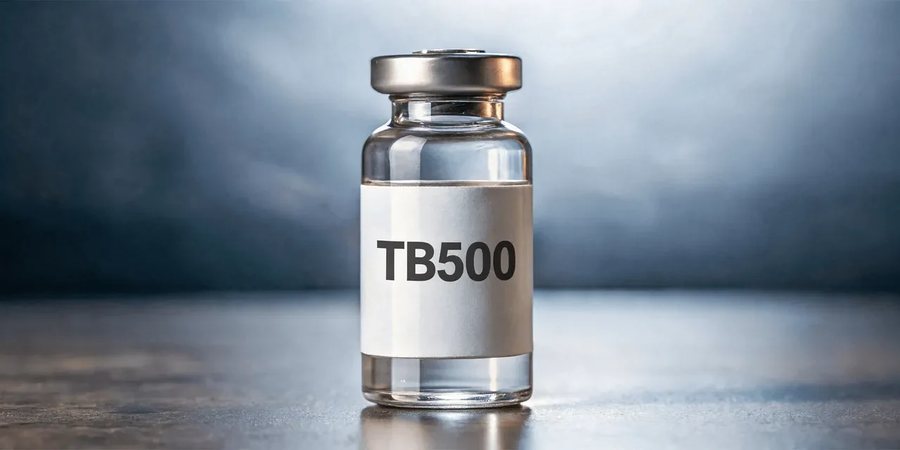
TB-500 5 mg/10 mg – a high‑potency peptide for regeneration and recovery: what it is, how it works, benefits, risks, combinations and its place among „Recovery & Anabolic Peptides“
Part of the "Recovery & Anabolic Peptides" category. See product: TB-500.
Summary (brief)
TB-500 is a synthetic peptide designed as a functional fragment/analogue of thymosin beta-4 (Tβ4) – a cytosolic peptide widely expressed in mammalian tissues. Its primary researched actions relate to actin dynamics (G-actin binding), cell migration, angiogenesis and anti‑inflammatory effects. In preclinical models TB-500/Tβ4 support wound healing, tendon/ligament regeneration, myocardial protection after ischemia and neuroregeneration. The peptide is supplied for research use and is not intended for human use.
What is TB-500 and how it differs from Tβ4
Thymosin beta-4 (≈43 AK) is a native peptide that binds G‑actin and regulates polymerization/depolymerization of F‑actin – a process critical for cell migration, angiogenesis and tissue remodelling. TB-500 is synthetically developed to replicate the „regenerative“ domains of Tβ4 while offering improved stability and practicality for research settings. It is important to distinguish: Tβ4 is endogenous, whereas TB-500 is a research reagent; both are predominantly studied in preclinical/early clinical contexts and lack established medical indications in humans.
Mechanism of action – why „actin“ is central
- G‑actin binding → modulation of the cytoskeleton, accelerated cell migration (fibroblasts, keratinocytes, endothelial cells).
- Angiogenesis → stimulation of VEGF‑dependent pathways and capillary neovascularization in wound models.
- Anti‑inflammatory effects → reduction of infiltration/cytokine activation, creating a pro‑regenerative milieu.
- Anti‑apoptotic and cytoprotective activity in cardiac and neural models.
These mechanistic lines explain why TB-500 is often positioned within „recovery and regeneration“ rather than as a „pure anabolic“ agent.
Potential benefits (research context)
- Wound healing and epithelial regeneration: preclinical and early clinical observations describe faster wound closure, improved granulation and re‑epithelialization. (Reviews/publications: PubMed/PMC – search for “thymosin beta-4 wound healing”).
- Tendons/ligaments/fascia: tendonopathy and ligament injury models show improved collagen organization, cellular proliferation and mechanical strength after exposure to Tβ4/TB-500.
- Muscle recovery: data indicating reduced damage markers and accelerated functional recovery after mechanical stress; hypotheses for synergy with training stimulus and adequate protein intake.
- Cardioprotection: in animal models – reduced infarct size, improved capillarization and function after ischemic events.
- Neuroregeneration: experimental models suggest neuroprotective effects and support for axonal growth/remyelination.
Note: The benefits above are derived from preclinical and limited early studies. They do not constitute proven medical indications in humans.
TB-500 in the context of the „Recovery & Anabolic Peptides“ category
This category includes molecules that:
- stimulate the GH–IGF-1 axis endogenously (e.g. GHRH analogues/ghrelin agonists),
- act „downstream“ (IGF-1), or
- provide supportive mechanisms for recovery (antioxidant/redox protection).
TB-500 is a typical representative of the third logic: it is not a GH/IGF-1 modulator, but a regenerative peptide that acts on the cytoskeleton, angiogenesis and cell migration. For this reason it is often considered as a complementary element to „pulsatile“ strategies (e.g. CJC-1295 without DAC + Ipamorelin for sleep/recovery) and redox support (glutathione).
Comparison: TB-500 vs. BPC-157
- Primary focus: TB-500 – actin‑mediated migration/angiogenesis; BPC-157 – gastrointestinal mucosa, tendon/ligament structures, NO signalling and vascular protection (based on preclinical data).
- Tissue targets: TB-500 is often associated with stronger effects on endothelium/angiogenesis and epithelium; BPC-157 – narratively stronger in tendons/ligaments/GI tract.
- Combination: some research protocols evaluate them together (hypothesis of complementarity – cell migration/angiogenesis + anti‑inflammatory/endothelial stabilization).
- Human data: neither has approved medical indications; the literature is mainly preclinical/early.
Benefits and limitations – what the literature shows (brief)
- Skin/cornea wounds: accelerated re‑epithelialization, increased angiogenesis, improved structural recovery.
- Orthopaedics/sports medicine (models): tendonopathy/injury – improved matrix organization and mechanical properties.
- Cardiac/neuro: in animals – reduced necrosis, improved perfusion, neuroprotection.
- Limitations: heterogeneous designs, small sample sizes, lack of consensus clinical endpoints in humans; need for high‑quality RCTs.
Possible research combinations (educational, not recommendations)
- TB-500 + BPC-157: complementary mechanisms for soft tissues/tendons/ligaments and epithelium.
- TB-500 + CJC-1295 without DAC + Ipamorelin: GH pulsatility (sleep, SWS) + regenerative axis for migration/angiogenesis → hypothetically a more complete recovery profile.
- TB-500 + glutathione (GSH): reduction of oxidative stress with high training volume/mechanical load.
- TB-500 + collagen/amino acids: availability of substrate (amino acids) is a required condition for matrix remodelling.
When not to use / cautions (research perspective)
- Active or unexplained neoplasms: angiogenesis and regenerative pathways raise theoretical concerns about mitogenic pressure – contraindicated.
- Severe cardiometabolic conditions, uncontrolled dysglycaemia, active infections: enhanced monitoring/exclusion required.
- Pregnancy/lactation; minors – not appropriate.
- Allergies/hypersensitivity to excipients/solvents.
- Anti‑doping: WADA classifies Tβ4/TB-500 among prohibited substances for athletes (see the current list on WADA).
- Regulation: product is „for research use only“ – not intended for human use.
Practical notes for protocols (educational)
- Lyophilized vs. ready‑to‑use liquids: in the absence of validated stability data for liquid forms, lyophilized powder is a more conservative choice for transport/storage; after reconstitution the „clock“ on use begins.
- Timing relative to sleep/load: logic for synchronizing with sleep (remodelling/hormonal pulsations) and with periods of low mechanical stress on the target tissue.
- Monitoring in a research framework: local reactions, signs of fluid retention, headache; subjective measures of sleep/recovery; in relevant models – tissue/biochemical markers.
- Diet/hydration/micronutrients: amino acid and electrolyte status are important for matrix synthesis and contractile proteins.
TB-500 vs. „classic anabolic“ approaches
TB-500 does not directly increase IGF‑1 and is not „anabolic“ in the classic sense (as GH/IGF‑1 axis modulation would be). Its strength lies in regenerative biology: accelerating cell migration/angiogenesis and preparing the „soil“ for recovery. For this reason it is often considered as an adjunct to:
- physiological GH pulsatility ( CJC-1295 without DAC + Ipamorelin),
- redox control ( glutathione),
- adequate protein intake/collagen/vitamin C,
- optimized training structure (load/recovery).
Risks and adverse reactions (what to watch for)
- Local reactions: pain/redness; rarely – inflammatory manifestations.
- Fluid retention/edema, headache, dizziness – nonspecific but reported with regenerative/angiogenic agents.
- Theoretical oncological concerns with prolonged exposure or in predisposed populations.
- Regulatory/anti‑doping risks for athletes (WADA).
Who might choose TB-500 (research rationale)
- Wound healing and epithelial regeneration models (skin, cornea).
- Orthopaedic models (tendon/ligament) where cell migration and collagen remodelling are limiting factors.
- Studies of angiogenesis/endothelial function and anti‑inflammatory mechanisms under tissue stress.
- Cardiac/neuro experiments seeking cytoprotection and recovery (preclinical).
External sources (selection for orientation; review the full text via the links)
- Reviews on thymosin beta‑4 and wound healing/angiogenesis – PubMed/PMC (e.g. search for “thymosin beta-4 wound healing review”; sample review on PMC).
- Data on actin‑binding functions of Tβ4 and cell migration – PubMed.
- Cornea/epithelium – peer‑reviewed publications on Tβ4 in ophthalmic models – PubMed/PMC.
- Cardioprotection/neuroregeneration – experimental studies on Tβ4 in infarct/stroke models – PubMed/PMC.
- WADA – Prohibited Substances List (TB-500/Tβ4)
FAQ (educational)
Does TB-500 replace sleep, nutrition and training?
— No. It is a regenerative modulator. Without sleep, adequate protein/collagen intake and a well‑structured training program the effect is limited.
Is TB-500 stronger than BPC-157?
— They are different. TB-500 is strongly linked to angiogenesis/cell migration; BPC-157 – to GI mucosa/tendons/vasoprotection (according to preclinical data). In research contexts they are often considered complementary.
Is TB-500 suitable for competitive athletes?
— No. Agents of this class are on the WADA prohibited list and are banned in competition.
Are there human data?
— Published human data are limited/early and do not form approved indications. Most evidence is preclinical.
Conclusion
TB-500 is a research peptide with a coherent biological rationale – actin‑mediated cell migration, angiogenesis and anti‑inflammatory effects – which explain benefits observed in preclinical models for healing and regeneration. Within the framework of „Recovery & Anabolic Peptides“ it complements strategies oriented to physiological GH pulsatility and redox control. Given regulatory and anti‑doping profiles, as well as limited human data, the approach to TB-500 should be conservative, ethically/regulatorily compliant and always grounded in fundamentals: sleep, nutrition, training and safety.
The text is for educational purposes and does not constitute medical advice. Products labelled „for research use only“ are not intended for human use. Follow local legislation, anti‑doping regulations and good practices for storage/handling. If you have health concerns, consult a medical specialist.