

Glutathione (GSH): „master“ antioxidant, mechanism of action, stability and safety profile
Expert review of glutathione: GSH↔GSSG, GPx/GR/GST, mitochondrial protection, detox conjugations and good practices for stability. Information is based on published studies and data.
- Key intracellular antioxidant: tripeptide (γ-glutamyl-cysteinyl-glycine); important is GSH:GSSG ratio.
- Enzymatic systems: GPx/GR for the redox cycle; GST for conjugations (phase II).
- Lyophilized form = conservative choice: more stable for transport/storage; after reconstitution – protect from light/metals.
- Good tolerance: data indicate a favorable profile; the product is for research use.
1) What is glutathione?
Glutathione (glutathione) is a tripeptide composed of L-glutamate, L-cysteine and glycine. Inside cells the reduced form GSH predominates and neutralizes ROS and electrophiles; the oxidized form GSSG is produced after reactions with peroxides/radicals. The GSH:GSSG ratio is an established indicator of intracellular redox status.
2) How it works: GSH↔GSSG and key enzymes
- Glutathione peroxidase (GPx): reduces peroxides using GSH → GSSG.
- Glutathione reductase (GR): restores GSSG back to GSH (NADPH-dependent).
- Glutathione-S-transferases (GST): conjugate GSH to electrophilic substrates (phase II), facilitating excretion.
- Gamma-glutamyl cycle (GGT): transport and resynthesis of glutathione.
- Mitochondrial GSH: protection of mitochondrial membranes/enzymes from peroxide damage.
3) Structure of GSH and conversion to GSSG (what the figure shows)
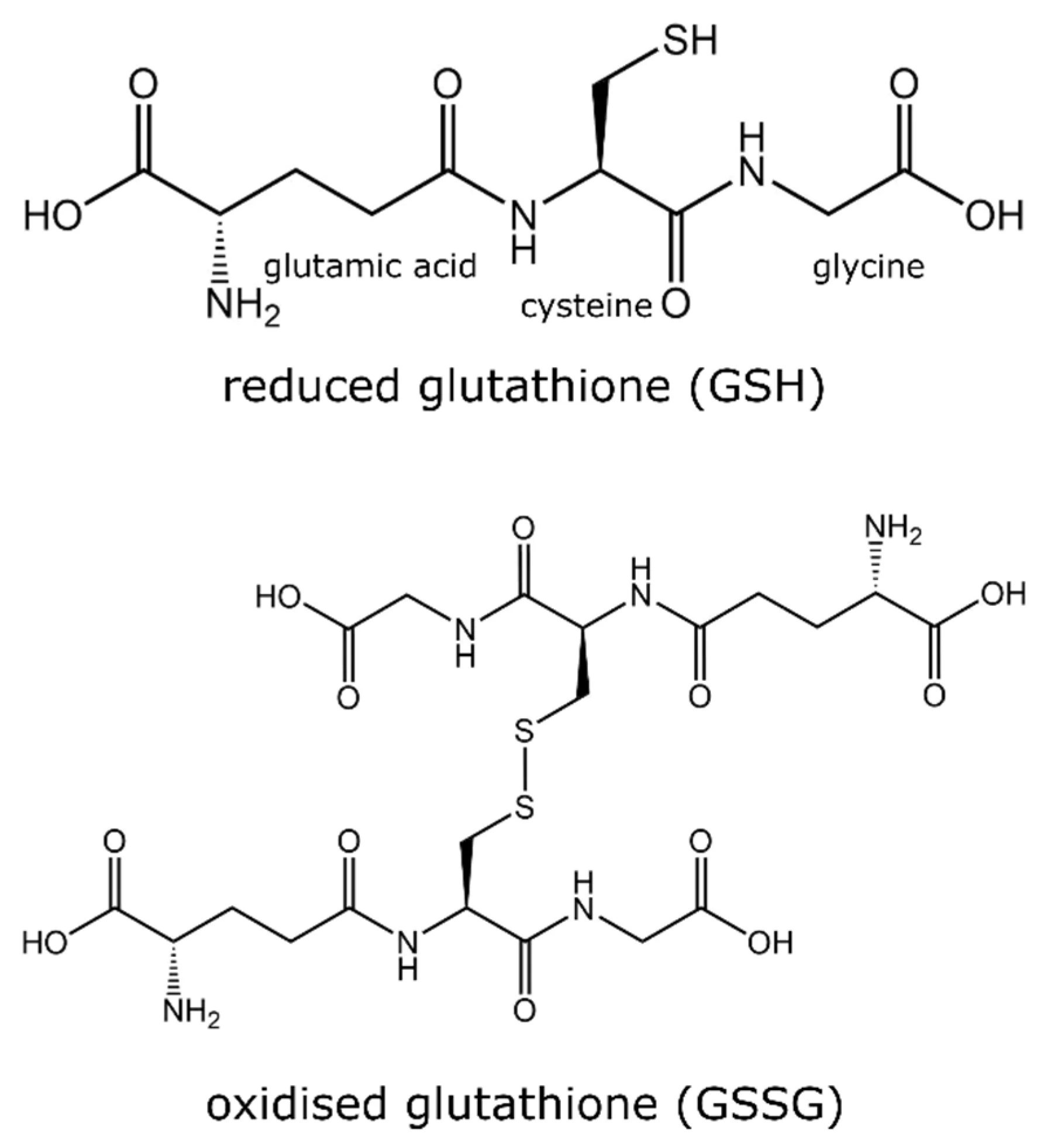
Glutathione (GSH) is a tripeptide (glutamate–cysteine–glycine) with an γ-glutamyl bond between the glutamate and cysteine. The thiol group (–SH) of cysteine is the reactive core that donates electrons to peroxides and free radicals.
Upon oxidation two GSH molecules form a disulfide bond (–S–S–) yielding GSSG (oxidized glutathione). The pair GSH↔GSSG is maintained by enzymes:
- GPx: 2 GSH + ROOH → GSSG + ROH + H2O
- GR: GSSG + NADPH + H+ → 2 GSH + NADP+
A high GSH:GSSG ratio indicates a protective, reducing intracellular environment against lipid peroxidation. The thiol group (pKa ~8,5–9) is pH-sensitive, so appropriate buffers and strictly controlled conditions are required in experiments.
4) Main research directions
- Oxidative stress and aging: GSH buffers ROS; research investigates effects on cellular homeostasis and recovery.
- Hepatic biotransformation: GSH-dependent conjugations (GST) – core of phase II.
- Immunomodulation/redox signaling: interaction with Nrf2 axis and anti-inflammatory pathways.
- Skin/pigmentation: effects on tyrosinase and melanogenesis in research models.
- Neuro-redox: protection of vulnerable lipid membranes from lipid peroxidation.
5) Forms, stability and reconstitution (lyophilizate)
The lyophilized glutathione offers better tolerance to logistical variations. After reconstitution:
- Store at 2–8 °C and protect from light.
- Minimize contact with air; work quickly and cleanly.
- Avoid metal ions, which catalyze oxidation.
- Determine concentration (mg/mL) and label date/time.
Good practices: validated solvent/buffer, SOP for „in-use“ periods, batch traceability.
6) Glutathione vs precursors
Precursors (e.g. L-cysteine/NAC) support endogenous synthesis of GSH; direct GSH provides control over the immediate concentration in the model system. The choice depends on experimental goals (rapid redox effect versus long-term support of synthesis) and the chosen model.
7) Safety profile
- Tolerance: generally favorable in the literature; possible mild local reactions during handling.
- Methodological risks: oxidative degradation with improper storage/light/metals.
- Good practices: asepsis, cold chain, proper packaging, CoA and batch traceability.
- Important: the product is for research use and not intended for human use.
8) Supplier checklist
- CoA (HPLC/LC-MS) for the specific batch.
- Stability data and „in-use“ instructions.
- Packaging/logistics: isothermal box, cooling, temp. log.
- Reconstitution instructions and concentration recommendations.
- Traceability: batch, reconstitution date, usage log.
9) FAQ
Is glutathione a "drug"?
No. The product is for research use and is not intended for human use.
How can I minimize oxidation after reconstitution?
Work cold and in the dark, minimize air contact, avoid metals and follow „in-use“ periods.
Does it make sense to combine with other antioxidant systems?
In research settings combined redox networks are often studied (e.g. GSH with GPx/catalase/Nrf2 pathways) according to model objectives.
10) Sources
- Peptology – Glutathione 1500 mg (Detox/Antioxidant)
- Forman HJ et al. – Glutathione in cellular redox homeostasis (review)
- Wu G et al. – Glutathione metabolism and implications (review)
- Townsend DM et al. – The importance of glutathione (review)
- Hayes JD et al. – Glutathione S-transferases and detoxication (review)
- Richie JP Jr. et al. – Glutathione status trial (randomized)
- PubMed – search: „GSH GSSG ratio review“