
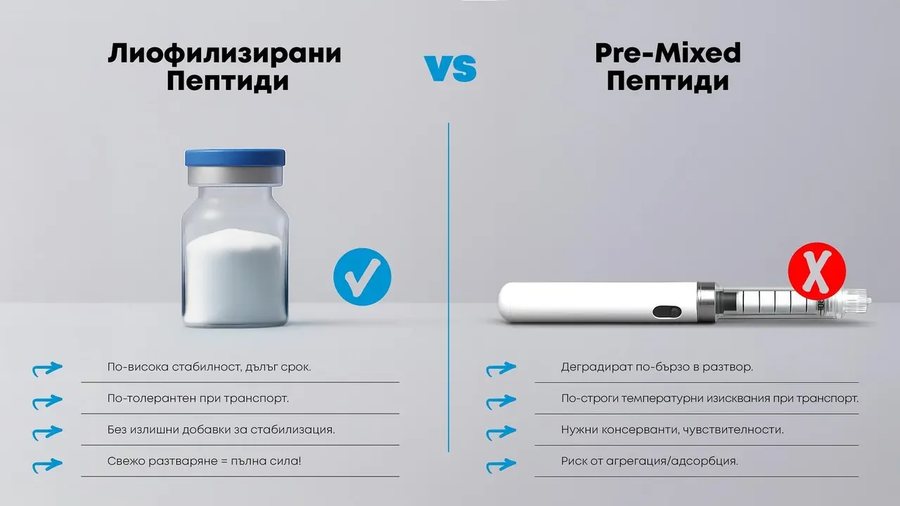
Lyophilized peptides vs. „ready“ pre-mixed solutions
Which is more reliable for quality, stability and reproducibility of results?
- Dry is the more stable default choice: when a validated formulation and ICH data for a ready solution are absent; the aqueous phase facilitates degradation.
- Lower transport risk: dry forms are more tolerant to temperature fluctuations.
- You control the reconstitution: you choose the solvent and exact concentration (mg/mL).
- The "clock" for liquids starts at the warehouse: for ready solutions the shelf-time often begins before delivery.
- Fewer excipients: shorter list of preservatives and buffers.
- That all liquid forms are unstable.
- That pharmaceutical ready solutions (with validated buffers/stabilizers) are equivalent to a 'research' vial without data.
- That lyophilizate is "always better" – we state it is the more conservative choice when evidence for stability/logistics of the ready solution is missing.
Why lyophilization is the "gold standard"
Lyophilization (freeze-drying) removes water by freezing and vacuum. In the dry state water activity is minimal and the molecule "ages" significantly more slowly. Simply put: dry powder is more tolerant of logistical fluctuations, while the liquid form is inherently more sensitive to time/temperature.
Key benefits
- Stability — longer shelf life compared to solutions.
- Logistics — more tolerant to temperature fluctuations during delivery.
- Flexibility — you choose the solvent (e.g. bacteriostatic water) and exact concentration.
What happens to peptides in water
Once reconstituted, peptides are vulnerable to:
- Hydrolysis — cleavage of peptide bonds.
- Deamidation — e.g. Asn→Asp, altering charge/structure.
- Oxidation and aggregation — accelerated by increased temperature and light.
The longer a solution travels or sits, the higher the chance of degradation.
The cold chain: where the real risk lies for "ready" solutions
Liquid, pre-mixed products rely on an impeccable cold chain at every step: manufacturing → transport → customs → warehouse → courier → door. A single temperature deviation of a few hours can compromise quality. Dry lyophilizate is substantially more tolerant.
Good practice: validated isothermal packaging, coolants, data-logger and recorded temperatures.
The "clock" after reconstitution
Once you reconstitute the lyophilizate, an in-use period begins (days/weeks at 2–8°C depending on the solvent and aseptic technique). For pre-mixed solutions that clock has often already started before they reach you.
Control over dosing and excipients
- Accuracy: with lyophilizate you set your own concentration (mg/mL) → easier and more precise dosing.
- Fewer excipients: typically a shorter list of preservatives and buffers compared to ready liquids.
When a pre-mixed solution is a reasonable choice?
When the seller provides clear evidence:
- Formulation and excipients: described buffers/stabilizers/preservatives and their role.
- ICH stability: real-time and accelerated studies + in-use period after first opening.
- Cold chain: validated packaging and temperature logs for the batch/delivery.
Without these documents, the risk with a liquid form remains higher for research use.
Comparison: lyophilized vs. pre-mixed
| Criterion | Lyophilized (dry) | Pre-mixed (liquid) |
|---|---|---|
| Stability | High (low water activity) | Varies by formulation; water facilitates degradation |
| Transport | More tolerant to temperature fluctuations | Highly dependent on an impeccable cold chain |
| Start of shelf-time | Starts at your reconstitution | Often already started at the warehouse |
| Dosing | You personalize the concentration | Fixed concentration |
| Excipients | Usually fewer | Often more (preservatives/buffers) |
| Risk of contamination | Low in dry form; depends on aseptic technique during reconstitution | Accumulates during the entire "wet" cycle |
| Traceability | Clear batches + CoA; you control reconstitution | Additional evidence needed (temperature logs) |
*Principles are general across product classes; exact shelf-times and conditions depend on the molecule and formulation.
Checklist for the supplier (before purchase)
- CoA (HPLC/LC-MS) for your batch.
- Actual stability data and test conditions.
- Packaging: thermal box, coolants, data-logger.
- Temperature log upon delivery.
- What are the solvent and concentration for ready liquids.
- Clear instructions for storage and in-use period.
Our standard
- Lyophilized forms from verified raw material suppliers.
- External laboratory testing by batch.
- Instructions for correct reconstitution and storage.
- Isolated packaging and delivery control.
FAQ
Pharmaceutical ready solutions (e.g. GLP-1 or insulin pens) — are they stable?
Yes — these are medicinal products with validated formulations (buffers/stabilizers), ICH stability programs and a strictly controlled cold chain. This article covers research solutions without such public documentation.
Is a ready solution more convenient?
It is convenient, but the price of convenience is a shorter shelf-time, greater dependence on the cold chain and less control over concentration and excipients.
How can I make a lyophilizate as convenient as a ready solution?
Prepare your concentration once, note date/time and store according to instructions. You get convenience plus control.
When is a pre-mixed solution a reasonable choice?
When there are transparent ICH stability data, a clearly described formulation (buffers/stabilizers/preservatives) and validated cold transport with temperature logs for the batch.