🇪🇺 Fast delivery (3–5 working days) with GLS ✅ Card or bank transfer 📦 Free shipping from €50

Semaglutide: Science, Results and Clinical Trials
Semaglutide is a GLP‑1 receptor agonist – a modified peptide that stimulates glucose‑dependent insulin secretion, suppresses glucagon, delays gastric emptying and reduces appetite.
Semaglutide: Science, Results and Clinical Trials
Peptology · 2026-06-04

What is semaglutide?
Semaglutide is a GLP‑1 receptor agonist – a modified peptide that stimulates glucose‑dependent insulin secretion, suppresses glucagon, delays gastric emptying and reduces appetite.
Thanks to a long half‑life (~175 h), it is administered once weekly subcutaneously.
The largest and longest trial of semaglutide (2.4 mg): SELECT Trial
Overall
-
The most extensive, long‑term study of the safety and efficacy of semaglutide 2.4 mg administered weekly.
-
Participants: 17 604 adults with overweight or obesity and established cardiovascular disease, without diabetes.
-
Duration: follow‑up up to 4 years (≈208 weeks). The trial assessed cardiovascular and metabolic outcomes over long‑term administration.
Main findings
Reduction in cardiovascular events (MACE)
-
Semaglutide reduces the risk of major adverse cardiovascular events (CV death, non‑fatal myocardial infarction or stroke) by 20% (6.5% vs. 8.0%; HR 0.80; 95% CI 0.72–0.90; P<0.001) versus placebo.
Durable weight loss
-
Mean weight loss tracked up to 4 years, consistently exceeding the difference versus placebo; all demographic groups showed significant results.
Safety and tolerability
-
Gastrointestinal adverse events: more frequent with semaglutide (RR ~1.47), but generally moderate and transient; small percentages of discontinuation due to side effects.
-
Serious adverse events: low incidence (~9%) in both semaglutide and placebo groups.
-
After treatment was discontinued, substantial weight regain was observed.
Across all subgroups
-
The effect is consistent regardless of sex, race, BMI or glycaemic status across the trial population of adults with overweight and cardiovascular disease.
Summary of this phase III/IV programme
|
Category |
Result |
|---|---|
|
Number of participants |
17 604 |
|
Follow‑up |
Up to 4 years |
|
Weight loss |
Sustained mean values over 4 y at 2.4 mg |
|
Reduction in MACE risk |
−20 % (HR 0.80) |
|
Adverse effects |
GI symptoms common, but small % serious events |
|
Discontinuation |
Regain on discontinuation |
Why this programme is key:
-
It exceeds in size and duration all other RCT programmes (the STEP trials), thus providing the strongest evidence base for assessing long‑term safety and durable effect.
-
SELECT reflects real patients with chronic cardiovascular disease but without diabetes, demonstrating the benefits of semaglutide even in the absence of diabetic disease.
Clinical data: STEP programmes
STEP 1 (68 weeks)
Includes 1,961 adults with BMI ≥ 30 or ≥ 27 with comorbidity, without diabetes. Dose 2.4 mg once weekly + behavioural therapy.
Mean weight loss: −14.9% with semaglutide versus −2.4% with placebo (difference −12.4%).
≥ 5% loss: 86.6% of the active group vs. 47.6% with placebo.
STEP 5 (104 weeks)
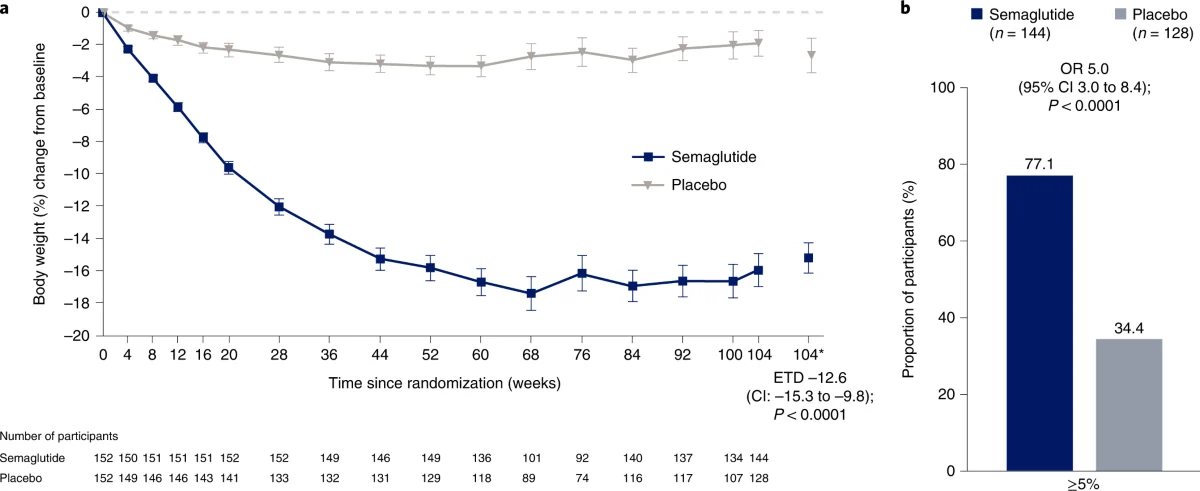
Continuation of the STEP trials – mean weight loss 15.2% at week 104. 44.2% reach ≥10%, 11% ≥15%, 4.9% ≥25% loss from baseline weight.
Notably, weight maintenance is durable with prolonged therapy – minimal regain between week 52 and 104.
STEP UP (7.2 mg dosage)
A new study (72 weeks) with 1,407 participants:
Mean weight loss: 20.7% (7.2 mg) vs. 17.5% (2.4 mg) and 2.4% (placebo). 33.2% achieve ≥25% weight loss.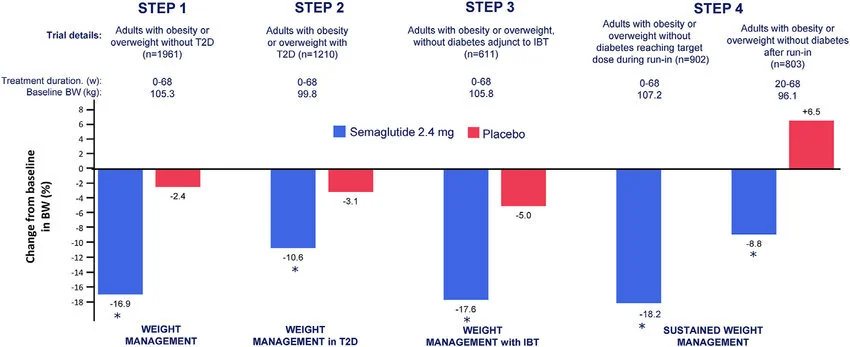
Real‑world practice: Cohort analysis
A cohort study includes 175 patients:
Weight loss: 5.9% after 3 months, 10.9% after 6 months, consistent with RCT data.
Systematic review (research)
A study summarises data from multiple RCTs: semaglutide has been shown to reduce weight, improve HbA1c, blood pressure and lipids, and to be effective for MACE protection, with benefits not solely dependent on the amount of weight loss.
Safety and side effects
-
Most common adverse effects – nausea, vomiting, diarrhoea, constipation.
-
Serious warnings: potential risk of pancreatitis, gallstones and a rare risk in patients with medullary thyroid carcinoma or MEN2 syndrome.
-
On treatment discontinuation – risk of weight regain: participants lost a mean 17.3% over 68 weeks, but regained around 11.6% by week 120 after stopping treatment.
-
Real‑world conditions – in cohort studies with widespread use only ~50% of patients remain on full dose at 1 year; mean weight loss is about 6.9% due to early stopping or low doses; in those who remained on the full dose, results were closer to RCT data (~15–18%).
-
Risk to lean mass – women and older adults may lose lean muscle mass.
Other potential benefits
-
Semaglutide demonstrates anti‑inflammatory effects, independent of weight: it impacts MASLD, metabolic inflammation and cellular regulation in animal models and in patients .
-
Recent studies indicate possible benefits in patients with type 1 diabetes and obesity: improved glycaemic control and weight loss among those using semaglutide plus insulin without increased hypoglycaemia risk , although larger RCTs are still needed.